














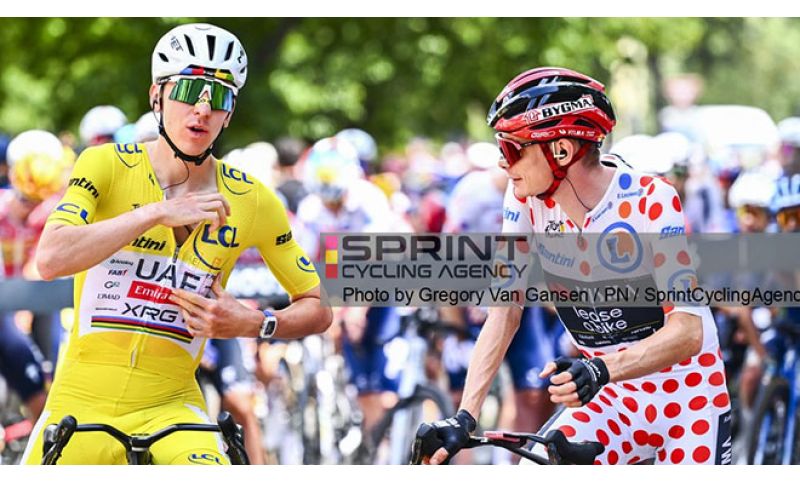
Important new details are emerging regarding the anti-doping controls carried out at the 2026 Tour de France. There would have been authorization from a judge at the Paris Court, who would have given the green light to the controls involving Tadej Pogacar and Jonas Vingegaard, respectively first and second in the general classification at the time of the tests.
Following the controversy that arose after inspectors from the International Testing Agency (ITA) visited Pogacar at 5 in the morning and Vingegaard at 2 in the morning, it is the French newspaper L'Équipe that reveals an element destined to further fuel the debate: the night-time controls would have been authorized by a judge from the Paris Court, as provided for by French regulations.
The news was reported by the newspaper L'Équipe shortly after 4 p.m. today, highlighting the information as their exclusive, as they would have directly contacted the Paris court, a method always used by L'Équipe regarding anti-doping investigations.
According to what was reported exclusively, before proceeding with the controls, the ITA would have turned to a Judge of Liberty and Detention (JLD) at the Paris Court to obtain the necessary authorization.
This is an exceptional procedure provided for by article L.232-14-4 of the French Sports Code, introduced in 2015 and, according to a source within the anti-doping agency cited by L'Équipe, applied for the first time during this Tour de France.
The measure is so rare that Tadej Pogacar himself, during the press conference following the fifteenth stage, admitted he didn't even know that controls of this type were permitted.
The most delicate aspect concerns precisely the conditions provided for by law. According to the French Sports Code, an anti-doping control carried out between 11 p.m. and 5 a.m. cannot be authorized automatically and must follow a specific legal procedure.
The magistrate must indeed verify the existence of "serious and well-founded suspicions" that the athlete has violated or is about to violate anti-doping regulations, as well as ascertain that there is a concrete risk of loss of evidence or contamination of the same.
This is a legal framework very similar to that provided for the authorization of a search in the context of a criminal investigation. When contacted by L'Équipe, the Paris Public Prosecutor's Office also confirmed the existence of the procedure.
In the statement, it is explained that, on the occasion of the Tour de France, the sections specialized in public health matters of the courts of Paris and Marseille regularly collaborate with the International Cycling Union (UCI) and with the International Testing Agency.
The Public Prosecutor's Office clarified that the judges of the two jurisdictions are competent to authorize any night-time anti-doping controls and that, in this case, the ITA submitted a formal request before carrying out the tests during the night of July 18-19.
The same French Sports Code establishes that such controls must be carried out in compliance with the principle of proportionality.
The law requires that checks be carried out: guaranteeing the proper balance between the protection of the athlete's rights and the need to combat doping; limiting themselves exclusively to the collection of biological samples; allowing the athlete to record any observations on the procedure.
The stated objective remains to ensure the fairness of the competition and the protection of athletes' health. The case continues to be discussed and the matter took on even greater relevance after what happened a few hours later in the fifteenth stage.
Jonas Vingegaard, woken at 2 in the morning for the anti-doping control, fell just over twenty kilometers from the finish line, suffering a fractured collarbone, an injury that forced him to withdraw from the Tour de France.
Tadej Pogacar himself, while avoiding any direct accusation, had hypothesized that a disturbed night could have affected his rival's concentration.
The Dane had recounted before the start that he had not slept well after the control, describing the time as "far from ideal" for preparing a high mountain stage. Richard Plugge, the team manager of Visma-Lease a Bike, had also expressed reservations about the choice of time, while reaffirming full support for anti-doping controls and respect for the application of the law.
However, L'Équipe's revelation adds a fundamental element to the matter. The authorization granted by the judge does not represent proof of guilt nor does it constitute an accusation against Pogacar or Vingegaard. French regulations provide that a magistrate evaluate the request submitted by the anti-doping authority based on the investigative elements at his disposal, possibly authorizing the night-time control when he deems the requirements provided for by law and already previously mentioned to be satisfied.
It remains to be seen whether the International Testing Agency or the UCI will decide to provide further clarification on a procedure that, while being provided for by regulation and French legislation, had never been applied so evidently during the Tour de France and which has inevitably sparked debate among insiders, teams, and enthusiasts.

 9
9


 9
9


 3
3
1
1
9
9
3
3
1
1
9
9

 Ritratti
 Oscar
Oscar Albi d'Oro

