














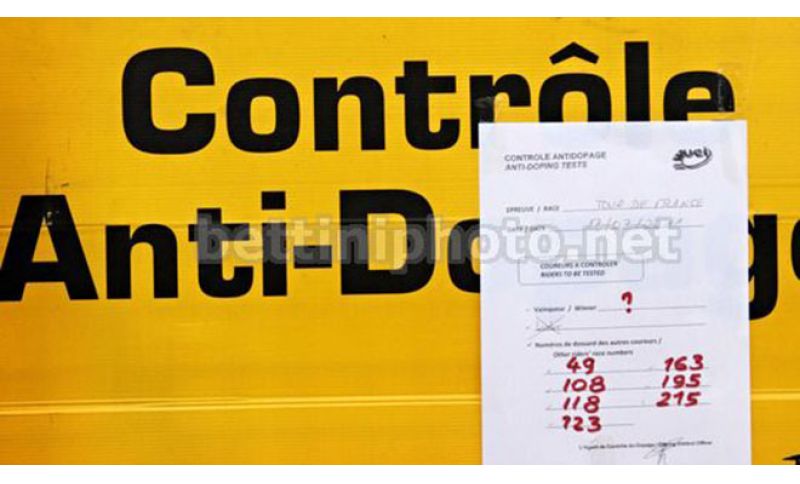
The anti-doping controls carried out between Saturday night and Sunday morning, just hours before the fifteenth stage of the 2026 Tour de France, have sparked heated debate in the cycling world. The French newspaper Le Parisien-Aujourd'hui en France was the first to break the news, revealing that Tadej Pogacar and Jonas Vingegaard, respectively first and second in the general classification, were subjected to anti-doping controls in the middle of the night.
A circumstance that inevitably sparked discussion, especially since just hours later Vingegaard was involved in a crash that forced him to withdraw, suffering a fractured collarbone. Pogacar himself, while not wanting to assign direct responsibility, suggested that a night of interrupted sleep may have affected the Dane's concentration.
According to the reconstruction by Le Parisien-Aujourd'hui en France, Jonas Vingegaard was woken up at 2 in the morning, while Tadej Pogacar received the inspectors' visit at 5. An interruption of rest that inevitably created discontent within the group, especially on the eve of one of the most demanding stages of the entire Tour de France.
The news, however, does not represent a surprise from a regulatory standpoint. Already on July 1st, the International Testing Agency (ITA) had clarified that anti-doping controls at the 2026 Tour de France could take place at any time during the three weeks of racing, and not exclusively at the end of stages.
Contrary to what many believe, the Tour de France anti-doping program is managed neither by the race organizers nor by the Union Cycliste Internationale (UCI). For the sixth consecutive year, management has been entrusted to the International Testing Agency (ITA), an independent body that also coordinates the anti-doping program for the Olympic Games.
For the 2026 edition of the Tour, one of the most imposing testing plans ever implemented has been prepared: over 360 out-of-competition controls carried out in the month preceding the Barcelona start; more than 40 ITA personnel present from the Grand Départ; approximately 600 samples to be collected during the three weeks of racing; strengthened use of the Athlete Biological Passport (ABP); sample storage for up to 10 years, allowing for re-analysis with potential future technologies; particular attention to markers related to growth hormone (hGH) and endogenous steroids.
The final number of controls, the ITA had explained, is determined based on risk analysis, information gathered by investigators, and operational requirements.
Why precisely at night? It's certainly the question many asked themselves after the news broke.
The answer comes directly from international anti-doping regulations. The World Anti-Doping Code establishes that every athlete can be subjected to testing "at any time and in any place" by an authorized organization.
French regulations also permit this. Since 2016, the Sports Code allows testing between 11 p.m. and 5 a.m. when there are sufficiently founded motivations. As Gérard Dine, a biotechnology professor and doping expert, explained, night-time controls make it possible to detect substances that are rapidly eliminated from the body and that could be undetectable after just a few hours.
The most cited case concerns microdoses of EPO. If a rider were tested only at the end of the stage and subsequently took a small amount of erythropoietin during the night, the next day the traces could already have disappeared. A night-time control, on the other hand, significantly increases the chances of detecting any irregularities. All these points have been covered by the French newspaper, which over the years has been among the most comprehensive in addressing such topics.
Athletic performance also represents one of the criteria used by the ITA to plan controls. For this reason, Pogacar and Vingegaard, first and second in the general classification, were among the riders most likely to be tested.
The agency had indeed explained that the Tour's anti-doping strategy is built through a "targeted and intelligence-based" system, with the objective of guaranteeing the integrity of the competition.
Certainly, the procedure used, in many respects, can be debatable, but it was certainly known to everyone. The fact that the controls took place in the middle of the night inevitably fueled controversy.
Jonas Vingegaard had already recounted before the start of the fifteenth stage that he was surprised by the timing of the control, explaining that waking up at two in the morning certainly does not represent ideal preparation for tackling a high mountain stage.
The team manager of Visma-Lease a Bike, Richard Plugge, also called the timing unusual while reiterating the importance of maintaining a rigorous and credible anti-doping system.
The ITA, however, had clarified from the start of the race that controls could take place 24 hours a day, without limitations related to stage schedules.
The coincidence between the night-time control and Jonas Vingegaard's subsequent withdrawal inevitably sparked debate, but at present there is no evidence linking the two episodes directly, the French newspaper has always specified.
It remains clear, however, that the 2026 Tour de France is experiencing one of the most rigorous anti-doping programs in its history. The International Testing Agency continues to reiterate its commitment to ensuring a transparent competition and conditions of absolute equality for all riders.
Controls can therefore continue until the final stage, at any time of day or night, according to a strategy that prioritizes effectiveness in the fight against doping over athlete comfort. A choice destined to spark debate, but perfectly provided for by international regulations.

 23
23


 23
23


 4
4
5
5
4
4
5
5

 Ritratti
 Oscar
Oscar Albi d'Oro

