















We'd all be on foot if it weren't for Hephaestus. The god of fire, metallurgy, engineering, technique and even sculpture. The god of the forge. And, almost, the god of the bicycle. Craftsman and architect, his showroom stood on Mount Olympus, his workshop in the volcanoes, where he forged thunderbolts and lightning, arrows and tridents, shields and armor, even scepters, bracelets and necklaces. But not bicycles. Now there exists a German e-bike named Eipha in his honor. Because if it weren't for him – already stated – we'd all still be on foot.
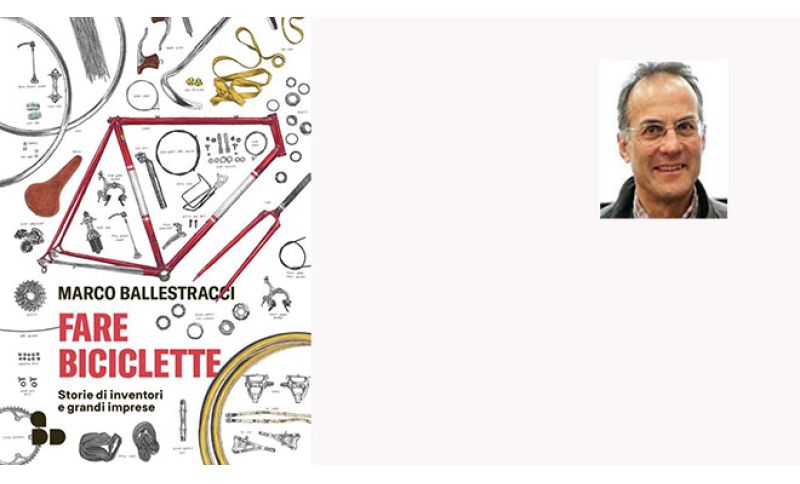
Disciples and great-great-grandchildren of Hephaestus inhabit the book that Marco Ballestracci dedicates to the stories of inventors and great enterprises: "Making Bicycles" (add publisher, 232 pages, 18 euros). And Ballestracci cites the old god in the title of a chapter and in a line of that same chapter, claiming that fiery legacy, forging – it's quite fitting to say – remote, spiritual, manual, working, and finally cycling kinships: "Frame sculptors who spend much of their existence among the tools and the fire of Hephaestus". And if the first connection is geographical (Teodoro Carnielli from Vittorio Veneto, about sixty kilometers from the author's Castelfranco Veneto), the others are enchantments born from races or riders, accidents or readings, memories or emotions. A map in which frames vibrate with feelings. And with stories. Let's be clear: it's not an encyclopedia, but a journey. On pedals, needless to say. And whoever's there, is there.
Let's call it intuition: like that "change something in the back" sighed by Tullio Campagnolo as a rider, in crisis on the Croce d'Aune. Let's call it illumination: like that instant when Tom Ritchey realized that "there was no need to possess the qualities of an alchemist or a materials genius to work with it", and with Gary Fisher would give birth to the mountain bike. Let's also call it desperation: like that ingenuity with which Graeme Obree built the bike for the hour record "introducing some clever solutions, the most famous of which was the use of washing machine bearings".
Let's call it obsession: like the one that consumed Giusto Pinzani when "he put bicycles 'to measure'", adhering "always to the criterion of adjusting bicycles as much as possible to the cyclists who pedaled them", starting with Gino Bartali and Gastone Nencini. Let's call it precision: like the one that Umberto Dei reserved for his creations, in which "by pulling the right brake lever, thanks to a small cylinder invented by Dei himself and housed in the handlebars, the bicycle brakes simultaneously front and rear". And if Dario Pegoretti was in love with steel ("I have nothing against carbon, aluminum or titanium. The thing is I grew up with steel and I'm convinced it's the only material that lives, that has its own smell and that even reacts to the physical condition of whoever handles it"), Ernesto Colnago was struck by carbon ("It was Enzo Ferrari who introduced me to the world of carbon", "Nobody even knew what carbon was", "So I studied that material, I felt it, I listened to it. I lost sleep over it. The others didn't believe you could work with it. They said: 'It will break'. They said I wouldn't make it"). Let's call it what we want, but it's genius or talent. And the first on the list was Baron Karl von Drais, who more than 200 years ago created almost everything from nothing: wheels, handlebars, saddle, but not pedals.
The Ballestracci of "Making Bicycles" is neither the dialectal storyteller of Imerio Massignan nor the theatrical and musical narrator of Koichi Nakano, but a romantic essayist (and at times sounds like a novelistic essay writer too) who writes in the first person and elevates frames to cycling, and cycling is always "chansons de geste". Here too. Like for Eugène Christophe, who at the 1913 Tour de France broke his fork, took his bike on his shoulder, marched for ten kilometers, returned to the blacksmith he had been, resumed the race, reached the finish line four hours late, dropped out of the standings but entered into history.



 1
1
 1
5
5
5
5
1
5
5
5
5

 Ritratti
 Oscar
Oscar Albi d'Oro


Se sei giá nostro utente esegui il login altrimenti registrati.