














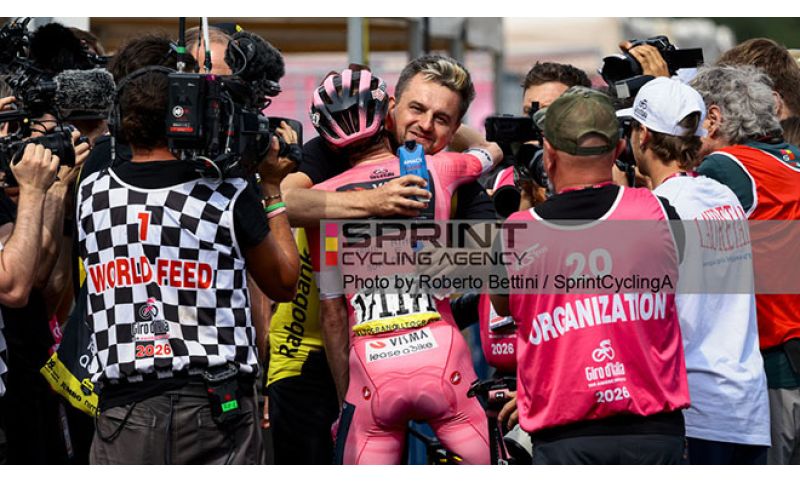
The 2026 Giro d'Italia delivered its technical verdict even before the final parade in Rome. The Piancavallo stage handed the race its clearest image: Jonas Vingegaard alone, master of the climb, the time, and the classification, with a margin of 5'22" over Felix Gall after the twentieth stage.
But a great race never ends solely in the name of its winner. Behind the pink jersey there always remains a deeper question: how truly valuable was the starting field? And how much of that quality remained alive until the moment the Giro decided who should command?
This is where statistics can offer a new reading tool. Not to replace the narrative, but to make it more precise. It's not enough to measure who starts; you must measure how much the quality of those who start endures until the moment the race decides who commands.
The Starting list quality assigned the 2026 Giro an initial value of 955 points: a high figure, built on the presence and ranking of the riders at the start. By stage 20, however, that effective value had dropped to 729. In simple terms, it means that the Giro, on judgment day, retained approximately 76.3% of its original quality.
The race had slimmed down, as always happens in the Grand Tours, but it hadn't emptied out. From this relationship emerges the IPD-Q, the Predictive Index of Gap on Quality. The principle is straightforward: take the gap in seconds between the leader and the top 10 riders, put it in relation to the initial quality of the starting list, and you obtain a value that measures not only how much a rider has lost, but how much that loss weighs within the overall level of the race.
In the 2026 Giro, the average gap between Vingegaard and the chasers from second to tenth place is approximately 545 seconds, that is 9'05". Normalizing this data on the initial Starting list quality of 955 points, you obtain an average IPD-Q Top 10 equal to 520.7.
The formula is intentionally simple: average gap in seconds multiplied by the quality of the starting list and divided by one thousand. There's no need to transform cycling into cold algebra. Rather, it serves to give a number to the sensation that everyone saw on the road: this Giro was not won against a weak field, but dominated within a high-quality race. The value 520.7 says exactly that. We are not facing a poor race, in which the leader stretches the margins because there are no rivals of equal standing.
We are facing a strong race, still consistent in its decisive phase, but decided by very marked individual superiority. The most interesting data is precisely the relationship between quality and gap. In theory, a stronger starting list should compress differences: more champions, more balance, fewer minutes between the best. But the 2026 Giro shows the other side of statistics. When the leader is clearly superior, the quality of the opponents doesn't cancel the dominance; it makes it more readable, almost heavier. Winning by a lot against little says one thing. Winning by a lot against much says another.
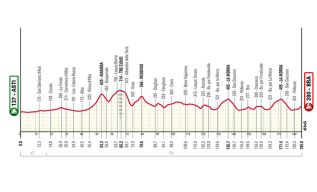
Stage 20 reinforces this reading. Applied statistics assigns the Gemona del Friuli-Piancavallo stage 200 kilometers, 3,751 meters of elevation gain, and a ProfileScore of 379: numbers for a selective day, not for a simple classification adjustment. It's the type of stage where theoretical quality is interrogated by the road. And the road, as often happens, doesn't ask for a curriculum: it asks for legs, lucidity, the ability to resist when fatigue becomes a common language. The IPD-Q can become, in perspective, also a predictive tool. If we know the quality of a starting list before the race begins, we can estimate what average level of gap we might expect in the Top 10, comparing the new race with similar historical models. It's not an oracle, because cycling remains made of crashes, crises, wind, tactics, recovery, and destiny. But it is a compass. A race with very high initial quality and expected contained gaps promises balance. A race with high quality but with a dominant leader can generate a value like that of the 2026 Giro: not compression, but selection.
The Giro, therefore, has pronounced its winner. But statistics allow us to read also what the podium doesn't say on its own. Behind Vingegaard's pink there is a race that started strong, arrived still competitive at its decisive turning point, and yet crossed by a line of clear superiority. The average IPD-Q Top 10 of 520.7 thus becomes the numerical signature of the 2026 Giro: the value of a race of high initial quality, but decided by strong individual dominance. Perhaps this is the new frontier of cycling storytelling: not choosing between emotion and numbers, but letting them speak together. Because the gap is not merely lost time. It is the exact measure of the space that, over three weeks, opens between those who endure and those who command.

 1
1


 1
1


 8
8
5
5
22
22
1
1
3
3
5
5
2
2
8
8
5
5
22
22
1
1
3
3
5
5
2
2

 Ritratti
 Oscar
Oscar Albi d'Oro

