
















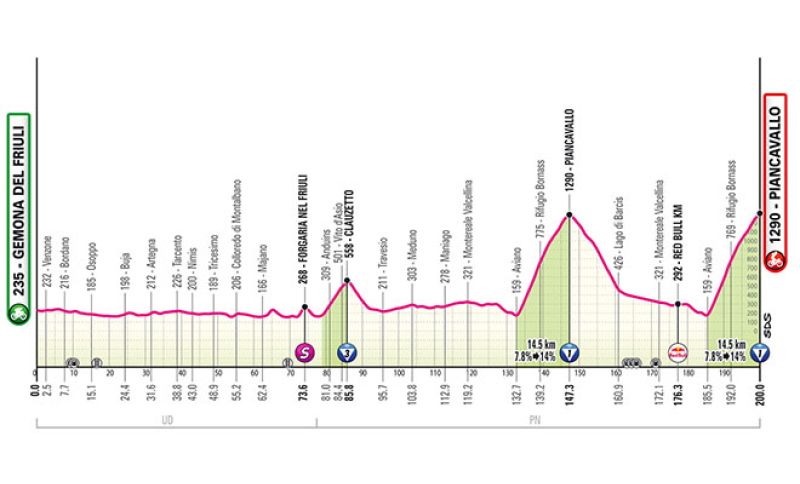
Entirely in Friuli, the last mountain stage of the 109th Giro d'Italia: from Gemona del Friuli 1976-2026 to Piancavallo are 200 kilometers to cover with 3,750 meters of elevation gain.
to follow the live coverage of the entire stage starting at 10:45 AM CLICK HERE
The stage features an undulating first section that crosses the Tagliamento plain around Gemona. Worth noting is the short climb of Forgaria (intermediate sprint) in Friuli and the Clauzetto climb (3rd category) that leads into Val Cosa from which you reach Maniago and then enter Montereale Valcellina in the final circuit of approximately 53 km that includes the double ascent of Piancavallo.
In the first section the roads are quite winding, but always wide and well-paved. After the first passage you descend to Lake Barcis with a fairly challenging descent followed by a tunnel of over 4 km in slight descent perfectly lit and with perfect surface. The route then becomes flat until Aviano where the final climb begins.
Last 15 km entirely uphill. First 10 km very steep always around 9% with peaks of 14%. At km 10.9 the road flattens and descends slightly before resuming the climb (you pass through an avalanche protection tunnel) with more moderate gradients (max 8%). Last km rather articulated always slightly uphill.
THE ROADS OF THE GIRO. Fifty years. That's how long it's been since the earthquake that razed Gemona del Friuli and a large area of its region to the ground. A tragedy from which, however, Friuli was able to quickly recover. With strength and unparalleled dignity. A recovery of which Gemona itself is the most striking testimony. From the rubble of 1976 was born a new city but capable of remaining faithful to itself, basing the reconstruction on the motto "where it was and as it was". Before the start of the twentieth stage of the Giro it will thus be particularly interesting to stroll through the city streets to admire the Cathedral of Santa Maria Assunta, rebuilt while preserving distinctive elements such as the large rose window and the Epiphany gallery, the Castle, the Renaissance Palazzo Boton and the Sanctuary of Sant'Antonio, considered the oldest in the world dedicated to the Saint of Padua. Built in the 13th century in the place where the Saint stayed, it preserves ex-votos, works of art and the so-called "Cell of the Saint".
Just after leaving Gemona you reach Bordano, the "village of butterflies", known for the presence of numerous and very colorful specimens on its territory. The House of Butterflies welcomes more than 400 species of these lepidopterans in its greenhouses and there are also many murals depicting these insects painted on the houses of a truly surprising village. At Colloredo di Montalbano you can admire the castle of 14th-century origins and dominated by the Clock Tower, then approaching the mountains it's the turn of Forgaria. Here you visit the open-air museum "The Places of the Great War in Hilly Friuli", then you look up to observe the flight of griffon vultures and other raptor species that populate the natural reserve of Lake Cornino. Maniago in turn requires a stop to visit the Museum of Blacksmith Art and Cutlery that celebrates the long history of forging in Valcellina.
After the first passage through Aviano - where you can admire in the same square the Cathedral of San Zenone in neoclassical style with notable 16th-17th century canvases inside and Palazzo Menegozzi with its statues crowning the facade – and a first climb up to Piancavallo, you relax on the shores of Lake Barcis which dazzles with the brilliant green color of its waters and from whose shores you can enjoy magnificent panoramas of the overlying Friuli Prealps. Here it is finally Piancavallo, capital of mountain sports in the Carnic Prealps, which even in summer offers countless opportunities for fun. An example? The Pasture Walk, a circular route of about 12 km that crosses woods and meadows, offering panoramic viewpoints over the plain and allowing you to discover the traditional alpine pasture structures of the place. An effort all in all limited capable of giving emotions that will remain in your heart for a long time.

 3
3


 3
3


 1
1
4
4
2
2
1
1
4
4
2
2

 Ritratti
 Oscar
Oscar Albi d'Oro

