



















For quite some time now, in my position as an observer, I have been observing a strange phenomenon that has emerged in recent years but is now consolidated as an iron rule: the true side effect of modern cycling is the disappearance of what we have called for centuries the underdog.
Just pronouncing or writing this Anglicism brings a touch of tenderness. Also a bit of nostalgia. It seems to come from a distant time and world, so far from today and now that it appears to be a fossil. There will certainly be some young kid who rightfully wonders: underdog, and what the hell is that, who the hell is Gatti talking about. Never in a million years would they believe that once the term was on everyone's lips, we would toss it back and forth before and after every race, first in the context of predictions (yes, it seems like an oxymoron, predicting someone outside the predictions), leaving that is always some space open among the most expected names, but also afterwards, when perhaps everyone found themselves headlining in newspapers or simply saying at the bar but look at that, an underdog won. It was the wild card, the only truly unpredictable variable, in those ancient times always possible and always lurking.
A simple web search is enough to find a bare definition: "An athlete, horse or team that wins or distinguishes itself unexpectedly, despite not being among the favorites on the eve of the event". Underdog clearly comes from English outside, that is, outside, external. Precisely: it is the figure that before a race, reasonably speaking, stands outside the predictions, certainly not among the most probable lords of the competition. But who then perhaps jumps out from who knows where, who knows how, and wins by turning all the most sensible predictions upside down.
So, starting from the definition, I ask: can anyone tell me what happened to the underdog in today's professional cycling? Has anyone seen it around? Of course we can say that every now and then an underdog still wins: it seems to me that Yates at the last Giro can fit into the category, emerging at the end, in the most thrilling and unpredictable way, from the Del Toro-Carapaz mess. But the fact is that nowadays the underdog only wins when they're not there, Pogacar and his ilk, that is to say when no one can any longer be considered an underdog, or when everyone is an underdog.
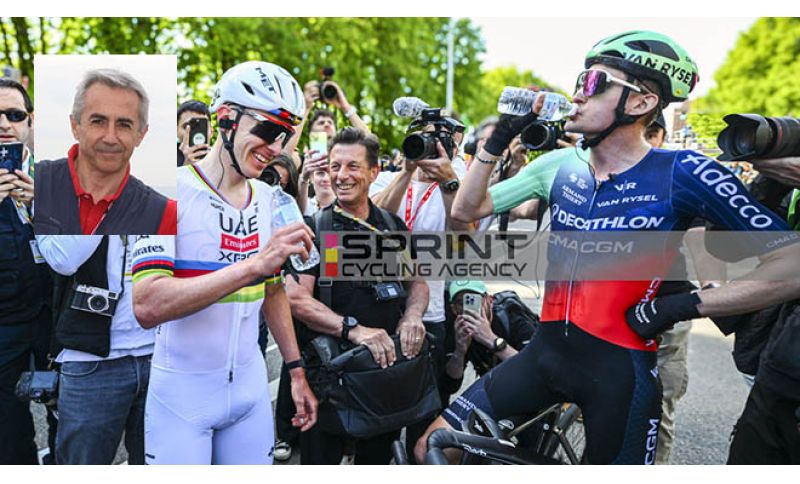
Let's review the last few seasons: in the major races, let's say tours and monuments, surprise has disappeared. The day before you predict those names and after the race those names divide up the pie, three quarters Teddy and a quarter the Van Der Poels, the Evenepoels, the Vingegaards, the Van Aerts, soon the Seixas. The art of prediction, in which I am totally hopeless, but which always fascinates everyone, has now become a clerical exercise: even the most foolish person gets it right now, if not by hitting just one name, at least within the narrow circle of two or three.
There will certainly be a good crowd of people who also consider this boring. Too much predictability, even in predictions, which instead are the open field of fantasy and hypothesis. Let's try for a moment to put ourselves in the shoes of Angelo Costa, who on tuttobiciweb must find ten faces by contract before every race: he of all people knows that if there's Teddy one would be enough, but like a martyr he sacrifices himself to the wave of insults from the know-it-alls who explain to him how ten names are too many, because one is enough...
For once I don't want to take sides. Not out of cowardice, but because I really can't say with certainty whether the disappearance of the underdog is a good or bad thing. I understand perfectly well those who mourn it like widows, because they cultivate the aesthetics of balance and unpredictability. But I also want to say that in recent years I have seen with my own eyes crowds full of people like Alpe d'Huez also here in Italy only when the most predictable of names passed in front, Pogacar (remember at Strade Bianche, on the climbs of his Giro in pink, at the Lombardia?).
However, let's stick to empirical observation: in fact, the possibility that victory goes to a Mr. Nobody, or in any case to someone outside the magic circle, is practically reduced to absolute zero. Like it or not, it is certainly an enormous merit, which must be recognized by all, precisely of Teddy and his ilk, as a demonstration of great generosity and great respect towards the noblest challenges. We predict them, perhaps now with a certain boredom, but they are always punctually there where we predicted them, up front, and that doesn't seem like a small phenomenon to me. When the champion is there and gives his all, the public can only feel gratified. Then of course: I already know that at the next monument race I will be miserably proven wrong, with the triumph of an underdog, precisely the figure whose funeral rites I am celebrating. But I must also warn immediately: from how the story has unfolded, in that case we wouldn't even speak of an underdog anymore, we would have to speak of a miracle.

 38
38


 38
38



 Ritratti
 Oscar
Oscar Albi d'Oro

