



















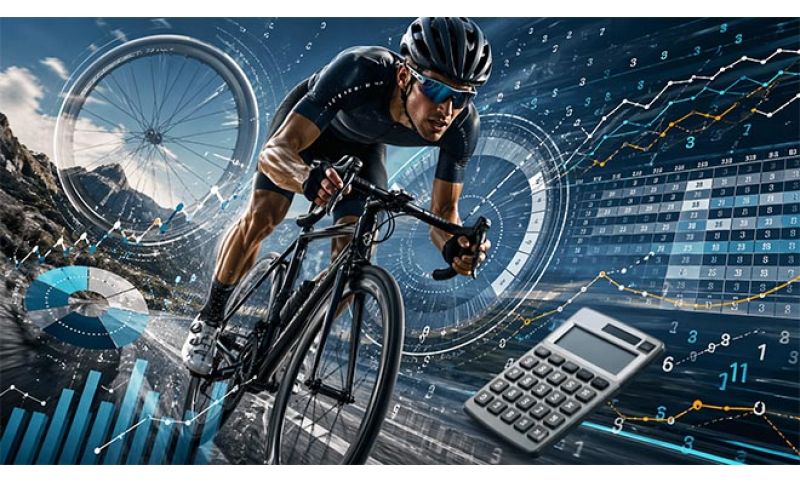
In contemporary cycling, precocity is no longer enough. A young rider can astonish, win a race, enter the media narrative and then fade back into statistical normality. To distinguish a promise from a reality, one must measure not only "how much" he wins, but "where," "with what density," "against what competitive level," and "in which specialties."
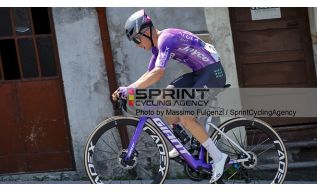
Paul Seixas, French rider for Decathlon CMA CGM, born September 24, 2006, is today one of the most interesting cases precisely because his numbers do not describe ordinary growth, but rather a performance acceleration.
The first data point is the scale variation between 2025 and 2026. In 2025, Seixas had accumulated 544 PCS points in 37 racing days; in 2026, as of April 22, he is already at 1,062 PCS points in just 14 days of racing, with 7 professional victories. The raw figure is remarkable, but even more significant is the ratio between performance and volume: his average rises from 14.7 PCS points per racing day to 75.9. The Competitive Acceleration Index, calculated as the ratio between 2026 density and 2025 density, returns a value of 516. In simple terms, Seixas is producing points at a speed over five times higher than the previous year. This is not linear growth: it is a change in statistical category.
The second useful indicator is the Kilometer Density Index, calculated as the ratio between PCS points and kilometers raced. In 2025, the Frenchman was traveling around 10.6 points per 100 km; in 2026 he rises to approximately 51.2. This coefficient is important because in cycling, volume can be deceiving: a rider can accumulate points through a long presence on the calendar, or generate value in just a few highly selective races. Seixas belongs to the second category. He races relatively little, but each appearance produces a very high competitive return.
The third parameter is the WorldTour Transfer Index, that is, the share of performance obtained at the highest level of the calendar. Here the transition is even more interesting: in 2025, the young Frenchman had already shown important signals, but in 2026, the prevailing part of his points comes from WorldTour races. The victory at the Flèche Wallonne, the overall success at the Itzulia Basque Country, and the three stage wins in the same race indicate that his performance is not built in a protected environment, but directly in the heart of international competition.
At this point, the question is no longer whether Seixas is a promise, but what type of rider he is becoming. The PCS specialty scores describe him as an athlete with a very clear center of gravity: 843 in the climber dimension, 797 in one-day races, 507 in general classification, and 318 in time trial. The ratio between one-day race value and climber value is approximately 0.95: this means that his climbing strength does not remain confined to the mountains, but transfers effectively in hard one-day races. This is his most interesting technical characteristic: Seixas does not appear as a pure climber, but as a selection rider, capable of transforming gradient, pace, and endurance into results.
The Selective Versatility Index, calculated as the geometric mean between climber, one-day races, and GC, produces a value close to 698. This is a very high number for a 19-year-old rider, because it signals a multidimensional structure: climbing, classics, and short stage races are not separate compartments, but parts of the same performance architecture.
The GC Maturation Index — where GC indicates General Classification, that is, the overall classification of stage races — calculated as the ratio between GC score and climber score, is instead equal to 0.60. Here caution is warranted: the value indicates a rider already in transition toward general classifications, but not yet fully tested in the Grand Tour dimension.
And it is precisely here that the most interesting question opens up regarding the Grand Tour season. Seixas already possesses three essential components: performance density, ability to win in WorldTour contexts, and physical-technical matrix compatible with stage races. However, the most severe variable is missing: endurance over three weeks. It is one thing to win the Itzulia, another to sustain twenty-one days of racing, nutritional management, recovery, crises, team tactics, and media pressure. Statistically, his profile authorizes the hypothesis of a future evolution toward a general classification rider; methodologically, however, it does not yet allow us to certify it.
The comparison with Tadej Pogačar is inevitable, but must be handled with rigor. Pogačar in 2019, in his first true season of explosion, accumulated 1,515 PCS points, 8 victories, and 62 racing days; above all, he immediately transformed talent into a Grand Tour performance, finishing third at the Vuelta and winning three stages. Seixas, in 2026, has an initial density even more violent: 1,062 points and 7 victories in just 14 days. But Pogačar had already passed the test that matters most for a general classification rider: continuity over three weeks. The parallel, therefore, does not say that Seixas is "the new Pogačar." It says something more precise: in the phase of entry into professional cycling, Seixas shows acceleration coefficients comparable, in intensity, to those of great generational talents; however, his profile still lacks the endurance test that transformed Pogačar from an exceptional promise to a structural reference point in world cycling.
The final assessment is therefore twofold. On the statistical level, Seixas is already a reality: the Competitive Acceleration Index, kilometer density, and quality of victories place him beyond the normal growth trajectory of a young WorldTour rider. On the predictive level, he remains a rider to watch during the Grand Tour season, not necessarily to immediately demand a podium, but to measure recovery, consistency, and resilience. The French promise has already become performance; now he must prove whether that performance can become structure.

 5
5


 5
5


 5
5
6
6
3
3
1
1
5
5
6
6
3
3
1
1


 Ritratti
 Oscar
Oscar Albi d'Oro

