
















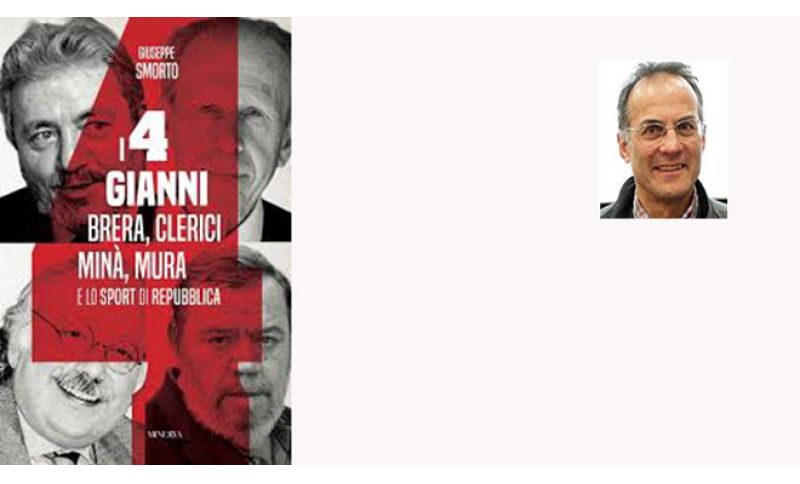
Brera and Mura more than Clerici and Minà, but all "The 4 Gianni" by Giuseppe Smorto (Minerva, 234 pages, 18 euros) have loved, followed and written about cycling.
Brera means Coppi. Smorto recounts: "Franco Brera shuffles childhood memories: 'I heard people talking in the hallway: one voice was my father's, the other... I peeked out and there was Fausto Coppi. He had come home to talk about his biography'". It would be published, "I, Coppi" (Vitagliano, 1960), two weeks after the Campionissimo's death. Brera would write about Coppi again, indeed, always, including "Coppi and the Devil" (Rizzoli, 1981), shortly before being hired by "Repubblica". Smorto: "For his entire life Brera carries within him the anger for a lost friend. Someone to go hunting with, an athlete so unlucky, but so unlucky that you wanted to curse him", "One (Coppi, ed. note) who started behind everyone, with an old man's bones, the legacy of an alcoholic father. And then, the irregular postures held in the countryside generation after generation modify bodies, the tragic is in every clod of earth", "A cyclist with a poorly constructed physique, rickety, with the keeled chest of a bird and a short neck", "His mother only rested when she gave birth to him, and a month later she was already ready for the harvest. A world where even bell towers have cracks".
Mura means, above all, the Tour de France. Smorto: "Gianni Mura sits next to Carletto Pierelli, the car must be comfortable and familiar to throw books, CDs, biscuits, some salami and some bottles, maps and guides in the back. Then, a bastard life", "On the noble roads of the Tour, hunting for restaurants to try, toward lost villages to talk about sport for everyone. Every day is a discovery: you can end up in an Andorran dive eating fried peppers (go back there in the evening to discover that half a portion is left)", "He always buys local newspapers and seasonal fruit", "At the Tour he curses apricots that are no longer what they used to be", "There's always a museum along the route", "He doesn't like press rooms under a tent at fifty degrees, where you can't smoke", "In Castres he runs away, his friend Aligi finally finds him, under a plane tree, writing at a tavern table. A small jazz orchestra, the farmers bring Gianni goat cheese, omelets, roasted pork".
Between Mura and Minà the connecting link is Pantani. The "Pantadactyl" climber or the rebellious "Little Elephant" for Mura, the tired and resentful Pantani of a television interview for Minà. As for Clerici, few know it, he covered Giros and Tours, also for "La Gazzetta dello Sport". Smorto: "Gianni Clerici is perhaps the most refined of the four Gianni and always maintains the physique of the athlete he was. He doesn't forget a couple of binges at the Tour with Antoine Blondin, the French Brera".
Cycling is always in the air of a newsroom, that of "Repubblica", open. "I saw Emanuela Audisio whizzing by on her bike between the desks". Regarding Mario Fossati: "Fossati - writes Brera - is an authentic Don Quixote of cycling. He believes in cycling as the melancholic nobleman of La Mancha believes in the survival of Chivalry". Smorto on Mura: "He can make you laugh, cry, or ignite the anger of some steamship owner, especially in football (from Berlusconi downward) and in cycling (Team Sky and surroundings)". Mura on Brera: "Farewell to the Muse Eupalla, to the Tourmalet / to Carl Lewis, to Coppi, to Consolini...". Smorto on the newsroom: "There was no need to discuss it, we all had in mind that sport was a right, a means and a place of integration. That at the base of the hyperagonistic pyramid there was also the pleasure of moving, that it couldn't weigh only the wave of sports fans, of blah blah. That a newspaper had to coherently address the doping phenomenon, in a sport that risked losing its identity. Doped champions, but also doped cycle tourists, a vertigo of hypocrisy".
Smorto writes that Audisio "is the best Italian sports journalist, and I hold tight, I would even remove 'sports'" and "this book could have been written by her, and it would have turned out much better". I take the liberty of objecting: not better, but different. Because "The 4 Gianni" is rich, elegant, entertaining, even miraculous. It manages to make you feel part of the same group. Like Malabrocca and Carollo with Bartali and Coppi.
(end of the sixth and final installment)
PREVIOUS INSTALLMENTS
the first installment: https://www.tuttobiciweb.it/article/1776236004
the second installment: https://www.tuttobiciweb.it/article/2026/04/16/1776238325/gianni-brera-ciclismo-storia-del-giornalismo-fausto-coppi-hugo-koblet
the third installment: https://www.tuttobiciweb.it/article/2026/04/17/1776375420/gianni-clerici-giornalismo-sportivo-tennis-ciclismo-storia-dello-sport
the fourth installment: https://www.tuttobiciweb.it/article/2026/04/18/1776411508/gianni-mina-giornalismo-sportivo-ciclismo-storia-dello-sport-repubblica
the fifth installment: https://www.tuttobiciweb.it/article/2026/04/19/1776541045/gianni-mura-ciclismo-giornalismo-sportivo-storia-dello-sport-repubblica



 5
5
 5
3
3
5
3
3

 Ritratti
 Oscar
Oscar Albi d'Oro


Se sei giá nostro utente esegui il login altrimenti registrati.