
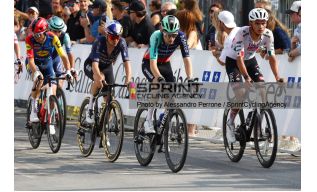


















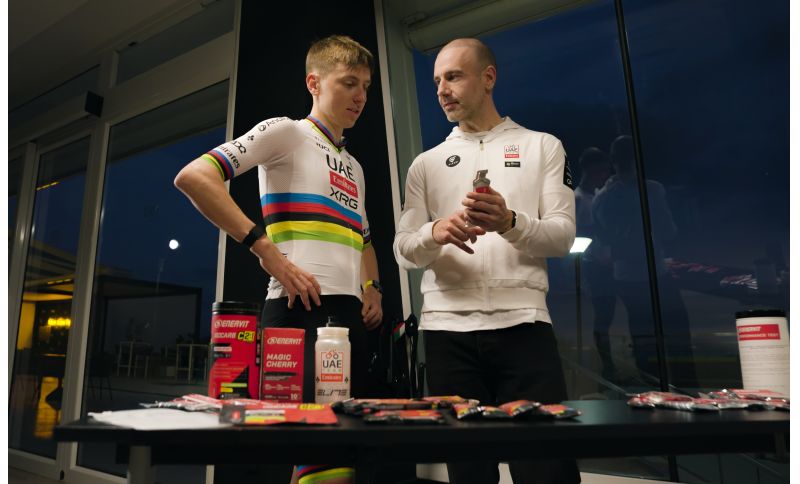
To pedal like a champion, it's best to follow in his wheel and... copy him. We can't even imagine emulating Tadej Pogacar, but we can imitate his nutritional plan.
If keeping his pace is often an impossible mission even for the world's best cyclists, the average amateur can still peek into his water bottle. That's what we did yesterday by following the webinar organized by Equipe Enervit with Spaniard Gorka Prieto-Bellver, who explored the nutritional strategies that support the preparation and performance of cycling's greatest champions, including the world number 1.
The nutrition manager of UAE Team Emirates-XRG illustrated, with concrete examples, the integration strategies adopted by the team to support extremely high training volumes and during competitions that impose significant energy expenditure.
He focused on the use of carbohydrates during racing and training, particularly with a glucose:fructose ratio of 2:1. "The combination offered by products like Enervit C2:1PRO currently represents one of the most functional solutions in terms of absorption. Taking carbohydrates during activities of 90 minutes or more postpones fatigue by 20%. Over the years we've moved from carbohydrate intakes of 30-60 g carbs/hour to as much as 120-140. Obviously the dose depends on the type of athlete, their starting weight, their role in the race and their objective, but you need to gradually train your intake as well to avoid overloading the intestines. In the team we do on average one training session per week to get riders used to eating that much. For an amateur wanting to go from 60 g carbs/hour to 90, I'd say do it gradually over 5 weeks," the expert began, before analyzing specific cases and offering concrete suggestions to optimize nutritional strategies.
Professional cyclists undergo frequent blood tests to monitor that iron and testosterone don't drop too low, and at the same time that creatine kinase and cortisol don't rise too high. They are weighed before and after the race and record everything they consume in an app that provides dietary advice to optimize body composition and avoid the risk of dehydration.
"As a general recommendation, it's important to say that you shouldn't lose more than half a kilo per week, otherwise weight loss will affect performance and recovery, with the risk of falling into chronic fatigue. To recover at your best sleep is fundamental, so the room where you sleep should have the ideal temperature set, it's best to disconnect from your phone 30-60 minutes before bed and 1 or 2 hours before sleep it's advisable to take a warm shower," Prieto insists.
On Saturday Tadej Pogacar and company will race the Milan-San Remo, the longest race of the year, in which it's estimated each rider will consume approximately 8,000 calories. It's the variety of formats of Enervit products they can draw from that makes such high intake sustainable, reducing taste fatigue and allowing them to personalize their strategy, combining:
- Carbo Gel in various flavors, also with sodium and caffeine, including the new neutral flavor with sodium
- Carbo Jelly, Carbo Chews and Carbo Bar, including the new Salty Caramel bar, to vary textures and consumption moments
- Isocarb to support hydration and constant energy intake
"It's a unique race because it stretches nearly 7 hours. The nutritional strategy begins already in the days before and during the race reaches 120-130 grams per hour of carbohydrates, even for women," concludes Gorka Prieto, before handing over to Dr. Luca Mondazzi, head of the nutrition service at the Mapei Sport Research Center, a medical doctor specializing in Food Science and Gastroenterology. The valuable member of the Equipe Enervit explained what the integration strategies are to promote athlete recovery, with an in-depth look at the benefits of antioxidants based on tart cherry, that extract of Vistula sour cherry rich in polyphenols that we regularly see pro cyclists consuming after crossing the finish line.
To close, here's a useful tip for amateurs, who even if they're not aiming to win a Monument, do well to take care of their nutrition on and off the bike. According to Dr. Mondazzi: "I see that attention to recovery is very high, but limited to procedures in the very first period after training. This is a mistake because the repair processes of muscle fiber don't end in just one hour but last at least a full day, in the 24 hours following the effort. For a cycling amateur it doesn't make sense to take Enervit Magic Cherry at the end of every training session, but when you have a specific objective in the sessions before and after the big day, yes".




 Ritratti
 Oscar
Oscar Albi d'Oro


Se sei giá nostro utente esegui il login altrimenti registrati.