















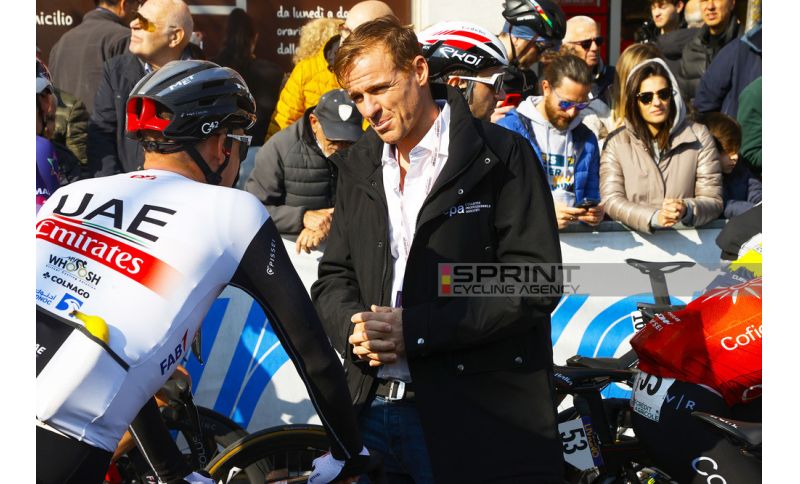
Following the Cyclingnews investigation and the numerous comments it sparked regarding the UCI's handling of the Sram case, Adam Hansen has taken the opportunity to explain to domestiquecycling.com the riders' position and their requests on a matter that is close to everyone's heart, especially theirs: race safety.
The president of the CPA, the worldwide union of professional cyclists, actively participates in the SafeR working group alongside Alessandra Cappellotto, director of CPA Women, representing elite category athletes.
SafeR is an organization composed of four stakeholders active in the cycling world: CPA (riders), AIGCP (teams), AIOCC (organizers) and UCI. Each interested party presents proposals and requests regarding safety. Although the gear ratio limitation test was a proposal advanced by a party other than the CPA, the international riders' association conducted a survey in which the majority believed that limiting gears would improve race safety. Fewer than 20% of professionals opposed this initiative. Riders have expressed more urgent concerns regarding course design, the 3 km rule, motorcycle proximity, hookless tires, and barrier safety.
The Domestique colleagues asked the former Australian pro why he believed the gear ratio test was important. "The CPA supported this trial because we are committed to following the collective voice of the group, and this includes listening to rider feedback. The same happened when we decided to bring neutralization in sprint finishes to 3 km instead of 1 km. After it was tested at the Tour de France, rider feedback was positive and the UCI updated its regulations. Although it is currently adjustable, we are still trying to fix it at 5 km for all races," Hansen continues. "Radio communications are another example. After testing the use of a single radio per team at two events, riders confirmed that radios are essential for safety, thus preventing a ban by the UCI. Hookless tires, although a highly debated topic, are an area where riders are afraid to speak out because their teams are sponsored by a product they don't feel safe racing with. One rider wrote to me: 'They are a death trap and nothing will be done until one of us dies!' I receive many messages from riders who are afraid to speak out against their teams and sponsors, especially when they don't feel comfortable using a product and are forced to do so".
Finally, regarding the specific case, he reveals the context that led to the clash between the UCI and Sram: "The gear ratio test was not a unilateral UCI decision. It was approved by all four interested parties, including the teams. In fact, SRAM initially supported the initiative, sending mechanics to UCI headquarters on two separate occasions to assist in planning the test for the Tour of Guangxi. Then, shortly before the Chinese race started, SRAM took the case to court. It was only a test and it's a shame it was never carried out, because it's one of the ways SafeR and the UCI follow rider feedback, as they have done in previous tests. The CPA welcomes rider involvement in important matters. Today riders are more involved than ever. This is what the CPA wants".
The former Australian pro, who from 2011 to 2018 completed 20 consecutive Grand Tours, explains how the CPA's position supporting the UCI in this case is based on a vote conducted by the national associations that make up the worldwide union. "In practice, this falls to SafeR, because the test was a joint agreement between all four interested parties: teams, riders, organizers and the UCI. The SafeR structure is based on all four interested parties reaching conclusions and recommending that the UCI implement them. If the UCI doesn't follow through, then SafeR has no purpose. I believe the funds could be used more productively, but SafeR did not initiate the legal proceedings and we don't want future tests to be blocked. It is essential that riders can be involved and always express their opinion," concludes CPA president Adam Hansen.



 3
3
 3
2
2
7
7
3
2
2
7
7

 Ritratti
 Oscar
Oscar Albi d'Oro


Se sei giá nostro utente esegui il login altrimenti registrati.