

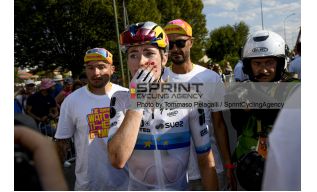
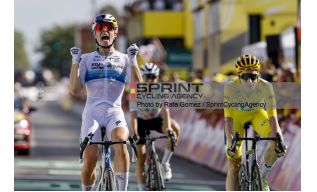
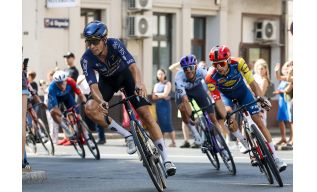

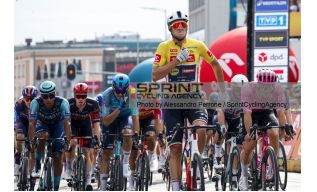















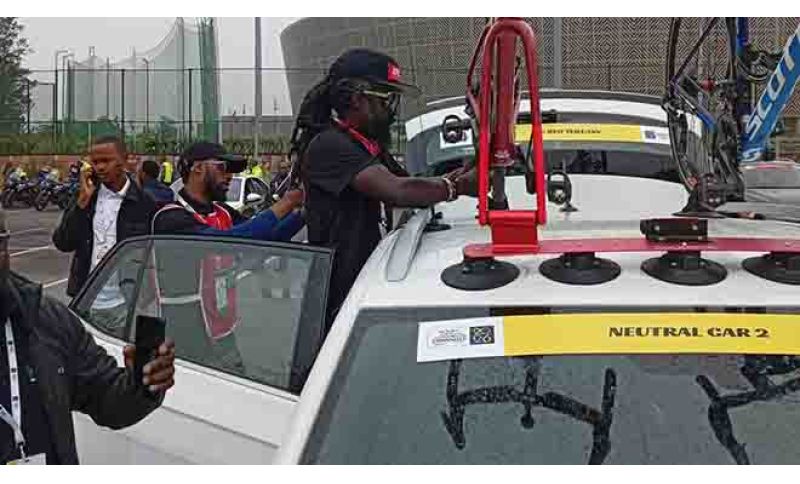
The wheel that turns at the Tour du Rwanda is also that of the history of a competition that is turning eighteen. The vivid representation of the pioneering beginnings in the year 2000, nine years before the race became a UCI event, is offered by Rafiki Uwimana, a 42-year-old who not by chance now works on the neutral support vehicle.
A tour guide, driving force behind the Academy situated at the top of Mount Kigali, Rafiki is the father of Johnatan, a 17-year-old talent who within a two-year span wants to be at the start of the Tour du Rwanda with his race number on his back. "There's the wheel turning—I took part in eight editions of this event and I remember the enthusiasm we immediately felt around us, during the ten stages raced along roads that cannot even be compared to today's billiard-smooth asphalt. We were the initiators as a generation, and personally I remember a powerful formative experience linked to your Pantani."
He was 17 years old, the same age as his son, and he had the opportunity to witness the Pirate's victory at the Tour de France, during the Ventoux stage when he rivaled Armstrong. From that dramatic television vision (there was one set in every home) came the additional motivational push for Rafiki, who arrived at the Grande Boucle as a professional: "I obtained my third-level mechanic certification from the UCI in Aigle, following the World Cycling Center team during their European tour. We climbed the podium with Pogacar—do I need to say more?"
Perhaps something about the legacy of the 2025 World Championships for the host country: "a boost effect that won't be momentary, and from this perspective the Tour du Rwanda is a reference point for something broader that includes the fundamental commitment to developing youth cycling. And then all the ancillary professions, us mechanics...us technicians. In 2000 we certainly weren't pedaling on today's bicycles, making do with models that had gear shifters, six speeds, positioned on the frame. A race with a coordinator of just 32 years old, Hubert Nkurayija, laid the foundations for further growth that cannot overlook the debt of gratitude to those who contributed to making it a benchmark for the entire Continent: where, without hagiographic representations, the first world championship held in Africa seems to have unleashed special energies, also to bridge a gap in terms of the number of races.
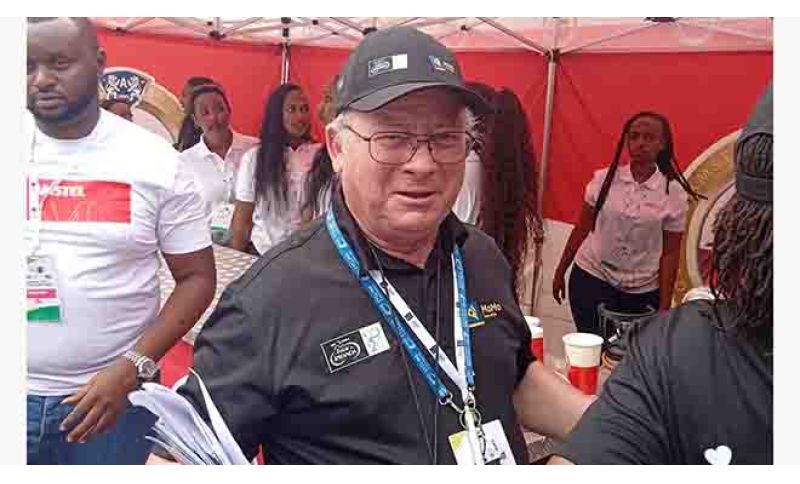
Not far from Hubert, here is the Frenchman Pierre Salvit, a historic figure whom all TDR organizers rightfully honor with great consideration: "It was 2008 and with my fellow countryman Olivier Grandjean we were in Ivory Coast at a race that also featured former American professional Jock Boyer. You know the story—he had come here together with Tom Ritchey of Ridley to ride and develop embryonic development projects (wooden bicycles for those working in coffee plantations, ed. note). When we arrived there was almost everything to be built from scratch, but a passion and a desire to do things well that made the bicycle a factor of cohesion. Let's never forget that in 1994 Rwanda had experienced a tragedy like the Tutsi Genocide."



 11
11
 11
1
1
18
18
11
1
1
18
18

 Ritratti
 Oscar
Oscar Albi d'Oro


Se sei giá nostro utente esegui il login altrimenti registrati.