


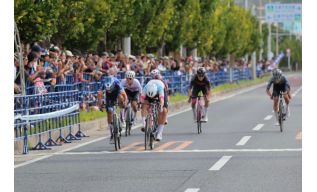





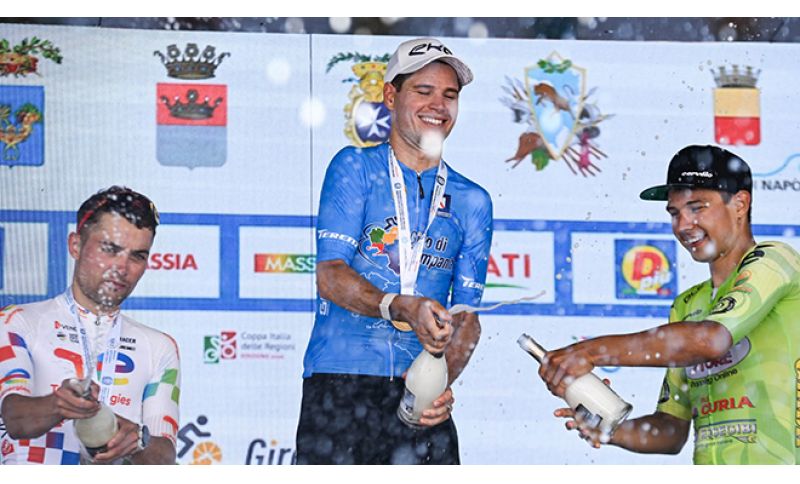
Sometimes, to truly understand a race, you have to stop looking at the winner's name for a moment and observe the gaps that separate one rider from another. In the Giro di Campania there is one that is worth almost as much as a race report: thirty seconds. Antonio Fagundez wins in 4 hours 21 minutes and 48 seconds, Alexandre Delettre arrives alongside him, Andrii Ponomar loses just two seconds, Einer Rubio six. Then you have to wait another thirty to find the fifth, Daniel Corres, at 36 seconds. It is in that void between fourth and fifth that the true technical signature of the race remains impressed.
The Giro di Campania measured 189 kilometers and was raced at an average speed of 44.116 km/h. Already a significant figure for a race contested late in the season and on a course that was anything but straightforward. But average speed only tells you how hard the pace was. It doesn't yet explain how the race produced its own selection. To understand this, you need to look at the distribution of the finishing order.
And that's where the result takes on particular significance. Before the race we had emphasized one element: Agerola, located about fifty kilometers from Naples, would hardly have been able to decide the Giro on its own. Too far from the finish line and too manageable, for professionals, to necessarily represent the point of no return. But it could break the balance and transfer the decision to the kilometers that followed. That's essentially what happened. The climb produced the first selection, the subsequent phase transformed that selection into a group capable of going all the way to the finish. The final data—four men contained within six seconds and the fifth at thirty-six—constitutes almost its mathematical photograph.
We could call it the breaking point of the finishing order. If we observe the first ten finishers and measure the difference between each rider's gap and that of the next, the largest jump is precisely between Rubio, fourth at 6", and Corres, fifth at 36": thirty seconds. This is not a formula constructed to explain this race. It is a simple and replicable indicator for any race. It serves to identify where the finishing order stops being a continuous succession and presents a true competitive discontinuity.
But the Giro di Campania contains even a second fracture. The 48th classified finishes at 4'41"; the 49th at 11'54". Between them are 7 minutes and 13 seconds, the largest gap in the entire classification. This means the race produced two different phenomena: up front it isolated the group that could fight for the result; much further back it sharply separated the still-competitive body of the race from the final group.
The other numbers also help understand its difficulty. Of the 118 who actually started, only 67 finished: 56.8%. There were 51 withdrawals, 43.2%. However, it would be methodologically wrong to automatically translate that 43.2% into a measure of the course's difficulty: in professional cycling you can abandon after completing your team's work, due to mechanical problems, or simply because, having lost any tactical function, there is no longer any reason to finish. Better then to also look at the dispersion of those who did reach the finish line.
Only 13 of the 67 classified, 19.4%, finished within one minute of the winner. Within two minutes we find 25, 37.3%. To reach 48 riders you have to go all the way to 4'41". The median rider in the finishing order, the 34th out of 67, is already at 3'58". These are numbers that describe a race far more fragmented than a simple reading of the top positions might suggest.
From here can also emerge a different way of telling cycling stories. Every race possesses its own statistical signature: average speed, percentage of finishers, gap of the tenth, twenty-fifth and median rider, largest gap between two consecutive positions, size of the group remaining within one, two or five minutes. By consistently applying the same indicators to Toscana, Matteotti, Agostoni, Pantani, Appennino and the other Italian 1.1 category classics, it would be possible to gradually stop defining a race as "hard," "selective" or "fast" solely on the basis of impressions. We could measure it.
The 2026 Giro di Campania thus leaves us with Antonio Fagundez in the roll of honor of its return after twenty-five years. But it also leaves us with a small statistical laboratory. Because every finishing order contains a geometry and within that geometry the technical history of the day remains written. In the case of the Giro di Campania, just two numbers are enough to begin reading it: 6 seconds and 36 seconds. Between those two values there are thirty seconds of empty road. And that is probably where this race tells itself best.



 1
 1
5
5



 |
 |
||
 |
 |
|
|
 |
|
||



 Ritratti
 Oscar
 Albi d'Oro


Se sei giá nostro utente esegui il login altrimenti registrati.