

















Is a WorldTour team worth more than a Continental one? If we're talking about structure, budget, roster depth and organization, the answer is almost obvious. But the question changes completely when you try to measure how much the lineup that team actually decides to bring to a single race is really worth. And it's precisely here that the Giro di Campania, on the eve of its return to the roads after twenty-five years, becomes a particularly interesting case study.
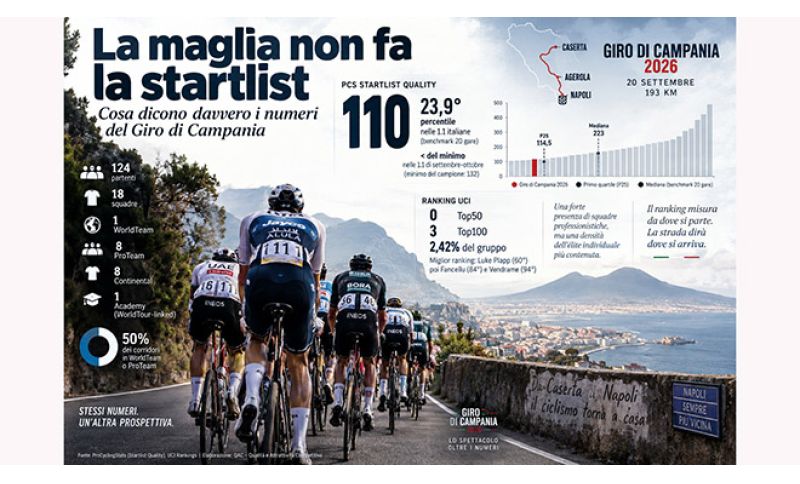
The definitive "certified" startlist counts 124 starters, distributed among 18 teams, following a slight variation to the course, Sunday's race will be held over a distance of 189.5 kilometers, with 2,625 meters of total elevation gain. Formally there is one WorldTeam, Jayco AlUla, there are eight ProTeams, eight Continental teams and the Movistar Team Academy, a formation linked to the Spanish WorldTour structure.
Exactly half the group, 62 riders out of 124, therefore belong to WorldTeams or ProTeams. Looking at just the jerseys alone, this could suggest a high-level participation. However, the individual ranking tells a different story. In the UCI ranking updated the week before the race, the best rider present is Luke Plapp, 60th in the world. He is followed by Alessandro Fancellu, 84th with 1,027 points, and Andrea Vendrame, 94th with 932. Giovanni Lonardi is just outside the Top100, in 107th place. In essence, out of 124 starters there are only three Top100 UCI riders and no Top50. The density of world elite is therefore 2.42%.
This is where statistics help us move beyond impressions. For this Giro we built a model, QAC – Competitive Quality and Attractiveness – that compares the race with a benchmark of Italian UCI 1.1 races already defined before knowing the startlist. Perhaps the most interesting data comes from ProCyclingStats: the Startlist Quality of the Giro di Campania is 110. PCS builds this indicator by assigning different values to riders based on their position in their ranking from the previous Sunday: 50 points for Top10, 35 for Top25, 20 for Top50, then progressively lower values down to Top1000. The stated objective is precisely to make startlists from different races and eras comparable. So what is 110 worth? In our sample of twenty Italian 1.1 races the median is 223, while the first quartile is at 114.5. The Giro di Campania thus places itself at the 23.9th percentile: almost exactly on the threshold of the lower quarter of the distribution. Narrowing the comparison to the fourteen Italian 1.1s held between September and October, the result becomes even clearer: the minimum value observed in the sample was 132. The Giro's 110 is therefore lower than all observations in that subgroup.
However, pay attention to what these numbers mean. They are not saying the race will be "weak", less spectacular or less competitive. They are measuring something much more precise: the competitive rank of the riders present before the start. And it's precisely this distinction that makes the Campania case interesting. Because while the individual quality of the elite is relatively contained, the professional structure of the teams is much stronger. This is perhaps the most relevant point: the team category measures the container, not necessarily the content that is fielded that day. A WorldTour jersey on the starting line does not automatically imply that the team brought its highest-ranked riders. The Giro di Campania shows this almost didactically: 50% of the group belongs to WorldTeams or ProTeams, but only 2.42% of starters are in the Top100 UCI.
Then there's the road, which is something else entirely. Fancellu comes off a victory in the first stage of the Giro d'Abruzzo and has entered these days in a phase of very high form. Vendrame, Crescioli, Oldani, Lonardi and Delettre have shown recent signs that the ranking, being a measure constructed over a much longer time horizon, cannot fully capture. And the course adds another variable: Agerola measures approximately 14 kilometers at 6%, but the climb finishes still 47 kilometers from the finish at Piazza del Plebiscito. There is room to select, but also to chase, regroup and change the script again.
For this reason, the true meaning of the startlist cannot be contained in a single adjective. The Giro di Campania presents a low statistical density of international elite, a professional presence of teams that is far more consistent, and several riders in significant recent form. Three different levels, which are often overlapped in cycling coverage.
The jersey, in short, doesn't make the startlist. And the ranking alone doesn't make the race. The numbers tell us where we're starting from. From Caserta to Naples, passing through Agerola, it will be the road that tells us how much of that hierarchy will make it all the way to Piazza del Plebiscito.

 6
6


 6
6


 20
20
8
8
13
13
20
20
8
8
13
13

 Ritratti
 Oscar
Oscar Albi d'Oro

