
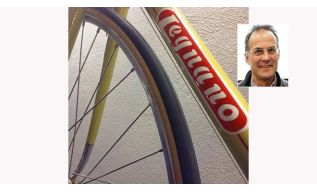
















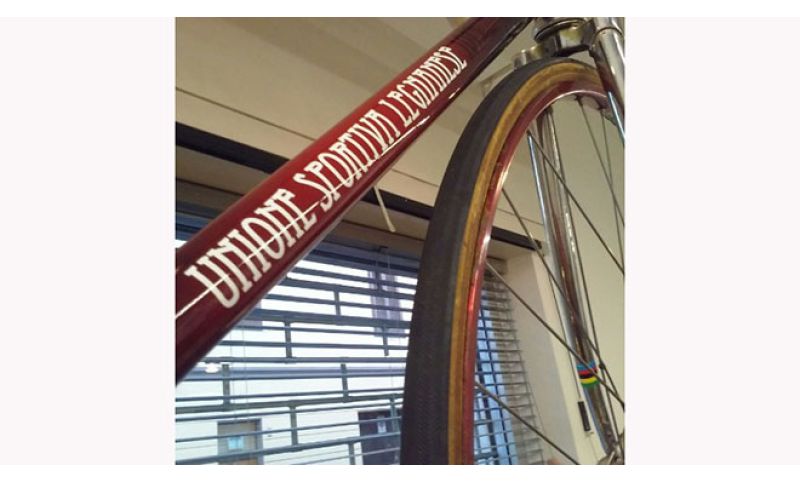
They were Legnano bikes ridden by Attilio Zavatti, from Forlì, number 60, and Giulio Modesti, from Rome, number 113, among the 127 riders at the start of the first Giro d'Italia, in 1909. Zavatti shone in the first stage, the Milan-Bologna leg of 397 km: he finished seventh in a sprint at the Zappoli hippodrome. But he had already made his mark before: "Zavatti, overheated – writes "La Gazzetta dello Sport" – sees a girl with a bucket of water. He leaps from his saddle, runs to the young woman, takes the bucket from her and plunges his head into it amid the wildest laughter of the onlookers". And it was a Legnano bike that Zavatti, nicknamed "e' biundì", rode in 1909 when he participated in and also finished the Tour de France, in fifteenth place.
It was a Legnano bike that Ernesto Azzini, from Rodigo in the province of Mantua, nicknamed "el Du Meter" for his height, rode in the final stage of the 1910 Tour de France, the Caen-Paris leg of 262 km, when he broke away 260 km from the finish line, that is, shortly after the start, and in a sprint at the Parc des Princes achieved the first victory by an Italian rider. History tells us that Italian journalists, convinced that this time too – the ninety-third stage in the history of the Grande Boucle – our riders would not win, learned of Azzini's feat while they were on the train, at Modane station, on the border with Piedmont, and dictated their highly emotional pieces relying on... their craft.
It was a Legnano bike that Gino Bartali rode during World War II, when he would leave his home in Ponte a Ema, today a neighborhood of Florence, pass through Assisi, 200 km along the Chiantigiana road, enter a convent of cloistered nuns, retrieve forged documents, hide them in the tubes of his bike and handlebars, get back on his bike, pass through checkpoints unscathed (they recognized him, but it's Bartali!, yes I'm training), finally deliver the new identity cards saving the lives of Jews persecuted by the Nazi-Fascists, then return home.
It was a Legnano bike that Imerio Massignan, from Valmarana di Altavilla Vicentina, rode when he became the first cyclist to reach the Gavia Pass, an honor, a prestige, a fame as if he had been the first man on foot on the Moon. But that day, Giro d'Italia 1960, the penultimate stage, 229 km, started from Trento and arrived in Bormio. And the descent from Gavia to Bormio proved fatal to Massignan, more of a climber than a descender: two punctures, three including the flat tire with which he reached the finish line, crying, second behind Charly Gaul and fourth in the general classification, but first in the ranking of the unlucky.
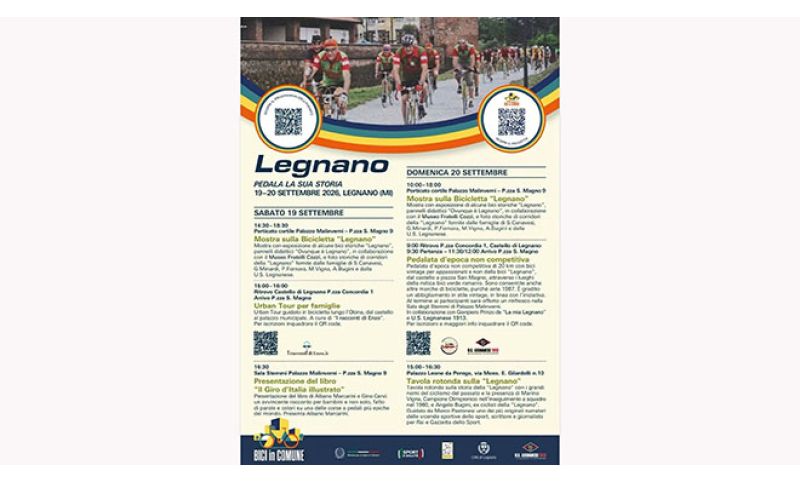
They were Legnano bikes ridden by Brunero and Binda, Volpi and Coppi, the two Ricci brothers and the three Zanazzi, and also by Baldini and Battistini, Fornara and Defilippis, Albani and Pambianco up to Fondriest. They were Legnano. And with that name, that brand, that symbol, that color, history was written. Because Legnano is to cycling what Alfa Romeo is to automobiles and Recco is to water polo, Legnano is to the bicycle what Nutella is to chocolate and hazelnut cream, Legnano is to the history of round sports what Rugby is to the history of oval sports. And Legnano celebrates itself, obviously in Legnano. Two days, Saturday, September 19 and Sunday, September 20, with exhibitions and meetings, family rides (guided and narrated) and vintage rides (20 km), strictly non-competitive. The center of the celebration will be Palazzo Malinverni, but the final round table, Sunday at 3 p.m., with guests of honor two Legnano riders from the 1960s, Angelo Bugini and Olympic champion Marino Vigna, will be held in Palazzo Leone da Perego, via Monsignor Girardelli.
Legnano's is a grandiose cycling and geographical story. Yet, as Gianni Brera wrote, "the road belonged to the humble, and produced / many champions whose names I cite / remained in the book of gold. The most important / was certainly Bottecchia, valiant / veteran of the war: Legnano did not want him / for his name (rob de matt), / he offered himself as a gregario in France for the Tour". The first time Bottecchia finished second, then he was first twice.




 Ritratti
 Oscar
Oscar Albi d'Oro


Se sei giá nostro utente esegui il login altrimenti registrati.