

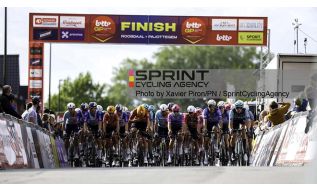














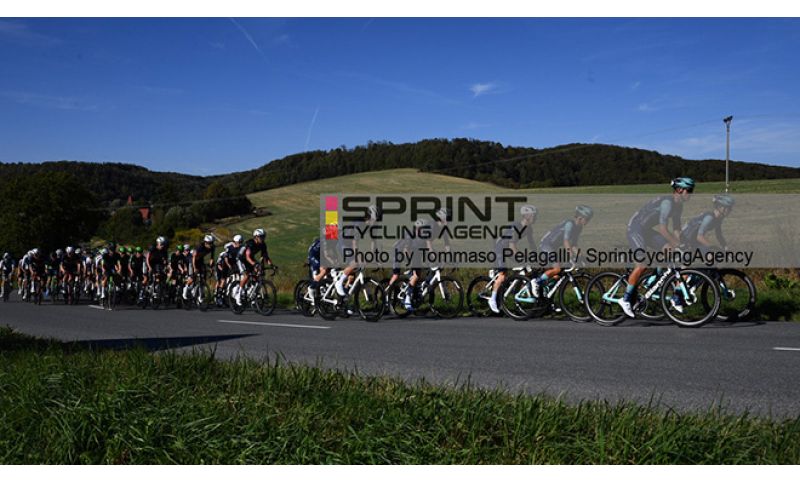
There are races that present themselves with a list of names and races that, even before the start, ask to be measured. The Giro di Campania that will return to the professional calendar on Sunday, September 20 after twenty-five years belongs to the second category. The presentation at Palazzo Santa Lucia has provided the institutional framework, the route, and the symbolic value of a race that reconnects a thread broken for a quarter of a century. But, for those who watch cycling with the eye of competition and not merely celebration, the most interesting question begins right now: what is the true value of the startlist for this sixty-fourth edition?
The first data point is already in the race profile. A UCI 1.1, over 190 kilometers through all five Campania provinces, from the Royal Palace of Caserta to Piazza del Plebiscito, within a geography that doesn't need to be invented to become a story: Sannio, Irpinia, Agro nocerino, Cava de' Tirreni, Amalfi Coast, Agerola, Gragnano, Stabia, Pompeii, Herculaneum, Portici and finally Naples. An extraordinary route from a scenic perspective, but far from trivial in its competitive reading. Agerola is far enough from the finish to not necessarily be decisive, while the descent towards Gragnano, the return to the coast and the final kilometers can transform the race into an open confrontation between resilient riders, attackers and teams interested in regrouping.
Then there are the names. The list transmitted by the organizers, pending the definitive startlist, already contains sufficient material to understand that the level will not be merely decorative. Jayco AlUla announces riders like Luke Plapp, Andrea Vendrame, Alessandro Covi and Filippo Conca; from the first team Movistar comes a rider of the caliber of Einer Rubio to strengthen the Academy formation. And then Alessandro Fancellu, Ludovico Crescioli, Stefano Oldani, Filippo Turconi, together with young riders seeking space and results in the professional ranks. For Campania cycling, the presence of the Maddaloni natives Michele Pascarella and Ivan Toselli also assumes particular significance.
Stopping there, however, would mean doing what cycling almost always does when trying to tell a field of starters: lining up palmares, victories and jerseys, adding a few adjectives and concluding that "the startlist is of quality". It is precisely this step that is worth trying to overcome. Because a UCI 1.1 race is not measured solely by the most famous name at the start. What counts is the overall density of talent: how many riders belong to the upper tiers of international ranking, how many are placed in the top 50, 100 or 200, what weight do the UCI points accumulated in the year carry, what is the average level of the teams and, above all, how much quality remains when you descend from the first to the fifth, tenth, twentieth most valued athlete.
It is a methodological difference, but also a narrative one. Plapp can shift the top of the distribution upward; Vendrame adds experience and the ability to win selective races; Fancellu and Crescioli represent values that must also be read through what they are doing in the current season; Rubio, Covi and Oldani add experience gained at the highest levels. But the real question is not establishing whether these riders are strong. We already know that.
The interesting question is another: how much does their presence, added to that of the rest of the group, make the Giro di Campania competitive compared to other Italian races in the same category? And it is here that the return of the race acquires an additional dimension. History tells of Coppi, Bartali, Bitossi, De Vlaeminck, Saronni, Moser. Enormous names that belong to the memory of Italian cycling. The new Giro, however, will have to build its own value without living solely on that memory.
As soon as the official list of starters is available, we can then perform an operation different from simple celebration: compare this startlist with a sample of editions of the main comparable Italian UCI 1.1 races and try to establish where it ranks in the distribution of quality. Not simply say that it is a good startlist, then, but try to measure it. Because if the Giro di Campania wants to return permanently to professional cycling, one of the first questions to ask is whether, already at its rebirth, it has managed to attract not just a few important names, but a true density of talent. The first signals suggest it's worth taking out the calculator.
in the attached pdf, the list of registered riders


 1
1


 1
1


 20
20
8
8
13
13
20
20
8
8
13
13

 Ritratti
 Oscar
Oscar Albi d'Oro

