














"The teacher asks the student sitting at the back of the class: 'What is light?' The boy answers: 'The Giro d'Italia'. That boy was me".
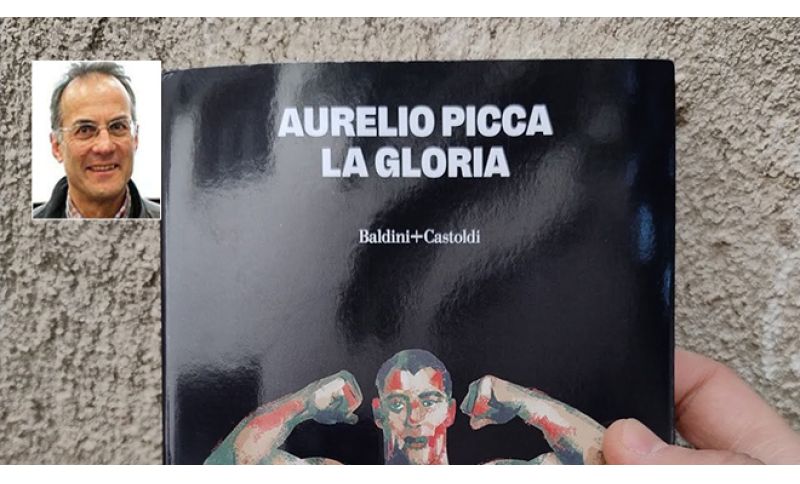
Aurelio Picca – 69 years old, from Velletri – is a poet, writer and journalist. His first book was a collection of poems ("Constructions of Plaster", 1982), his most recent a novel ("Rome of Mine, I Will Not Die Again", 2025). The striking opening of the chapter "The Giro d'Italia" belongs to "Glory" (Baldini+Castoldi, 192 pages, 17 euros, 2024).
"At two years old my grandfather had given me a blood-red tricycle. Perhaps Ferrari red. Or Alfa Romeo red. I would weave through the legs of big men with gold teeth, without arms and legs, being disabled from the last war. There was the smell of wine and hard-boiled eggs; of salt and pepper...".
Glory dwells in Michelangelo's marble or in perfect sandals like wings on Perseo's feet, but also on the highest step of a podium, on the grass of a football field or on the canvas of a ring where one dances beside death. Glory is orgasm, eruption, ecstasy, but also stories and existential geographies, those that dwell within each of us.
"The patrons smiled at me, and I imagine they cheered for Bartali and Coppi. Precisely the cyclists in black and white climbing up the dirt roads with mountains of steel. Thin as birds ready to collapse from the effort. Yet they never collapsed. The bicycle riders that I still didn't know, that I had never even seen on television...".
Picca finds Glory in football, he a Lazio supporter, a family inheritance, neighborhood, faith, but also in athletics. "Marcello Fiasconaro, the Che Guevara of the four hundred meters. Why Che Guevara? Yes, for the long hair, the beard, the white jeans, a cool rockstar, a sweet virility. Actually I don't know. Perhaps because in the end he was a kind of stateless person, a revolutionary too with disappointment for the revolution".
"The Giro d'Italia is a journey through the body of the homeland. I have always imagined it upside down. With wheels up and the cyclists' bodies down. It's an aerial journey while clinging to the ground. Sometimes it's the roads that twist the bicycles; sometimes it's the bell towers that make them small...".
Picca fell in love with boxing, therefore with boxers and gyms, with uppercuts and guards, with heavy bags and mirrors, and there's always a master who "strips vices" from his students. His passion for Giulio Rinaldi, "a champion of the common people", his adoration for Primo Carnera, "the mountain that gathered the derelicts and wretched who had nothing to eat", his respect for Nino Benvenuti, "He used to say: 'I fought at the old Madison, not the new one'. By saying this to me he meant: 'I battled where the tears of Glory lie'".
"When Marco Pantani appeared, you saw a young boy, a little animal with a bandana on his head. They called him 'the Pirate'. It seemed he pedaled uphill without a bicycle. He pedaled without pedals".
Between Gimondi and Merckx, Picca favored Motta. Between Giacomo Agostini and Renzo Pasolini, Pasolini. Between Muhammad Ali and George Foreman, Foreman. Between horses and bulls, all indiscriminately. Picca remembers, recounts and writes in the first person. His writing contemplates the knockout, like that striking opening of "The Giro d'Italia". And the knockout, as he explains it, "is the blow of all blows". So much so that: "They never gave me a bicycle. They must have done it to leave my dream intact. And my love for the body and the viscera of Italy".



 1
1
 1
1
1
1
1
1

 Ritratti
 Oscar
Oscar Albi d'Oro


Se sei giá nostro utente esegui il login altrimenti registrati.