
























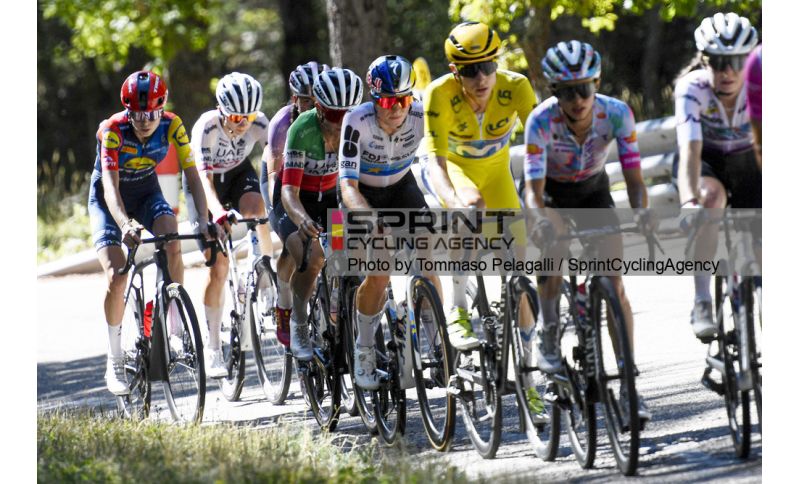
"Investments in women's cycling have become too substantial to settle for the current calendar": this is the statement with which Philip Roodhoft, Team Manager of Alpecin and Fenix-Premier Tech, has recently reiterated the need to expand the number of races on the women's calendar, which in his view is currently insufficient to financially reward the efforts made by sponsors in supporting teams and athletes at the center of the movement.
"There are still too many races that generate insufficient media attention to justify investments in women's cycling" Roodhoft elaborated. "We have two Grand Tours, the Giro and the Tour, and about ten significant one-day races, so the women's season consists of 25/30 commercially interesting days. A men's Grand Tour lasts twenty-one days: the Tour de France Femmes is nine. Only nine" emphasized the Belgian team manager before explaining even more concretely what has given rise to this situation.
"They are paying salaries that defy all logic. There isn't enough talent to fill all the positions, which means that good cyclists are being paid more than they should be. Therefore, something needs to be done".
What? According to Roodhoft, in addition to trying to develop "cyclists with greater talent" and hoping there could be "more competition in the sprints", to change the status quo it would also be necessary to prepare "a broader calendar" with more events capable of generating a return, economic and otherwise, that is valid for all the actors involved.
In principle, such reasoning would not be wrong, but perhaps, before thinking about increasing the number of races, it would be appropriate to consolidate the many that today still struggle to take place and reduce (if not even bring to zero) the number of those that are routinely, season after season, cancelled, thus putting a brake on a trend that, over the last four years, has taken a decidedly negative turn.
The reasoning stems from the news, which passed completely under the radar, of the cancellation of the Tour of Guangxi Women, a race that, as happened in 2023, 2024, and 2025, was supposed to close the World Tour calendar of the season, a role that should now (better to use the conditional given the times we live in) be assumed by the other race scheduled in Chinese territory, the Tour of Chongming Island. Even if this, as it seems, were to take place, it cannot go unnoticed that two of the three races that, between September and October, were supposed to bring the curtain down on the top world calendar (the Tour de Romandie Femenin, precisely, the TOG Women) will not take place and that, with them, the figure relating to the total number of races reserved for women cancelled during the season will be for the fourth consecutive year higher than that of the previous season.
The numbers, in fact, do not lie: according to what is reported on ProCyclingStats, today, in 2026, there are 21 races scheduled and then, for various reasons, removed from the calendar, a quantity higher than that of last year (19) which, already in itself, had negatively adjusted those of the 2024 (18) and 2023 (13) seasons. In light of this trend, it is natural therefore to think and hope that, before making changes to the race program by considering new events, it is probably the case to preserve the races that already exist or are navigating in particularly turbulent waters by providing organizers, sports teams, and federations with the tools and solutions that can, logistically and financially, facilitate their work thus making a calendar less shaky—one that unfortunately has never proven to be particularly stable in the last four years.

 22
22


 22
22


 1
1
2
2
10
10
19
19
2
2
3
3
1
1
1
1
2
2
10
10
19
19
2
2
3
3
1
1

 Ritratti
 Oscar
Oscar Albi d'Oro

