
















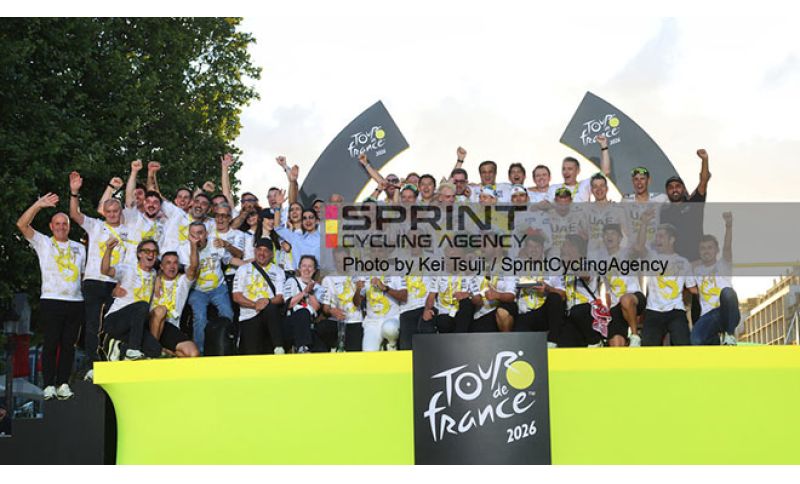
The 2026 Tour de France did not merely crown a winner: it certified the existence of an era. Tadej Pogačar has conquered his fifth Grande Boucle of his career, his third consecutive, reaching Anquetil, Merckx, Hinault and Indurain in the exclusive club of five victories. He finished in 73 hours 56'26", with 6'26" over Remco Evenepoel and 9'42" over teammate Isaac Del Toro. Numbers that describe not merely a victory, but a now-consolidated hierarchical structure.
The first data point is the margin. Six minutes and twenty-six seconds equals 386 seconds: an enormous distance in contemporary sport, in which preparation, materials and data analysis should theoretically compress differences. Instead, the opposite occurred: science brings the middle group closer together, but amplifies the advantage of those who simultaneously possess the rarest talent, the strongest team and the best ability to transform every piece of information into performance. Pogačar's superiority, however, is not measured solely on the podium in Paris. The Slovenian won five stages, nearly one in four, bringing his total in the French race to 26. On Alpe d'Huez he stopped the clock at 35'27", over a minute below the historical reference attributed to Marco Pantani on the same race segment. This is data, however, that must be used with caution, because the length of the section, environmental conditions, the position of the climb in the stage and race dynamics are never perfectly homogeneous. Nevertheless, it remains an unequivocal indicator of the speed reached by contemporary cycling.
The Tour was decided early, but it was not necessarily monotonous. This distinction is essential, because the vertical uncertainty, that relating to the yellow jersey, proved very low; while horizontal uncertainty remained profoundly significant. Evenepoel won two stages and confirmed his superiority against the clock; Tim Merlier imposed the law of the sprint; Richard Carapaz transformed aggression into victories and the polka dot jersey; Mads Pedersen conquered the green jersey; Mathieu van der Poel signed off the finale in Paris after Ussel.
The race thus lost balance at the top, but retained plurality in specialties and objectives. The retirement of Jonas Vingegaard after his crash on the fifteenth stage deprived the Tour of the only antagonist with a comparable recent history. We cannot, however, state with certainty that he would have reopened the race: at the moment of his withdrawal, as we know, he had already suffered significant time losses. We can, however, maintain that his exit reduced tactical pressure on UAE and transformed the final week from a battle for first place into management of an already-acquired advantage.
The UAE itself represents the second great winner. Del Toro, third and best young rider, was not merely a beneficiary of the captain's strength: he demonstrated consistency, resilience and maturity. His podium finish also tells of a systemic advantage. When the strongest rider can control his opponents, win stages and simultaneously protect a teammate's placement, individual superiority becomes organizational power.
The French press read the victory primarily in its historical dimension, focusing on the fifth Tour and the Alpe d'Huez record. Reuters spoke openly of a "dynasty," while Italian media emphasized a yellow jersey dominated without real possibility of contestation. These are different readings of the same phenomenon: Pogačar not only preceded his opponents, he modified their decisions; the others often raced awaiting his attack, measuring their ambitions against his presence and redefining their objectives in function of his superiority.
The most troubling data point for traditional cycling is another: for the first time France, Italy and Spain concluded the Tour together without a stage victory. This is not a statistical curiosity, but the signal of a geographic and technical shift in cycling power. The nations that built the history of the Grand Tours no longer automatically hold the present.
The final judgment must therefore avoid two opposite errors. The 2026 Tour was an event of the highest performance quality and reduced uncertainty for the final victory; Pogačar transformed the Tour into a laboratory on dominance: it is not only about how much time you gain, but how much freedom you deny others. The definitive measure of his superiority is not the 386 seconds over Evenepoel. It is the fact that, for three weeks, almost all competitors had to decide not how to beat him, but what result was still possible to achieve behind him.
Giovanni Di Trapani is a senior researcher at CNR currently on secondment to the Office of the Prime Minister: he coordinates the support structure for the Bagnoli Coroglio Commissioner.

 6
6


 6
6


 2
2
11
11
5
5
25
25
1
1
3
3
5
5
2
2
11
11
5
5
25
25
1
1
3
3
5
5

 Ritratti
 Oscar
Oscar Albi d'Oro

