















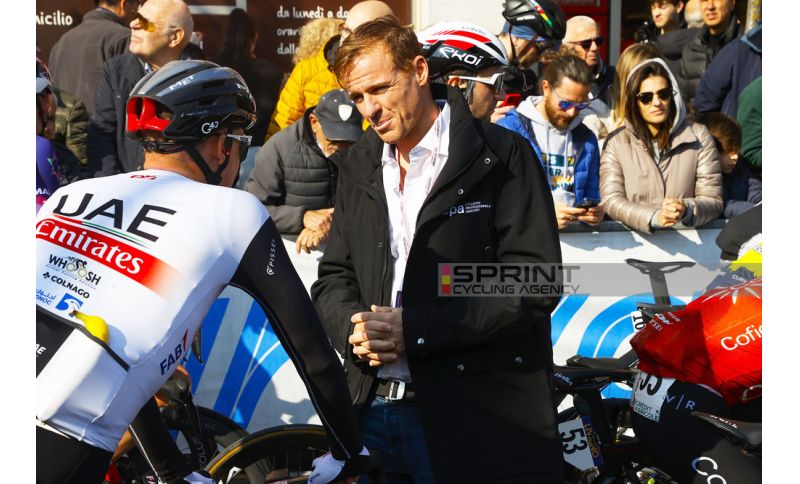
Yesterday the CPA issued its statement following the night-time anti-doping controls that took place at the Tour de France, which involved Tadej Pogacar and Jonas Vingegaard, and discontent continues to be evident within the peloton. On the rest day, when practically all teams of the Grande Boucle were tested, Adam Hansen gathered the opinions of riders, who are increasingly reluctant to fund a system that appears to focus on cycling far more evidently than other sports. The former Australian pro who heads the global riders' union posted on X how the anti-doping system works and how athletes demand it becomes more efficient, fair and respectful. We present his full post:
Our position is clear: the CPA is extremely disappointed with the current direction of anti-doping efforts in professional cycling.
Did you know that cyclists are the only athletes in the world who pay out of their own pockets to fund supplementary anti-doping controls, long-term sample storage and data analysis? This financial burden is a direct consequence of our sport's historical past. Although modern cycling is today significantly cleaner, active riders are paying for the mistakes of previous generations. Is that fair?
Within the SafeR initiative, members often argue that incidents happen because riders lose concentration or look down at their bike computers. But consider the human cost of the current anti-doping system: think about how you would perform in your normal daily work after just four hours of sleep, or after being woken right in the middle of your REM cycle at 2 in the morning for a blood draw.
Now, imagine that happening during a Grand Tour, between two crucial mountain stages after two full weeks of racing. The pressure weighing on your shoulders. I'm not saying this was the cause of Jonas Vingegaard's crash, but subjecting an athlete to all this during the most important race of the year, after two weeks of racing, certainly has an impact on his daily performance or could simply remain in the back of his mind during the stage.
It's not just about Jonas: all professional cyclists must be available 365 days a year.
The one-hour window: during their assigned daily one-hour window, riders must be at exactly the location specified in their whereabouts statement.
The other 23 hours: outside that time window, DCOs (doping control officers) can still show up without notice. If a rider isn't home because they went out for a coffee or took their son to the park – something they decided to do during the day – they are required to provide proof of where they were and why.
Failure to account for one's whereabouts can be recorded as a missed test. Riders are terrified of receiving a missed test. I've seen cases of riders who had to obtain a statement from restaurant owners, along with the receipt, attesting that they were out to dinner outside their one-hour window. Now, how can they get a written statement from their 3-year-old child if they went to the park?
To make matters worse, the ADAMS application that riders must use to submit their whereabouts data is known for technical issues and frequent downtime.
We have always advocated: "Quality over quantity". Cyclists directly fund the ITA and we have repeatedly argued that increasing the number of tests is not the solution, but a waste of resources. Those funds should instead be invested in upgrading the equipment of analysis laboratories.
Currently, equipment standards vary from one accredited laboratory to another. Some are far more advanced than others in detecting traces of substances. We want an approach that prioritizes quality over quantity, with state-of-the-art laboratory equipment capable of detecting the absolute smallest traces of prohibited substances. This means fewer tests, but more accurate ones, that identify the real cheaters while reducing the constant harassment of clean riders.
If there were advances in analysis equipment, this would expand the detection window for prohibited substances, leading to a more efficient approach: these night-time tests would no longer be necessary, there would be less stress and workload for riders, and greater chances of unmasking cheaters.
But that's not the direction being taken. Funding is not going to improve laboratory equipment, but rather to increase the number of tests and enhance data monitoring, and all this means more work and stress for riders. They have enough already. We want cheaters to be unmasked, we don't want clean riders to be harassed and presented with a report where the total number of tests increases year after year with an ever-decreasing number of positive cases.
We must ask ourselves whether we want to continue contributing to a system that is not going in the right direction, namely becoming more efficient, unmasking cheaters, harassing clean athletes less, and not treating riders like criminals.

 6
6


 6
6


 1
1
2
2
1
1
2
2

 Ritratti
 Oscar
Oscar Albi d'Oro

