

















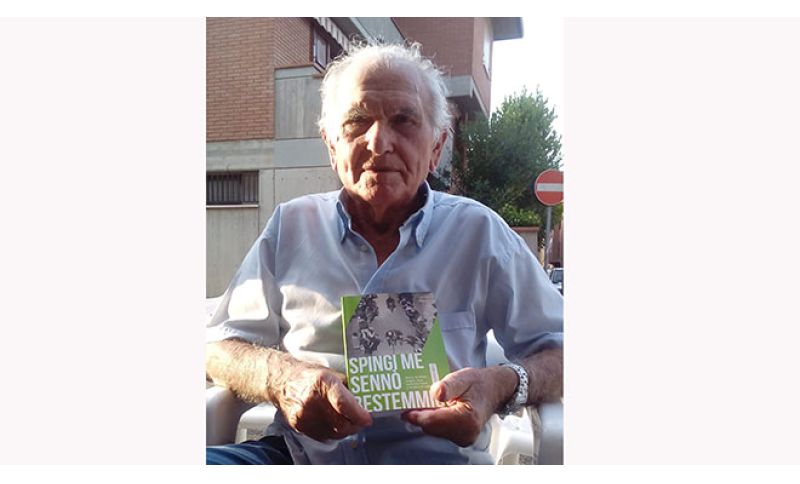
First on four legs, then on two wheels. The four legs belonged to cows, to be milked. The two wheels belonged to a Benotto, to be pedaled. And between the four legs and the two wheels, between the cows and the Benotto, between milking and pedaling, there was obviously no contest for Dino Bruni.
Dino Bruni died last night. He was 94 years old and almost three months—months count as years when you pass 80, let alone 90. He was born on a billiard table, so to speak, as anyone who sees the world flat, 180 degrees from dawn to dusk, from morning to evening, would know—for instance, in his Portomaggiore, 27 kilometers in a straight line from Ferrara, less as the crow flies, in the air of the plains, the Padania air, the air of agriculture and cycling, in his case it was about speed and sprints. His first six races as a junior, he told me sitting in the living room of his house, surprised by interest after years of obscurity, turned into six victories.
Dino Bruni had talent: I always add the full name because there are cyclists who have, by right and almost by duty, the privilege of complete biographical information, as has always been the case with his fellow regional rider Ercole Baldini. Italian champion among juniors, Dino Bruni collected about a hundred victories as an amateur plus an Olympic silver medal (team time trial at Helsinki 1952, plus fifth place in the individual road race at Helsinki 1952, and fourth again in the team time trial at Melbourne 1956) and a world bronze medal (individual road race at Frascati 1955), and about thirty victories as a professional, including the first stage of the 1960 Giro d'Italia, the Rome-Naples stage, which gave him the pink jersey. Statistics had passed him down, until last night, as the oldest living stage winner and pink jersey wearer. "When I saw the finish line banner," he confided in me, "my feelings would change."
Dino Bruni was handsome, in a period (a long, perhaps very long period) when cyclists weren't handsome because the hardships of cycling marked them like bricklayers or miners, as if pedaling on roads was equivalent to building roads or even digging beneath them, a mining and mineral sport. He was above all a tough guy, Dino Bruni. In 1964, at Paris-Roubaix, rain, cobblestones, carnage, he was overwhelmed by riders—even Jacques Anquetil—ended up in the hospital, fractures to shoulder and hand, 20 days of immobility, not the best thing one could wish for someone who a month later would have to face the Giro d'Italia. It took him six stages to get back in the group, on the Alps and Apennines he gave his all but didn't give up, in the Rimini-San Benedetto del Tronto stage he finally saw the front of the group again and fought in the sprint, the next day he was hit by a car while taking a bathroom break, two cracked ribs and five stitches on an arm, and from that moment on he continued pedaling thinking only of finishing within the time limit. Invited to "The Stage Trial," Sergio Zavoli asked him who made him suffer the torments of hell, and Dino Bruni answered him: "I want to suffer so much that I'll never regret the Giro, cycling, and the bicycle again." He succeeded. First Anquetil, last (ninety-seventh) Dino Bruni, at 4 hours, 20 minutes and 25 seconds, which at an average speed of almost 36 kilometers per hour meant, more or less, 155 kilometers behind. One stage. The black jersey as an honor was compensated by a double prize: an automatic Beretta hunting rifle and a set of kitchen pots. So, at home, everyone was happy.
In his last years Dino Bruni was hard of hearing too. In my opinion, though, he was faking it. The questions that interested him, he heard perfectly well. The others, so be it. A small privilege that comes with age, dear old Dino Bruni.

 1
1


 1
1


 3
3
3
3

 Ritratti
 Oscar
Oscar Albi d'Oro

