



















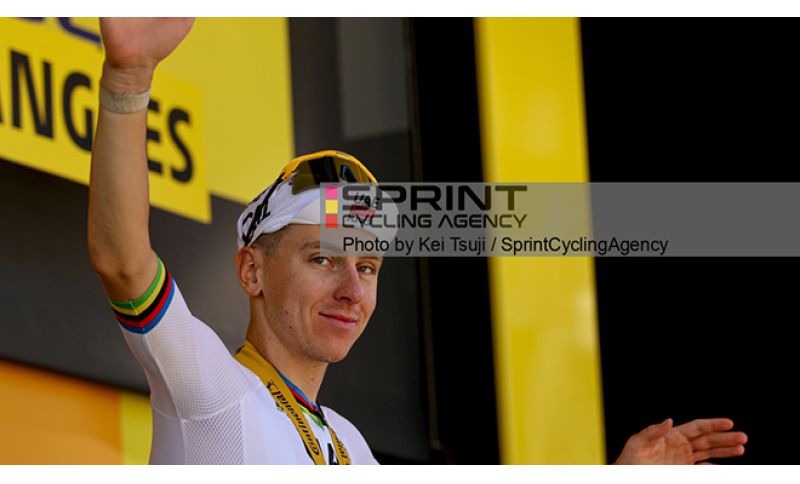
There are numbers that describe. Others that explain. Then there are numbers that, simply, force you to stop. That of Tadej Pogačar belongs to this last category: 19 racing days, 14 victories. Translated into elementary, but brutal terms, it means a conversion percentage equal to 73.7%. Every four times Pogačar pins on the number on his back, almost three times the final result registers his name as the winner. It is a figure that must be handled with precision, because in cycling a general classification victory can be added, on the same day, to a stage victory.
So, we are not saying that Pogačar won 14 different days out of 19, but something perhaps even more significant: in 19 actual days of competition he produced 14 official successes among road races, stages and general classifications. The distinction does not reduce the scope of the phenomenon, it clarifies it. Because it tells of a rider who does not limit himself to winning individual episodes, but transforms entire competitive blocks into platforms of dominance.
In modern cycling, on a calendar of this level, it is difficult to find anything comparable. We are not facing a sequence built on minor appointments or on a protected route. In his season opener there are Strade Bianche, Milan-San Remo, Tour of Flanders, Paris-Roubaix, Liège-Bastogne-Liège, Tour de Romandie, Tour de Suisse and the opening stages of the Tour de France. In other words: monuments, classics, WorldTour stage races, time trials, climbs, nervous finishes, direct confrontations with the world's best riders. The statistic here is not an embellishment of the narrative. It is the heart of the narrative.
Because Pogačar is not simply winning a lot: he is compressing the very concept of performance. In cycling, a sport by definition unstable, exposed to crashes, wind, tactics, team dynamics, bad days, meteorological variables, the cruel bounce of a detail, a percentage above 70% does not belong to competitive normality. It belongs to a rare zone, almost counterintuitive, in which victory no longer appears as the happy exception, but as the statistically most likely outcome.
This is the point that makes the Pogačar phenomenon so stunning. Cycling is the sport in which the strongest can lose most easily. He can be marked, isolated, anticipated, forced to chase, hindered by a puncture, a crash, by an opposing team that sacrifices men and tactics to limit him. Yet, in this season, the impression is that every race starts already traversed by a question: not whether Pogačar can win, but how others can prevent him from doing so.
The figure of 14 successes in 19 days then assumes an almost narrative dimension. It measures not only physical strength, but the density of presence. Pogačar enters a race and immediately modifies the statistical field. Every attack of his alters the odds, every acceleration forces opponents to make a choice, every appearance of his at the front of the group becomes a signal. It is as if the race changes shape when he decides to interpret it. Historical comparison must be cautious, because the eras of cycling are not overlapping.
Eddy Merckx raced much more, within a different calendar, with quantities of days and competitive logic far from current ones. But precisely the comparison with history helps us understand the particularity of the present. Merckx remains the absolute reference for hunger, totality, dominance extended across entire seasons. Pogačar, instead, is expressing something that belongs to contemporary cycling: an extreme concentration of performance within a selective calendar, built on the highest objectives and on an extremely high average quality of opponents.
For this reason his 73.7% should not be read as a simple percentage. It is an indicator of transformation. It says that a modern champion, programmed, scientific, tactically mature and technically complete, can arrive at converting his presence into results with a regularity that seemed incompatible with the very nature of cycling. Statistics meet emotion; because Pogačar does not win giving the impression of managing talent. He wins by still searching. He wins as if every finish line were not the confirmation of dominance, but the occasion to measure his limit once again. He wins classics, he wins stages, he wins general classifications, he wins on gravel, on climbs, in hard races, on days when everyone knows he will try to win and precisely for this reason everyone races against him.
The quantitative data becomes almost poetic: nineteen days, fourteen victories. It is not merely a balance sheet. It is a declaration of statistical superiority. It is the systematic transformation of the start into a threat, of presence into result, of the race into a theater where everyone plays a part, but only one seems able to rewrite the ending. Saying "never seen anything like it" is a strong expression, and precisely for this reason it must be used with rigor. The most correct form is perhaps this: in modern cycling, on a sample of races of this level, it is very difficult to find anything comparable. Because Pogačar is not simply adding victories to his palmares. He is producing a statistic that forces cycling to question itself.
There are champions who win. There are champions who dominate. And then, rarely, there are champions who change the scale with which we measure dominance. Today Tadej Pogačar is exactly this: not only the most winning rider of the moment, but a statistical event that races on two wheels.

 10
10


 10
10


 7
7
2
2
5
5
3
3
7
7
2
2
5
5
3
3

 Ritratti
 Oscar
Oscar Albi d'Oro

