















There is a conventional way of telling the story of the Tour de France. You start with the favorites, the anticipated duels, the mountains, the time trials, the teams, the strategies. You talk about Pogačar, about Vingegaard, about the general classification contenders, the sprinters, the team leaders and the domestiques. It is the necessary narrative, the one of the road. But there is another, deeper and perhaps more striking one: the Tour as a statistical measure of the impossible.
Because the Tour is not merely a race, it is the endpoint of an almost ferocious selection, a pyramid that starts from millions of people and arrives at a few hundred names. Every rider who takes the start represents not only himself, his own team, his own nation. He represents an infinitesimal probability that has become flesh, effort, talent, discipline. He represents everything that world cycling has filtered before granting him a race number.
Let us assume a conservative baseline: approximately forty million road cycling practitioners worldwide. Within this figure lies the indistinct ocean of the bicycle: those who race, those who train, those who dream, those who compete in youth categories, those who live cycling as an absolute passion, those who every morning measure their body against a climb, a headwind, a distance. It is from this immense mass that the summit is born. At the threshold of the Continental level, understood as the broadened base of international professionalism, approximately 4,500 athletes arrive. Translated into statistics, this means 0.011% of the total: one for every 8,900 practitioners. It already seems very little.
But the number alone is not enough. You have to see it. Imagine San Siro full. Not with fans, but with cyclists. Seventy-five thousand people with the same passion, the same dream, the same accumulated fatigue in their legs. In that packed stadium, only eight or nine would reach the threshold of international professionalism. Not a complete team. Not a peloton. Barely more than a small breakaway group, while everyone else would remain outside the first great gate. Then comes the WorldTour. The highest level of the ordinary pyramid. About five hundred riders in the world. Here the selection becomes almost brutal: 0.00125% of the estimated base. One athlete for every 80,000 practitioners. It means that an entire San Siro would not even be enough to statistically produce a single WorldTour rider. We would look at those packed stands, that human sea of bicycles and ambitions, and we would have to accept that perhaps, within it, there would not yet be a single athlete destined for the top world circuit. But the Tour de France narrows the gate even further. In 2026, there are 184 riders at the start, distributed across 23 teams, compared to forty million practitioners, meaning 0.00046%. One for every 217,000. Here statistics cease to be a table and become vertigo.
Fill San Siro once. Then a second time. Then a third time. Three Meazza stadiums full of cyclists alone. Over 227,000 people. In that immense crowd, only one would have the statistical possibility of taking the start at the Tour de France. One alone. Not a row, not a section, not a curve: a single person, lost in three packed stadiums. And if we want an even more contemporary metaphor, even more physical, think of the oceanic crowd at Ultimo's concert in Rome, that mass of approximately 250,000 spectators gathered for an event capable of transforming itself into a collective image. If each of them were a road cyclist, the Tour would statistically choose only one. One among an entire people. One among faces, dreams, kilometers, training sessions, falls, sacrifices, seasons consumed waiting for a call that for almost everyone will never come.
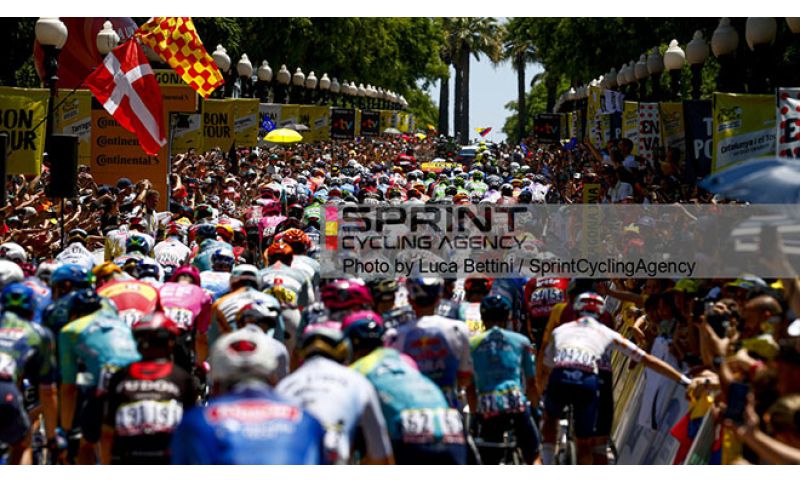
This is why the Tour makes an impression even before it begins. Not only because of the Alps, the Pyrenees, the echelons, the time trials, the media pressure, the weight of the yellow jersey. It makes an impression because every starter is already a survivor of the selection. Before the race eliminates, the world has already eliminated. Before the road decides, the pyramid has already narrowed the field to near invisibility. We see the group and think: there are many. In reality, there are very few. Those 184 riders are what remains after millions of practitioners have stayed below the professionalism line, after thousands of high-level athletes have not reached the WorldTour, after hundreds of professionals were not selected for the Tour. The peloton of the Grande Boucle is not a mass: it is the luminous residue of an extreme selection.
Statistics do not cool emotion: they multiply it. They tell us that every race number is an improbable story. That every rider at the start is a rare combination of genetics, discipline, opportunity, mental resilience, family context, team, calendar, health, avoided or overcome crashes. They tell us that even the most silent domestique of the Tour belongs to an almost unreal minority. That whoever pulls in the flats for a hundred kilometers, whoever carries water bottles, whoever sacrifices himself without ever winning a stage, is nonetheless already within a statistical elite that borders on the implausible.
This is why the Grande Boucle should not be told only as the challenge between the strongest. It should be told as the place where the impossible becomes ordinary for three weeks. Every morning, when the group sets off again, it is not simply a stage that departs: a minuscule fraction of all world cycling departs. One out of 217,000 departs. The dream that survived mathematics departs. The Tour de France is this: a road, certainly. A race, naturally. But above all, a very narrow fissure in sporting history. To cross it, it is not enough to be strong. You must have arrived there after the entire world of cycling has completed its selection. And so every time we see the group flowing compactly along the roads of France, we should remember one thing: those riders are not merely the protagonists of the race. They are the exception within the exception. They are the one who remains when three full San Siro stadiums disappear from the scene.

 6
6


 6
6


 9
9
1
1
1
1
4
4
2
2
9
9
1
1
1
1
4
4
2
2

 Ritratti
 Oscar
Oscar Albi d'Oro

