

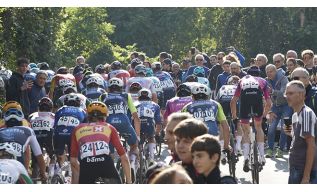















The Tour de France 2026 will not be merely the new chapter in the rivalry between Tadej Pogačar and Jonas Vingegaard. That would be a correct reading, but an incomplete one. The upcoming Grande Boucle should be observed as a statistical laboratory for extreme selection: a race designed to measure not only the peak power of champions, but their ability to remain competitive within a progressive process of depletion. The route's numbers are already a technical statement. The Tour will depart from Barcelona on July 4th and arrive in Paris on July 26th, with 21 stages, 7 flat, 4 hilly, 8 mountain stages, 5 summit finishes, one team time trial and one individual time trial. The total elevation gain indicated by the organizers is 54,450 meters; the individual time trial will be only 26 kilometers, while the opening team time trial will measure 19.6 kilometers.
The first formula to understand this Tour is simple: Altimetric Density = Total Elevation / Total Distance. Over a total distance of 3,325 kilometers, this results in an altimetric density of 54,450 / 3,325 = 16.38 meters per kilometer. This is the data that shifts the narrative: the 2026 Tour is not merely mountainous, it is certainly "dense." The climbing does not appear as a spectacular episode, but as a permanent competitive environment. International technical analyses have grasped this trait: the route ranks among the most mountainous of the recent period, while the individual time trial carries limited weight. In sporting terms, this means the race reduces the space for pure specialization and increases that of cumulative endurance. The time trial may have an impact, but it will hardly be able to compensate for a structural decline in the mountains. To synthesize the profile, one can use an editorial indicator: the Extreme Selection Index. The formula is: ESI = AD × MP × (1 – ITT), where AD is the altimetric density, MP the weight of mountain stages on the total, and ITT the incidence of the individual time trial on overall kilometers. Applying the 2026 Tour data, AD = 16.38; MP = 8/21 = 0.381; ITT = 26/3,325 = 0.0078. The result is an ESI ≈ 6.19. It is not an official indicator, but it helps to read the nature of the race: the higher the value grows, the more the route selects through climbing, fatigue and recovery.
The quality of the starting field also confirms the statistical centrality of the Tour. The Startlist Quality Score, calculated by assigning points to riders based on their ranking position at the start, assigns the 2026 Tour a provisional value of 1,527 points. The general formula is SLQ = Σ wi, where wi is the score assigned to each rider based on their ranking bracket: 50 points for a top 10, 35 for a top 25, 20 for a top 50, 10 for a top 100, and so on. The Tour thus remains the race in which route difficulty and maximum concentration of talent tend to overlap. The final double ascent of Alpe d'Huez will be the point of maximum tension. The twentieth stage, with Croix de Fer, Télégraphe, Galibier and Sarenne before the final climb, appears as a test of survival after nearly three weeks of racing. Here the Pogačar-Vingegaard rivalry returns to center stage, but within a broader framework: it will not be enough to attack better; one must decline less.
In the Grand Tours, the winning rider is not always the one who produces the highest peak, but the one who maintains an elevated level of maximum performance for longer. The formula we propose is therefore: Performance Resilience = Week 3 Performance / Week 1 Performance. In this quantitative context, the 2026 Tour becomes a true laboratory. The yellow jersey will not be awarded solely by talent, but by the curve of endurance: the first week will say who can win, the second who can still resist, the third who has truly remained themselves. For this reason, the strongest narrative key is not "Pogačar versus Vingegaard," but "Pogačar, Vingegaard and the others within the algorithm of fatigue." The route is the true third protagonist: it distributes loads, multiplies variables, progressively reduces excuses. The 2026 Tour de France will not simply select the strongest. It will select the most resilient among the explosive.

 5
5


 5
5


 1
1
1
1
2
2
2
2
1
1
1
1
2
2
2
2

 Ritratti
 Oscar
Oscar Albi d'Oro

