


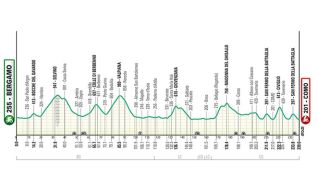



















We're in Milan, it's Sunday, May 24th, 35 degrees in the shade. At first, it seemed like one of many breakaways. In the team bus, there was race radio in the background, gaps rising and falling, someone watching the monitor without saying much, someone trying almost not to get their hopes up.
In professional cycling it happens often: there are breakaways that are born already with an expiration date and others that, slowly, change the atmosphere. The one from last Sunday, in the Voghera-Milan stage, belonged to the second category. Because at a certain point something happens. Something almost imperceptible, but those who follow cycling closely recognize it immediately: the breakaway stops being a hope and starts to appear as a concrete possibility.
And that's when everything changes. Outside you continue to see the same things: regular pace changes, the gap, the chasing group, the kilometers ticking by. But inside your head, the way you read what's happening changes completely. And this, probably, is one of the most fascinating things about cycling.
Research in the world of neuroscience and behavioral sciences has discovered something very interesting on this subject: the human brain doesn't react to results in absolute terms, but reacts in relative terms. In other words, based on the possibility of results and the point of comparison we have in mind. It seems like a subtle distinction, but in reality it changes everything.
Because as long as a victory remains distant, even improbable, then the mind manages it in one way. But when that possibility suddenly starts to seem concrete, then tension increases and the emotional weight of every kilometer increases: the mind begins to seriously consider the possibility of victory, and therefore modifies the way it interprets what's happening and the results it achieves.
In short, while the body continues to do its work, the head begins to move forward in time. It simulates finishes, worries, anticipates scenarios (both negative and positive: it's up to us to direct our thoughts in the way we find most useful): "What if it actually happened today?".
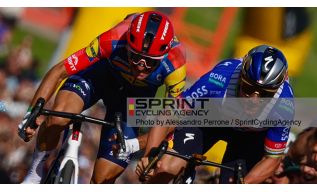
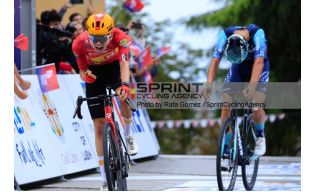
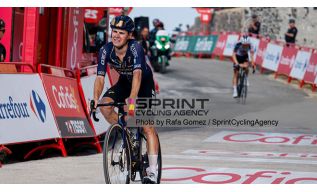
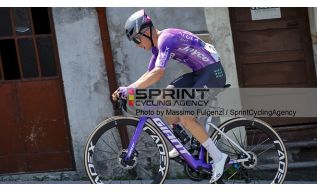
An example? Mirco Maestri's tears at the end of the stage, finishing second by just half a wheel after an incredible breakaway, alongside Fredrik Dversnes, Martin Marcellusi and Mattia Bais. Those tears weren't really about the second place (which in itself is an excellent result, following an objectively extraordinary performance from start to finish, over the course of 157km), but rather about the weight of the "almost", that is, the invisible cost of a possibility that, for a few kilometers, had truly started to seem real and within reach.
And it's precisely in these situations that, both in cycling and in life, our mind can put a spoke in our wheel and sabotage us, rather than play to our advantage.
Our mind tends to leave open especially the opportunities we've missed. Those that could have become something, but didn't materialize. Those that we unconsciously continue to rewrite in our head even hours later, even when we lie down in bed at night and – despite our eyes having been closed for a while – continue to pass before us, like a film that repeats endlessly.
And then the questions begin: "What if I had waited? What if I had anticipated? What if...? What if...? What if...?"
Technically, this cognitive mechanism is called counterfactual thinking, and it's that tendency of our mind to continuously construct alternative versions of reality, even when a certain result already belongs to the past.
And it's probably one of the reasons why some "almosts" manage to wear us down much more than many clear and immediate defeats.
But there's another aspect that's perhaps even more interesting: very often we believe we're suffering because of objective reality (a second place, a mistake, an oversight), but the truth is that we suffer mainly because of the way we interpret that reality, compare it with our expectations and assign it a meaning. As we said: it's never a judgment in absolute terms, but always and only in relative terms.
Think, for example, of how many times a failed interview, a negotiation that fell through at the last moment, or a relationship that ended has made us suffer not so much because of the fact itself, but especially because of everything that, in our head, "could have been". Because the human brain doesn't just register what happens, but constantly continues to compare reality with expectations, with imagined alternatives and with missed opportunities.
After all, perhaps training the mind also means this: learning not to automatically believe everything we think in moments of pressure, fear or fatigue. Because the human brain, especially when it's tired or emotionally involved (just like at the end of 157 km under the scorching sun, or after a long and stressful day of work in the office), doesn't just describe reality, but alters it. Literally, and constantly.
And understanding this difference, in every area of your life, changes greatly the way we face our climbs, our falls and our second places. Because the truth is that when you manage to change the way you look at things, the things you're looking at change.
We should remember this, after all: it's always and only the interpretation we choose to give to what happens to us that truly determines the impact it can have on us. It's one of the most powerful cognitive illusions we experience every day, inside and outside of sport (I've also discussed this in a recent article published on my Substack channel: The 5 Lies Your Brain Tells You Every Day).
Because – especially in the most delicate moments: when the mind tells us to give up, when obstacles seem insurmountable, when the race becomes harder than expected - what happens TO us doesn't necessarily have to correspond to what happens IN us.
And it's precisely from here that we can (indeed, must) start again: from the way we arbitrarily choose to observe and judge our results, our performances, our races and in general our days. Because a second place can be a failure from which we can't recover or an incredible achievement, capable of teaching us valuable lessons to start again even better and even stronger. It's a matter of perspective, a matter of choices.
Perhaps that's also why cycling continues to have something profoundly different compared to many other sports. Because within certain images, like that of Maestri at the end of the stage (which went viral on social media), we don't just see a race, but we see first and foremost human beings with whom to empathize, who are trying to manage expectations, pressure, fatigue and hope while everything around them continues to ask them to keep going, without respite.
And so, perhaps, those tears at the finish line weren't simply telling us about a second place (which, as we've seen, can be interpreted in different ways, very different from each other), but were telling us an even more important lesson: from a purely neuroscientific point of view, it's never objective reality that determines how we feel, but always and only the interpretation we have of reality that truly makes the difference.
FOR FURTHER READING
The Giro d'Italia tells us much more than just a cycling race. It tells us the way we think, choose, react to pressure and manage fatigue when the road gets harder. These themes are also at the center of Accendi la mente (Bompiani), the book written by Michele Grotto together with Ivan Basso, two-time winner of the Giro d'Italia. A journey through neuroscience, human behavior, performance and great lessons born inside and outside professional cycling.
2 - to be continued
Michele Grotto is an architect of choices and behavioral strategist. He works with behavioral sciences applied to decision-making processes and improvement of human performance. He founded BrainHacking® and is co-author, together with Ivan Basso, of the book "Accendi la mente" (Bompiani).



 4
4
 4
5
5
6
6
4
4
4
5
5
6
6
4
4

 Ritratti
 Oscar
Oscar Albi d'Oro


Se sei giá nostro utente esegui il login altrimenti registrati.