















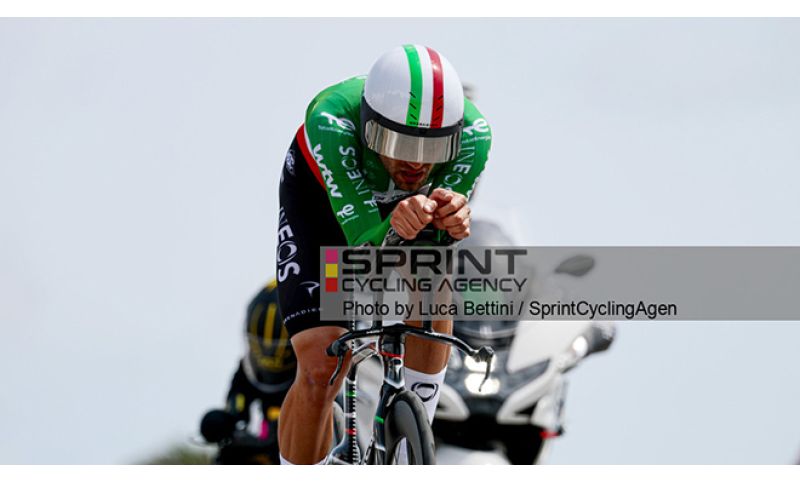
There are days when cycling ceases to be merely a race and becomes an almost perfect measurement of human limits. The tenth stage of the 2026 Giro d’Italia, the individual time trial of 42 kilometers from Viareggio to Massa, belongs to this rare category. Filippo Ganna did not simply win: he transformed a race against time into a demonstration of controlled power, applied aerodynamics, and intelligent effort. Forty-two kilometers covered in 45’53”, at an average speed of 54.921 km/h, is not a number to read quickly. It is a technical statement, almost a formula written on the asphalt.
The most important data point is precisely the distance. Very high averages in short time trials can be the result of explosiveness, freshness, and the prologue effect. Here, instead, the test had depth. There were no climbs, but there was sufficient length to separate pure power from the ability to maintain it. In a 42-kilometer time trial, the body cannot lie: the position must remain efficient, the pedaling continuous, the pace sustainable, the mind sharp. Ganna won because he knew how to hold all these elements together, bringing speed into a dimension of duration. The margin over his rivals confirms the exceptional nature of the performance.
Thymen Arensman, his teammate and the best among the general classification contenders, finished 1’54” back; Rémi Cavagna, a recognized specialist in the discipline, 1’59” back. Translated into statistical terms, Ganna gained approximately 2.7 seconds per kilometer over Arensman and nearly 2.8 over Cavagna. In a long and steady test, a differential of this magnitude is not coincidental: it measures structural superiority. It is not the gap from a corner taken better or a favorable wind phase; it is the result of a superior performance across the entire course. Ganna’s victory at Massa is also another step in the historical construction of his profile. It is his seventh individual time trial victory at the Giro d’Italia, the same number as Eddy Merckx. Only Francesco Moser remains ahead, with twelve time trial victories in the Corsa Rosa. The comparison should not be understood as a simple ranking, but as a placement in a genealogy: Moser, Merckx, Ganna. Three different ways of interpreting strength, three different eras of the bicycle, three forms of dominance over the cruelest variable in cycling: time.
Even more impressive is the relationship between average speed and distance. At 54.921 km/h, Ganna’s is the fifth fastest individual time trial in Giro history. But the absolute figure must be corrected with context: the fastest performances are often achieved on very short courses, where the average speed is amplified by the reduced duration of effort. Here, instead, we are beyond 40 kilometers. And precisely on this threshold, the Massa test assumes historical value: it is the fastest individual time trial ever contested in a Grand Tour over a distance exceeding 40 kilometers, surpassing the reference of the Nantes time trial at the 2003 Tour de France, won by David Millar at 54.351 km/h over 49 kilometers.
The technical figure thus becomes a narrative figure. Ganna does not enter history with a flash, but with a continuous line. Not with an acceleration, but with a duration at the highest intensity. His presence in six of the ten fastest time trials in Giro history confirms that we are not facing an isolated episode. Palermo 2020, Turin 2021, Milan 2020, Milan 2021, Desenzano del Garda 2024, Massa 2026: his name recurs like a statistical constant, as if the modernity of the Italian time trial had found in him its reference parameter.
Yet the stage speaks not only of Ganna. It also speaks of the general classification, and here the most surprising data point is Afonso Eulalio. The Pink Jersey remains on his shoulders with a 27” advantage over Jonas Vingegaard and 1’57” over Arensman. It was not the most expected profile to resist in such a selective time trial, but he defended his lead with a more solid performance than predicted. His race shows that the symbol can become performance: sometimes the jersey does not weigh, it pushes. Leadership, when it does not crush, can generate additional energy.
Vingegaard, for his part, does not claim the Pink Jersey but emerges from the day in a favorable position. His 23rd time is not dominant, but it is functional. He loses 1’06” to Arensman, but gains 1’22” on Felix Gall, who in the mountains appeared to be one of the most threatening references. His time trial is therefore a selective loss, not a setback: he falls back against one rival, consolidates against another, remains less than half a minute from the top. In tactical terms, he is still in the exact position where a favorite can wait without fully exposing himself.
Arensman deserves specific analysis. Second on the stage, first among the general classification contenders, he confirms a dual nature: a high-level time trialist and a rider capable of adding depth to the general classification. Netcompany Ineos thus signs an almost perfect day: Ganna dominates the scene, Arensman moves the classification. The team not only achieves a prestigious victory, but consolidates two strategic lines in the same afternoon. May 19, 2026, will remain above all the day when Filippo Ganna gave speed a geometric form. A long, flat time trial, apparently simple, but in reality ruthless in its essentiality: no place to hide, no climb to change the narrative, no tactical alibi. Only road, wind, position, watts, breath. And a man capable of traversing all of this at nearly 55 kilometers per hour, transforming the statistical data into emotion and emotion into history.

 10
10


 10
10


 3
3
1
1
1
1
2
2
2
2
3
3
1
1
1
1
2
2
2
2

 Ritratti
 Oscar
Oscar Albi d'Oro

