















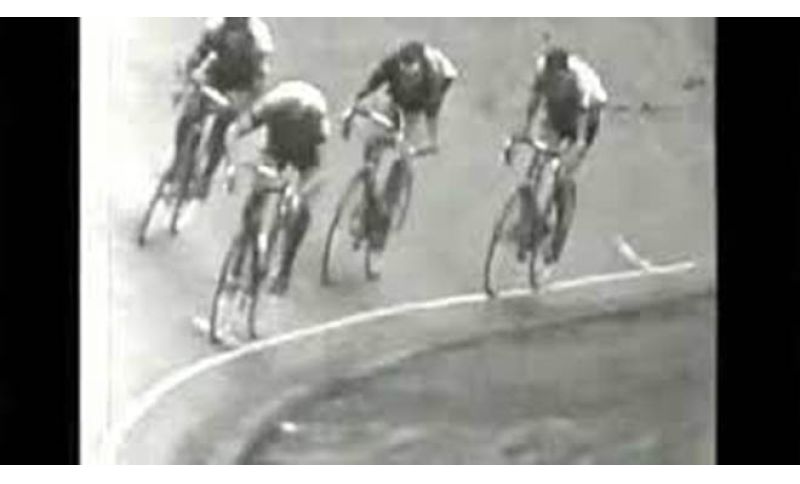
Once upon a time there was the Rocourt velodrome, on the outskirts of Liège. A concrete bowl battered by wind, where cycling ended and began again every spring, when the Liège-Bastogne-Liège returned to tell its ancient story. Today it no longer exists: demolished in 1973, it took away a piece of memory, along with the stadium that also hosted the Royal Football Club of Liège. But those who were there, who lived through those years, swear that in that velodrome you could feel the heartbeat of the "Doyenne".
It was there that epic days concluded, under the rain and low skies of the Ardennes. It was there that exhausted men arrived after more than seven hours of racing, covered in mud and fatigue, after crossing roads that cut through forests and mines, short climbs but sharp as blades. Liège has never been a race for the faint of heart: it doesn't have the cobblestones of Flanders, but it has the Redoute, a terrible wall that begins to make selections a hundred kilometers from the finish. And then it doesn't let you go: relentless climbs, one after another, until Ans, up there, where the finish line waits like a stern judge. Since 2019 it returns to Liège, and with the return to the most famous city in Wallonia, which also gave birth to Inspector Maigret, the passage over the Saint-Nicolas climb, known as the hill of the Italians, was also lost.
Yet, for many years, the finish line was Rocourt. And it was there that on May 2, 1965, one of the most intense pages in Italian cycling history was written. It was raining, it was cold, and the group had crumbled along the roads. At the front, among crashes and resistance, only a few remained. Among them, a 22-year-old boy, son of emigrants: Carmine Preziosi.
Son of miners, like so many Italians who arrived in Belgium after the war, Carmine was not just a cyclist. He was one of them. People who descended into galleries at dawn and emerged at sunset, with dust in their lungs and fatigue in their bones. People who had left Italy out of hunger, chasing a better future in the coal mines of the Ardennes.
On the road from Bastogne to Liège that day, they were there too. The "blackened faces", as they were called: workers covered in coal, invisible men who lived on the margins. Between Mons, Charleroi, Namur and Liège, Italian was the most widely spoken language in bars, homes, and construction sites. Southern dialects, preserved like a treasure, so as not to lose their roots, which together with the vegetable gardens planted between one house and another, told of a distant Italy, where the sun always shone.
Their story was hard. The Italian-Belgian protocol of 1946 had brought thousands of Italians to Belgium: in exchange for coal, young arms to send into the mines. Rigid contracts, low wages, almost non-existent safety. And tragedies, like the one at Marcinelle, on August 8, 1956: 262 dead, 136 Italians. An entire community marked forever.
In that context, the Liège-Bastogne-Liège became something more than a race. It was a symbol. An opportunity for redemption. Emigrants came to the roads to watch the cyclists pass, hoping that one of them, an Italian, could win. Because that victory would have been theirs too.
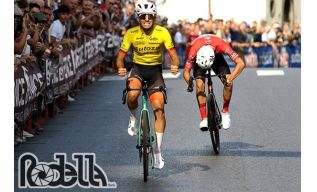
And when Preziosi entered the Rocourt velodrome that day in 1965, he was not alone. With him came an entire people. In the sprint he beat Vittorio Adorni, who would soon win the Giro d'Italia. But that day, in Belgium, Carmine won. And with him, the Italian miners won.
It was more than a sporting success. It was a social vindication. It is said that, spurred on by that achievement, many managed to obtain better working conditions. As if that victory had restored dignity to those who had lost it descending underground.
Liège, for this reason, has always been an Italian race too. After Belgium, it is Italy that has won the most: eleven victories. From Silvano Contini to Moreno Argentin, dominant in the Eighties, from Michele Bartoli to Paolo Bettini, to Rebellin and Di Luca. 2002 remains the pinnacle: Bettini ahead of Garzelli, with Basso third. An all-Italian podium, unique in history.
And then there are the places. Like the hill of the Italians at Saint-Nicolas, just before the modern finish line at Ans. There, every year, a community gathers. Tricolor flags, chants, familiar accents. It was a piece of Italy transplanted to Belgium, where time seemed to have stopped.
Because the Doyenne is not just cycling. It is memory. It is fatigue. It is rain that falls incessantly on roads that seem never to end. It is the story of men who pedal and others who work in the shadows, united by a common destiny.
The Rocourt velodrome is no more. In its place, silence. But those who know this story know that there, among those vanished curves, life passed through. And that every time the Liège-Bastogne-Liège returns to the roads of the Ardennes, something of that past always returns.
It is the sound of a crowd, it is the breath of a cyclist. It is the dream of a miner who, for one day, saw one of his own become the strongest of all.

 1
1


 1
1



 Ritratti
 Oscar
Oscar Albi d'Oro

