

















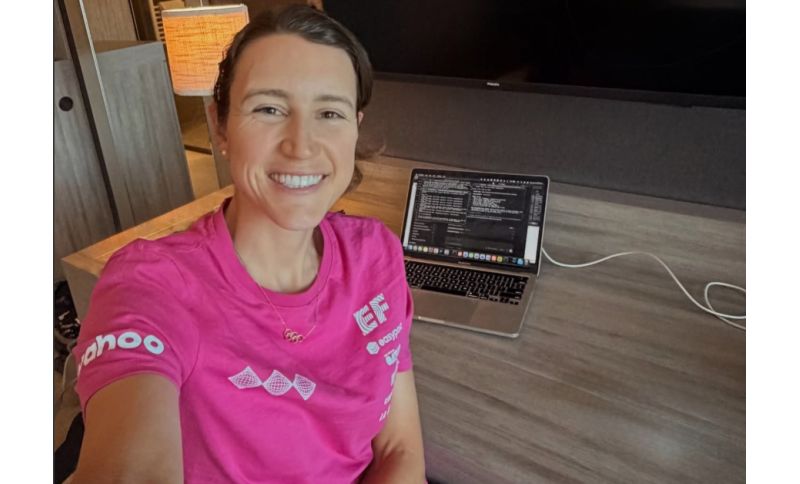
We had already told you that she was an atypical champion with multiple talents when at Paris 2024 she became Olympic champion by winning the road race, but Kristen Faulkner is giving us yet another proof today.
On her LinkedIn profile, the American from EF Education-Oatly revealed that she is conducting research on herself for the benefit of all female athletes. "The answers I was looking for about my body didn't exist. Not because they weren't important, but because too little research has been conducted on women, especially on women like me: endurance athletes trying to understand how performance, health, and recovery integrate with each other. Only 6% of sports science studies are conducted exclusively on women. So this winter, I stopped waiting for someone else to do this research. I started building it myself - she announced publicly on her social media. - Over the last two months, I've programmed every time I wasn't training. Often more than 10 hours a day, trying to build something I wished existed for me years ago. Women deserve better tools and better research. If we want change, we have to be willing to build it. So I stopped talking and started building. I'm still working on a closed group. My hope is that what I'm creating can one day help other women feel less in the dark about their bodies and more informed and confident in the decisions they make. I'll share most of the updates on LinkedIn as I continue to work. Follow me there if you want to see how it turns out".
Originally from Alaska and a Harvard student, after her experiences in finance and computer engineering, Faulkner decided to leverage artificial intelligence for her most recent passion: "During the winter I spent in San Francisco I witnessed the AI boom up close. For nine years I've collected biometric data that I struggled to synthesize: heart rate, HRV (heart rate variability), sleep, weight, power, temperature, training load, menstrual cycle phases, blood tests, DEXA scans (which measure bone mineral density). Every app gave me a piece of the story, but the answer was never contained in just one app. It was in how everything interacted. So I built a system that collects the data sources I actually use as an athlete and runs them with 4,400 hours of my training history. It doesn't just show me dashboards. It builds personal models of my physiology. Every discovery is specific to my history. And every result is actionable, not just interesting. I used this method to prepare for the Pan American Championships, where this year I won 3 gold medals. Today I produced my best 20-minute power output ever thanks to the help of training from this app. AI will change research on female performance from the bottom up, and I want to be part of it. I studied computer science at Harvard. I worked in venture capital. I actively invest in AI companies. I race in the Women's WorldTour. I'm training to defend my Olympic gold at home in Los Angeles 2028. I applied all that knowledge to build all of this. I came to cycling late. I didn't win because I had more experience. I won because I used my brain as much as possible. Before my first European race, I analyzed other riders, studied every corner of every course, and evaluated my data rigorously. I'm doing the same thing now, with artificial intelligence".



 1
1
 1
4
4
2
2
1
4
4
2
2

 Ritratti
 Oscar
Oscar Albi d'Oro


Se sei giá nostro utente esegui il login altrimenti registrati.