














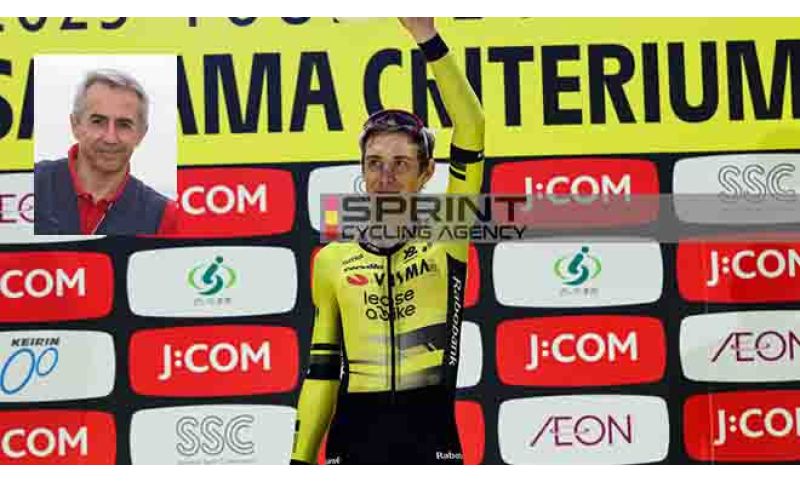
Vinge has already won the prologue of the 2026 Giro. Simply by deciding to come here. He will arrive in Bulgaria wearing the pink jersey. Then, as the race unfolds, he will try to earn the final one in Rome as well. In the meantime, from now until May, he deserves only applause as a leader. But not so much because he saves our race from anonymity, though yes, but because he demonstrates a virtue unfortunately increasingly rare in a world that calculates everything in bank transfers: wisdom.
To whoever will certainly already be posting vitriolic comments to explain to me that Vinge also comes to Italy for money, who knows how much Cairo gave him (yes, notoriously someone with deep pockets, sure), to this "whoever" I say stop right now: sure Vinge likes money, why not, sure he also knows how to make good contracts, but certainly he doesn't need to come to the Giro to generate revenue. So, let's definitively set aside economic calculations and talk—if possible, for once—about reasoning and intelligence.
Let's free ourselves once and for all from toxic conspiracy theories and shadowy speculation, always seeking a truth truer than simple truth. It's actually good for your health. Much more logical, much more straightforward, is truly the path of wisdom. Vinge knows that by winning the Giro he surpasses even Pogacar, putting together all the greatest stage races, a collection reserved for very few collectors with the most noble lineage. Furthermore, by winning the Giro, Vinge immediately puts the 2026 balance sheet in the black, because no matter what can be said about the Giro d'Italia, winning the Giro d'Italia remains a goal that is worth an entire season. Someone says: but what if he then loses the Tour... If he then loses the Tour, it will always be less serious than losing the Tour by racing only the Tour. I believe wisdom has taught him how concentrating everything on the three French weeks is too great a risk, with Pogacar around, but ultimately it's also a danger to one's peace of mind and balance, and consequently to one's efficiency, because there's nothing like competing with excessive pressure to complicate your life. Winning the Giro without exhausting himself (the course is fair), then going to the Tour with a lighter spirit, more serene, with a clear conscience, and the freedom to challenge Teddy without obsessions, with ease: this is the right objective. Then we know that without psychological baggage, performance improves. The first to uphold this idea is Pogacar himself, who recently demonstrated the feasibility of the plan, after years and years of telling us that Giro and Tour together were no longer possible. Of course, you can't say that Teddy at the Giro did the bare minimum, that he saved himself with the Tour in mind, but Teddy is Teddy, his best way to live peacefully is to dominate every day, real stress assails him when he loses.
Then there are the optional extras and accessories in this Giro operation. First among all, establishing a sympathetic connection in the Italian market, where so far Vinge hasn't sown much, he has always appeared and felt as foreign, distant, unknown, except for a few glimpses at Tirreno-Adriatico. The Italian public is competent, much more so than the French public who mostly go to the Tour like they go to a water park, to party, to enjoy the summer; the Italian public recognizes talent and is immediately ready to applaud it, even if perhaps it's not at the top of their fan preferences. I'm absolutely sure that even Pogacar's devoted followers will be ready to recognize Vingegaard's strength, if Vingegaard knows how to give himself and open up on Italian roads. It happened with Dumoulin and Froome, it happened even with Yates last year, it will happen this time too. To be loved and respected, Vinge will only need to love and respect the Giro. And in the end the operation will close with a big profit and an excellent dividend, if he wins.
And if he doesn't win? This is the only real, concrete risk. Coming to the Giro as the second force in world cycling, Vinge knows he's putting himself in a position of obligation. He can only win. The excuse will be worth little, in case of defeat, that he raced the Giro only to train. Defeats remain, no ifs or buts. So losing the Giro will significantly damage his credibility, with reasoning like "if he loses at the Giro to XY, how can he think of beating Pogacar at the Tour". And so on with the gossip. Better not to relax, better to impose one's stature, as at the last Vuelta, and nip complaints in the bud. And this is ultimately the best guarantee for us: no matter how you tell it, a champion doesn't come to the Giro to train. He can win without damning himself, without exaggerating like Teddy, but he wins. And if he loses, then other wisdom is needed: to accept himself. Without excuses.
from tuttoBICI February issue

 39
39


 39
39


 8
8
10
10
8
8
10
10

 Ritratti
 Oscar
Oscar Albi d'Oro

