The Giro di Campania is made this way. This Sunday it will return to the professional calendar after twenty-five years and, when the race leaves the Royal Palace of Caserta to begin its journey towards Naples, it will not carry with it only bicycles and riders. It will carry more than a century of stories.
The first dates back to 1911. Then came the great names, the transformations of the race, the roads that became the stage for feats and defeats. Learco Guerra, the record holder for three consecutive victories. Bartali. Coppi. Bitossi. De Vlaeminck. Saronni. Moser. And men who perhaps never won, but who within this race found a day capable of lasting forever. This is the difference between a race and a story. The race ends. The story does not.
Coppi, when Agerola became legend
On April 3, 1955, Fausto Coppi climbed towards Agerola and decided that the group would have to do without him that day. He accelerated. Magni, Astrua, Minardi and Coletto fell behind. The Campionissimo continued alone, transforming fourteen kilometers of climbing into an enormous distance between himself and the others. At the finish line, his advantage over the first pursuers would have been 4 minutes and 46 seconds.
Agerola did not have the impossible gradients of the mountains that would become famous many years later. But it had something that no percentage can measure: the possibility of becoming legend. Coppi gave it to her. From that day on, that climb is no longer just a climb. It is the exact point where a Campanian road entered the mythology of cycling.
This Sunday the riders will pass through it again. Fourteen kilometers at 6 percent, the summit 49 kilometers from the finish and that monument that remembers the man who in 1955 made solitude a form of dominion. While the year before the heron of Castellania in the rainbow jersey had won it with a sprint among the select few, sending thousands of people who had rushed to acclaim him on the Albricci track into raptures.
But the memory of the Campania does not belong only to those who raised their arms. Sometimes it belongs especially to those who remained breathless while chasing their own day.
Gigi Mele and that dream that seemed already written
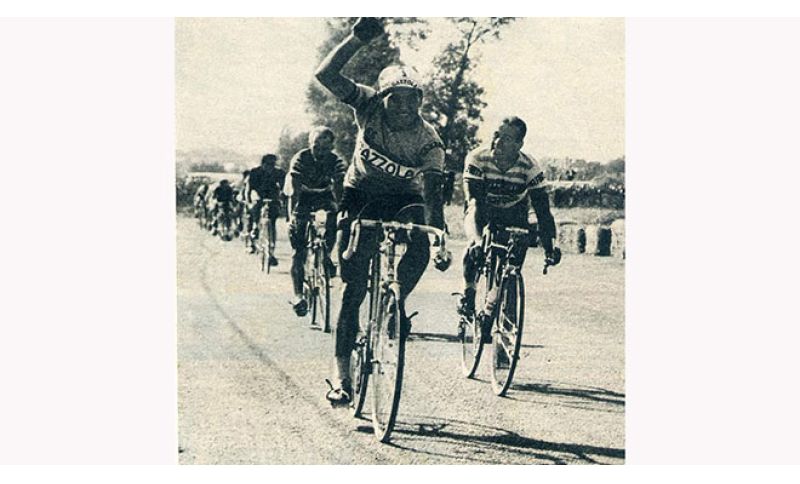
In 1963 Gigi Mele set out for the Giro della Campania in Gazzola colors with something that can be heavier than any bicycle: the expectation of an entire town. In Calvi Risorta, a small town in the province of Caserta from which he had left as a boy with his family towards Turin to seek his fortune, they had organized a bus to follow him. Along the race he found people shouting his name. For someone who had always put glory before money, that was fuel.
The night before he had even dreamed of his race. A long breakaway. The attack. The dream that faded just a few kilometers from the finish. Upon waking he did not remember the reason. Then the Campania truly began. Mele found himself ahead, even won with arms raised the intermediate sprint at Caivano and went beyond. He overcame fatigue, held on the slopes of Dentecane, tackled the Chiunzi cresting 25 seconds ahead of Adriano Durante and arrived at Agerola. Coppi's mountain became his mountain too. That day he pedaled with a lightness that seemed almost unreal to him. He managed to attach himself to Pierino Baffi and Durante, the Legnano standard-bearer. For a few kilometers he even thought he could beat them.
The dream was there. Within reach. Then Castellammare arrived. A puncture on the front wheel. The team car had fallen behind. And so an ordinary man, a spectator, did something that perhaps tells better than a hundred victories what cycling is: he took the wheel from his own bicycle and handed it to him. Mele set off again. He chased. He fought. But the dream of the night, the one he had forgotten upon waking, had found its answer. He finished tenth, without disputing the sprint for fourth place which went to the great Ercole Baldini. And he returned home a hero. Because in cycling the result does not always coincide with the value of a day.
And that day Nencini remembered he was the lion
Then there is Gastone Nencini. The Lion of Mugello. A Giro d'Italia and a Tour de France in his palmares, legs that had known glory and, as happens to all champions, the years that slowly began to present the bill. One day, during the Giro di Campania, Nencini found himself dropped with about thirty riders. The race was now far away. Fatigue had taken the enthusiasm from the group and Gastone too was chewing bitterness. For men accustomed to winning, the hardest part is not always the climb. Sometimes it is accepting that you are no longer at the front. It was then that an insult came from the roadside. They were passing at the height of Marcianise.
"Nencì, you're a washout". A small word, spoken by someone who probably would never have known what it meant to be on a bicycle for hundreds of kilometers, with your body emptied and your head continuing to order your legs to go. Nencini heard it. And he did not forget it. Slowly he moved towards the edge of the road, reached the man and grabbed him by the collar.
"I'll show you who the washout is". What followed was one of the many incredible episodes that cycling of those years carried with it: Nencini, furious, forced the provocateur to reckon with the anger of a champion wounded in pride. The other dropped riders, companions in suffering, had to intervene to stop him. Today that episode belongs to another era and another way of living sport. But within that scene there is something that still matters.
A rider can lose a race. That does not mean he stops being a rider. And above all he does not stop knowing how much it cost him to get there. Cycling has a merciless memory with winners and often unjust with men. The Campania, on the other hand, seems to have preserved them all.
Maddaloni and that thin thread that reaches to today
This is why it is no coincidence that the new race starts from Maddaloni, the official starting point of the race. Because Maddaloni means Alberto Marzaioli. And Marzaioli means a generation of Campanian riders who tried to stay within an enormous cycling world, populated by names we now pronounce almost in a whisper.
In 1963, at the start, Gigi Mele exchanged words and intentions with him. They were two Campanian boys within a race that belonged to the world. Sixty-three years later, from Maddaloni, the thread does not break. The men change. The desire does not.
Three young riders facing an enormous story
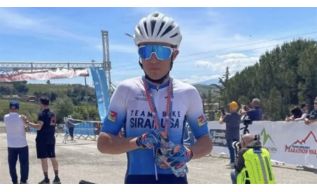
This Sunday Ivan Toselli, Michele Pascarella and Giuseppe Sciarra will be the three Campanian riders at the start. They do not yet have a place in the roll of honor. They do not have feats to pass down. They have something much more fragile and, precisely because of this, more precious: possibility.
Toselli, born in 2006, is a climber and was Italian junior champion in 2021. Agerola will offer him a real climb and, together with it, a difficult question: how much is that talent worth today when the road begins to climb?
Pascarella, born in 2007, arrives with the first concrete signs of a career trying to take shape. Twenty-second place at the Tour of Istanbul, eighth among the young riders and those first three UCI points are numbers that, read from the outside, seem tiny. For those who conquer them for the first time they can instead have the weight of a door opening.
Sciarra from Caivano completes the Campanian trio. Three young riders. Three bicycles. And before them a race that has seen Coppi, Bartali, Guerra, Moser, Saronni, Nencini, Mele, Marzaioli pedal. They do not have to be equal to those names. They only have to have the courage to try to leave their own.
Why the Campania does not go backwards but is a vision
The race will start from the Royal Palace of Caserta, will cross all the provinces of Campania and will arrive at Piazza Plebiscito. But the real journey will be the invisible one. The one that connects 1911 to 2026. A Coppi breakaway to Mele's punctured wheel. Nencini's anger to Marzaioli's bicycle. And from there, without interruption, to the still light legs of three young riders who this Sunday morning will find themselves facing a race bigger than themselves.
This is how cycling continues. Not through statistics. Through the stories that one rider passes on to the one who comes after. Dino Buzzati had intuited it: in the bicycle there is something that escapes measurement. You can count the kilometers, the watts, the seconds, the gradients. But you cannot measure the exact moment when a young rider understands he can go further than he thought.
Perhaps it will happen on Agerola this Sunday. Perhaps it will happen elsewhere. Perhaps it will not happen at all. And that is precisely the beauty of it. Because cycling does not guarantee legend. It puts it at stake. The Giro di Campania returns after twenty-five years. Coppi returns through his climb. Marzaioli returns through Maddaloni. Mele returns through a memory that a puncture was not able to break. Nencini returns through that anger of a champion who did not want to be called a washout. And Toselli, Pascarella and Sciarra arrive, who still do not know what story they will tell.
Perhaps this is the most authentic poetry of the Campania. The race begins again. Memory is already on the attack. And now it is up to today's young riders to try to catch it.





















 1
1
 1
1

 Ritratti
 Oscar
Oscar Albi d'Oro


Se sei giá nostro utente esegui il login altrimenti registrati.