
















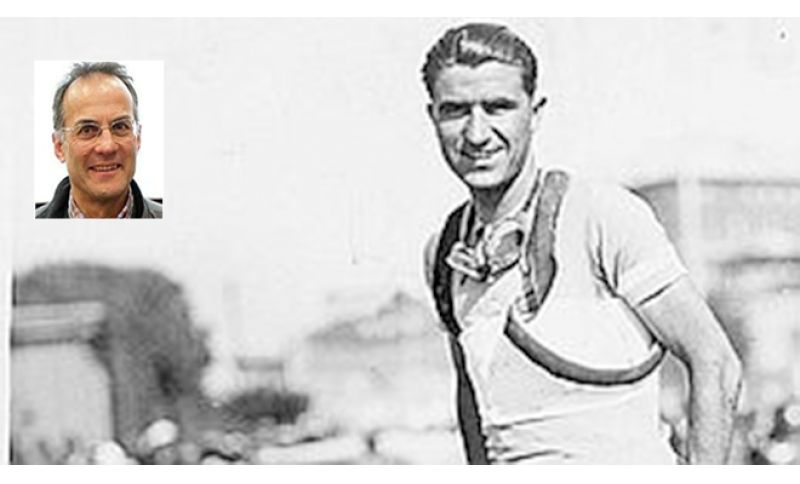
He possessed the gift of modesty, which belongs only to the greatest. As the winner of a Milan-Sanremo, that of 1937, and of three stages of the Giro d'Italia, between 1937 and 1938, as well as a holder of the pink jersey for eight stages, he could have put on airs. Instead he downplayed, minimized, simplified.
He had a sense of humor, probably also an inheritance from his Tuscany, he was from Pisa, from Buti. At the end of one of the two interviews I conducted with him, he told me, his gaze serious, but his soul light, "That's enough now, or you'll fill your head with my stories", he added, with subtle complicity, "And don't write down everything I've told you, because I already pay my taxes", finally he concluded, sighing, "Old age is worse than poverty: I have both".
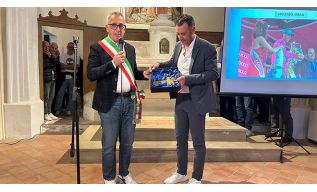
Cesare Del Cancia will be remembered, with affection and gratitude, also with esteem and nostalgia, tomorrow at 6:30 PM at Castel Tonini in Buti: an exhibition (open Saturday and Sunday from 4 to 7 PM until September 30, for information tel. 349/5662007) and a meeting that will include, among others, Arianna Buti (mayor of Buti), Fernanda Del Cancia (Cesare's granddaughter) and Massimo Pratali (author of the cyclist's biography "Cesare Del Cancia – the terror of the aces" (CLD Libri, 256 pages, 28 euros), and which will be moderated by Carlo Alberto Tamberi (journalist). Free admission.
His colleagues also called him – the tradition was mainly oral – Del Gancia. One year younger than Bartali and four years older than Coppi, Cesare had been a fine cyclist. Back then it was more nature and instinct, today one would say DNA or talent, rather than academy or team. One began pedaling out of curiosity ("With a bike given by a villager"), one began racing out of inspiration ("The first race was a track event not far from home, I fell and cracked a rib, but I said nothing to my family"), one continued racing out of vocation ("The second race was at Montecalvoli, it went better, second place") but also to earn one's bread and perhaps build a house, until day after day one also learned to suffer ("When young, you don't tire, but later you do. There was a cyclist from our parts, Francesco Doccini, who had participated in the Giro d'Italia in 1939 and 1940, and who used to say: 'If I have to curse someone, I tell them: may you participate in a Giro d'Italia'"). Water, mud. Sun, scorching heat. Thirst, hunger. Crises, falls, fevers. Rain, snow. Dirt roads, macadam, potholes. Stages of 350 kilometers. "We would leave in the dark – Del Cancia used to say – and arrive in the dark". Brutal stuff. "There were also those – Del Cancia swore – and sometimes scattered by some ignorant person".
Del Cancia was not only a fine cyclist, but also a handsome man. You could sense it in the sepia-toned photos, you could see it in the black and white ones, you could still appreciate it with a glance. Age had reduced his stature, but had not diminished his charm and a certain elegance, which was not measured by clothing labels, but which was there or wasn't, regardless. He also possessed the gift of storytelling: when he opened his heart and spoke of his family, his races, the cyclists, he enchanted, elegant even in his speech. That Milan-Sanremo won by a large margin ahead of Pierino Favalli and Marco Cimatti: "At the refreshment stop in Savona, among the counters and the staff distributing supplies, I recognized my brother Cecco. He handed me a bag and begged me: 'Take this, don't touch anything else'. It contained zabaglione prepared by my mother with her own hands: six to eight eggs beaten with plenty of sugar in Marsala wine. And it was Marsala from a special demijohn that came from Sicily". The effect was immediate. "I took the zabaglione and felt like a lion. Seventy kilometers of solo breakaway and solitary victory".
It wasn't just the zabaglione that gave Cesare Del Cancia an extra gear. It was the life of an athlete, "a cyclist at the forefront", "eating homemade food", "sleeping early and waking at dawn", "rope exercises, hunting on Monte Serra, training and one day mid-week when we would do the distance", "and the bike, the cones straightened by myself, the pedaling so smooth, it almost went on its own". Almost. The rest he provided. The Second World War cut short his career. "I didn't race anymore. It was work's fault: standing all day, my muscles had hardened, and when I returned to cycling, they wouldn't loosen up anymore". He returned as a name and surname, history and legend, hero and myth of a country.



 1
1
 1
1

 Ritratti
 Oscar
Oscar Albi d'Oro


Se sei giá nostro utente esegui il login altrimenti registrati.