


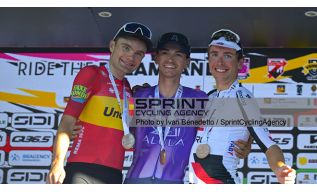
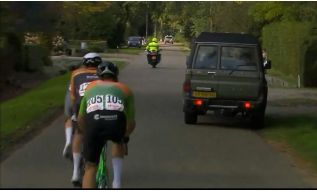
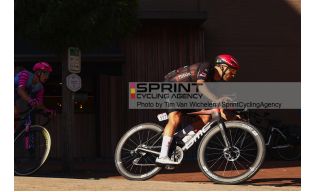
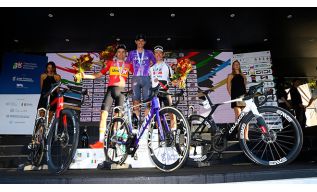















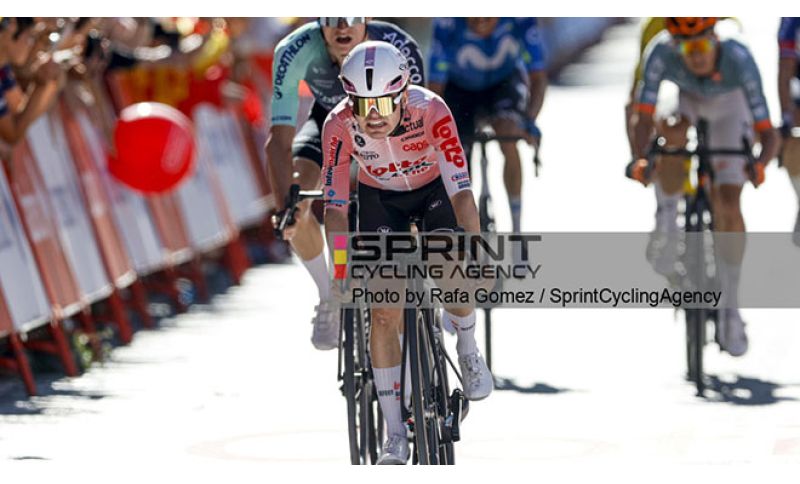
Jarno Widar is the young rider who challenges the cycling greats and his second place behind Pogacar yesterday at the Vuelta has revealed a new talent in great growth. At twenty years old there are riders who arrive at the World Tour with the promise of an important future. And then there are those who, almost without realizing it, decide to bring that future forward. Jarno Widar belongs to the second category.
In the fourth stage of the Vuelta a España, the young Belgian from Lotto-Intermarché secured a surprising second place behind Tadej Pogacar, leaving behind some of the most important names in the race: Primoz Roglic, Oscar Onley, Sepp Kuss, Felix Gall, Richard Carapaz and Enric Mas.
For Widar, in his first season as a professional, it was only the third road stage of a Grand Tour. Yet, when the road started to climb, he was not afraid to stay alongside the champions.
«This is a childhood dream. I am very honored to race among them and I am proud of myself» he said after the finish, with the smile of someone who knows they have just lived a special day. If you look at this young man's palmares, you see victories that highlight the qualities of this rider born in Hasselt, the same area that produced Tim Merlier and Dylan Teuns.
Pogacar made the difference once again and behind him the group of the best crossed the finish line with 2'39" of delay and another group at almost 3 minutes. The Slovenian attacked and secured the victory, confirming his role as the great favorite for the general classification. But behind him the battle was completely different and it was there that Widar emerged.
The Belgian knew how to read the finale and above all he exploited those characteristics that have accompanied him since the youth categories. He doesn't like to define himself as a pure climber. In fact, he prefers a much more precise definition. «I'm not a pure climber, I'm more of an attacker».
A statement that explains much about his racing style. Endless climbs can put him in difficulty, but when the road steepens, shortens and becomes explosive, Widar manages to express all his talent. He had already demonstrated this during the Coll d'Ordino, the longest climb of the finale.
«There I struggled and had a lot of difficulty finding my rhythm», he admitted. Then, however, came the last two climbs of the day, the ones the Belgian was waiting for. «I knew those last two bumps would favor me and that I would be able to get over them».
And so it was. «Second? We didn't expect it». At Lotto-Intermarché they had confidence in their young talent, but the result exceeded all expectations.
«We had hoped, and perhaps even thought, that Jarno could finish in the top ten. But second, no, we didn't expect that», team manager Mario Aerts said.
Then a statement that perfectly sums up the value of the result: «And with Pogacar, this is simply the best possible result. The best among all the others».
Widar didn't need particular strategies or a breakaway to get this high. He raced with the best and beat them in the sprint for second place. A characteristic that could become one of his most important weapons in stage races.
«He has an advantage: the sprint. He's quite explosive and that's very useful in these times. You saw it in the sprint for second place too: nobody managed to pass him», Aerts explained.
And now the general classification? The question comes naturally. Because after a performance like that, it would be impossible not to look at the general classification as well.
Widar is currently in a very interesting position: he's ninth, just 45 seconds behind Roglic, who is second in the standings. But the young Belgian doesn't seem inclined to change his program.
«I didn't come here for the general classification and I'm not even focusing on that. Maybe at the end we'll see if there's a possibility for the general classification, but right now that's not what interests me».
Lotto-Intermarché, however, certainly won't ask him to lose time deliberately. «The intention is not for him to lose time on purpose. Of course, he could lose time with a crosswind, for example, but he won't be deliberately slowed down», Aerts clarified.
And then there's the real objective with which Widar was brought to the Vuelta: to understand how much he's really worth over three weeks.
«It would be fantastic if he finished in the top ten or fifteen, but it's possible that one day things go completely wrong. That's why we brought Jarno to the Vuelta: to see if he can hold up for three weeks in a row. Because, honestly, we don't know him yet in a Grand Tour. Three weeks of racing are a completely different thing compared to a one-week Tour».
Perhaps this is the most interesting aspect of Widar's story. The Vuelta is not just a race: it's a gigantic laboratory in which Lotto-Intermarché wants to understand what kind of rider they have on their hands.
In the past year Widar's name has been accompanied by enormous expectations. The Belgian has already dueled with Paul Seixas, another talent of the new generation, and at last year's Tour de l'Avenir he managed to beat him twice.
The comparison is inevitable, but Aerts urges caution: «It's logical that there's a lot of anticipation in Belgium and that people compare them, but they're really two different types. Jarno needs to find his own path and see where it takes him».
Widar has his own characteristics: he's light, explosive, resilient and above all possesses that ability to change pace that can become precious in today's races. At twenty years old, however, there's still everything to discover and one day, whether positive or negative, can change a career.
The second place in Andorra doesn't mean that Widar has suddenly become a candidate for the Vuelta victory. That would be premature. Three weeks are another story and the road will present days very different from the one just lived.
But one thing is now certain: Jarno Widar can compete with the best in the world. And he did it not in a one-week race, not in a minor calendar event, but at the Vuelta a España, against Pogacar, Roglic, Gall, Onley, Kuss and Carapaz.

 3
3


 3
3


 4
4
2
2
4
4
2
2

 Ritratti
 Oscar
Oscar Albi d'Oro

