















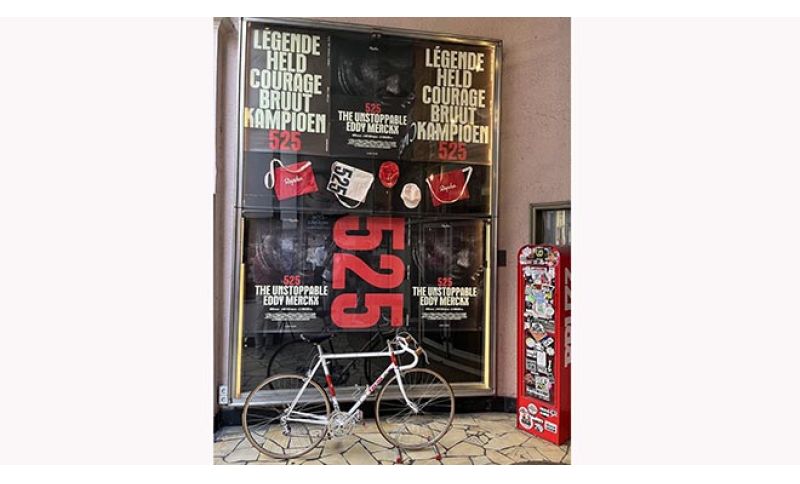
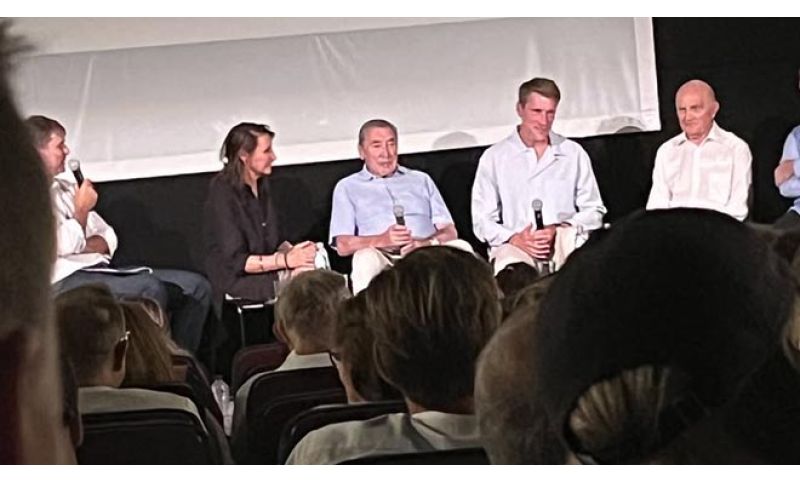
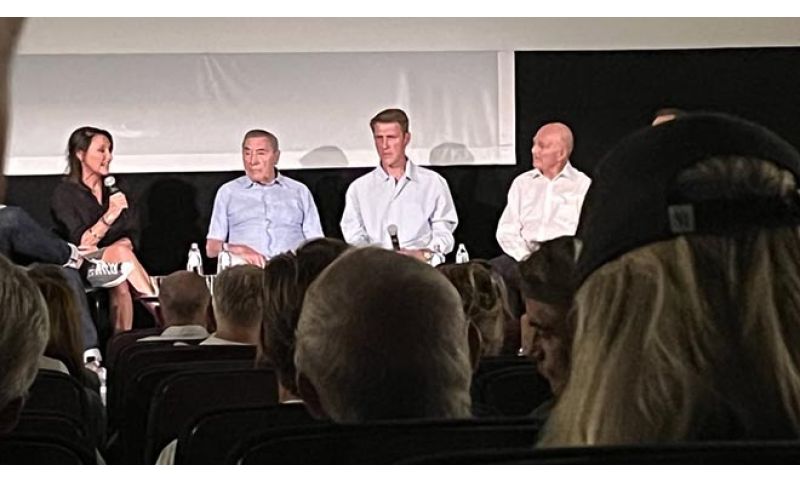
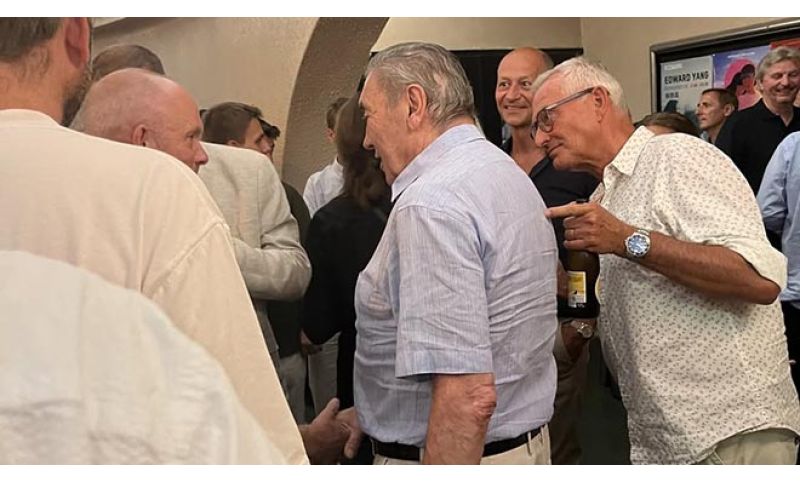
Last night I had the privilege of attending the screening of the film "525: The Unstoppable Eddy Merckx", a film destined for the English-speaking world (https://www.rapha.cc/us/en/story/eddy-merckx-525-film)
The film was screened at a cinema in the Sint-Hubertusgalerij, near the center of Brussels and the magnificent Grand Place. The film's distinctive feature lies in the extensive testimonies from Eddy Merckx, his wife Claudine Acou, and his children Sabrina and Axel. His daughter-in-law Lotte Kopecky also spoke in the film, along with his caregiver, confidant, and key witness Guillaume Michiels. They were all present at the screening, together with Eddy's sister Micheline Merckx and Eddy's grandchildren. Also present was Italo Zilioli, a great Italian friend and former teammate of Eddy's, along with Johan Museeuw, who won the world championship in Lugano in 1996 with Eddy Merckx as the Belgian team's selector. Eddy's former teammates Jos Spruyt and Jos De Schoenmaecker were also there, along with his friend and fellow cyclist Willy Vekemans. Also present was the renowned cycling photographer Tonny Strouken, who was active during Merckx's era: the film also features some of his previously unpublished photos.
After the screening, there was an interview with Eddy, Sabrina, Axel, Italo Zilioli, and Johan Museeuw.
Here are some quotes from the film that struck me:
Sabrina, Axel, Eddy himself, and many witnesses reminded us how much of a relentless winner Eddy was and remains. Not only in races, but also in board games. In the film, his son Axel said: "When I was young, Eddy would race against me in speed competitions. When I started beating him, he didn't want to challenge me anymore." Eddy laughed and replied: "I don't remember you ever beating me in a speed race." The film indeed seeks to show the man behind the champion.
It is significant that Eddy gave statements in both French and Dutch. Linguistic balance remains important to Eddy. Even more remarkable is that the interviews with Eddy and Claudine were conducted by his children Sabrina and Axel. Eddy gave many statements with a smile on his face: the fact that his own children were interviewing him clearly made him more relaxed.
Sabrina and Axel emphasized how important Eddy's wife has been to his career. Claudine herself stated that her main desire was for Eddy to have no worries at home, so that he could be "Eddy" within the walls of their home and no longer the star "Merckx". She said that sometimes she had to chase away people who came to disturb them at home. Sabrina expressed it very beautifully: "behind every strong man there must be a strong woman".
In the subsequent conversation, director Lee Donaldson said it took considerable persuasion to convince Claudine to participate in the film. He said she initially refused to be interviewed. He told her that Eddy, Sabrina, and Axel were actually in the film, and added that people would ask questions if she wasn't there. Finally, she responded: "Let's do it." Donaldson also said that a 26-minute interview with Claudine was recorded and her answers were so incisive that 24 minutes of them could have been inserted directly into the film. I myself was fortunate enough to interview Claudine for an entire afternoon for the biography I wrote about Eddy Merckx. She said she accepted because Eddy had asked her to.
In the film, Roger De Vlaeminck left no doubt that for him Eddy Merckx is and will forever remain the greatest of all time. Roger also emphasized that Eddy had a large number of rivals in Italy. He immediately listed them: Felice Gimondi, Gianni Motta, Francesco Moser, Michele Dancelli, Franco Bitossi… Roger also reminded everyone that Merckx had asked him to ride for his team when he was leading the amateur classification at the Tour of Belgium. Roger said: "Eddy, I won't race *with* you. I'll race *against* you". Roger believes that the best riders should never be on the same team. For him, they must race against each other.
In the film, the tenacious Danish cyclist Ole Ritter apologized for Eddy's crash at the 1975 Tour, at the beginning of the Valloire stage. Following that crash, Eddy suffered a double fracture of the jaw, had to take enormous amounts of painkillers, and could only be fed liquids. Ritter said that Eddy had asked him to make room for him, but he hadn't, and that's why Eddy had crashed. He added that he deeply regretted not making room for him. This statement caused a stir and was an absolute novelty.
Another important witness was Guillaume Michiels, a former rider and Eddy's confidant. He was present when Eddy crashed during the derny race in Blois, after which he could no longer get back in the saddle without pain. Eddy called Guillaume "a brother". Guillaume replied: "We were even better than brothers because we never argued". Eddy's sports director was also present.
At Faema, Marino Vigna was a key witness. He emphasized how Eddy learned to eat differently and in smaller quantities in 1968, which allowed him to lose weight and improve his climbing performance. Another witness from the Merckx era was bicycle builder Ernesto Colnago, who built, among other things, the bike with which Eddy set the hour record. He stated that Eddy reached his peak levels for the love of racing. The five-time Tour winner, Bernard Hinault, stated that Merckx was his idol and an example for his cycling career. I was also struck by the enthusiastic testimony of Tour director Christian Prudhomme, who spoke of Eddy with immense respect. I also found Bradley Wiggins's opinion on Eddy Merckx's dominance very powerful. For him, he remains forever the GOAT, the greatest of all time…
In the film, Eddy also expressed great pride in his 1970 Paris-Roubaix, won with a margin of over five minutes. He stated that no one has been able to replicate that feat since. I also saw many beautiful color images in the film, including those from "One Day in Hell" about the 1976 Paris-Roubaix, Merckx's film "La course en tête" from 1973, and a film about the 1973 Giro d'Italia.
In the subsequent interview on the podium, Eddy said in Dutch: "I managed to turn my childhood dream into my profession. I think that makes me the happiest person in the world".
In French, he added: "I am very proud to have been able to defend Belgian colors throughout the world". Later, Eddy spoke in English. He was asked what he was most proud of: "My first Tour victory, 30 years after a Belgian had won it. I am also very proud of the hour record". It was a real struggle, though.
Axel also made a significant statement: "We made the film to show his grandchildren and great-grandchildren everything he has accomplished. That way, they will have a lasting memory."
Johan Museeuw also made a funny revelation about the "winner", then Belgian coach Eddy Merckx, after the World Championships in Japan: "To celebrate Rudy Dhaenens's victory and Dirk De Wolf's second place, we went out with the Belgian team and drank quite a bit. It was kind of a competition. After a while, only four of us were left. I was there at 22 years old. Then, at six in the morning, Eddy was the only one left. He had won there too."
Museeuw also shared an anecdote about his victory at the Lugano World Championships: "Eddy had told me that I should raise my saddle by two millimeters and then I would become world champion." "If Eddy Merckx tells you that, you do it..."
Italo Zilioli was part of Eddy's Faemino team in 1970: "Of the 15 years I was a professional, the year with Eddy was the best. We had a lot of laughs." Eddy recounted that Zilioli had taken the yellow jersey from him for a few days at the 1970 Tour: "Otherwise, I would have worn it for the entire Tour. But it was given to Italo".
In the end, Eddy received a standing ovation that lasted several minutes: after a while, he even started applauding himself. He seemed amazed by the enormous respect and admiration he had inspired…
Later, director Lee Donaldson approached me. He told me he had read my books on Merckx, particularly the one about 1969, which was also translated into English. In the film I actually noticed the recurrence of many phrases that Eddy had told me, also in relation to the controversial positive doping test in Savona during the 1969 Giro: "I had already tested negative eight times in that Giro, and then suddenly I tested positive in an insignificant stage". "Being the one wearing the pink jersey, I was the only one who knew I would be tested".
Anyone wishing for a complete overview of Merckx's cycling career and life can still consult my book "Eddy Merckx - The Definitive Biography", which includes testimonies from Eddy Merckx and many other key witnesses.

 3
3


 3
3


 4
4
1
1
4
4
1
1

 Ritratti
 Oscar
Oscar Albi d'Oro

