






















Tadej Pogačar will return to the Vuelta a España seven years after his debut which, in 2019, definitively revealed him to professional cycling: third in the general classification, three stage wins and the white jersey. This time he is not starting to discover himself, but to complete his palmares. After the 2024 Giro d'Italia and five Tours de France conquered between 2020 and 2026, the Spanish race is the only Grand Tour still missing from his collection.
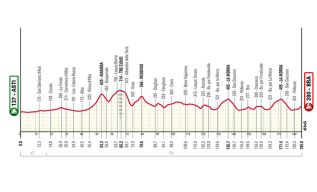
The participation is official. UAE Team Emirates-XRG has announced a lineup built without ambiguity around the Slovenian: João Almeida, Jay Vine, Pavel Sivakov, Pablo Torres, Kevin Vermaerke, Domen Novak and Ivo Oliveira. The route, from August 22 to September 13, measures 3,275 kilometers, includes 21 stages, six mountain stages, four medium mountain stages and two individual time trials. The race organizers also indicate seven summit finishes. It is a technical structure that rewards completeness, recovery capacity and consistency: exactly the qualities that have transformed Pogačar into the absolute reference point for three-week races.
International media coverage reflects this exceptionality, but with different emphases. In Spain, the value prevails that the presence of the world number one transfers to the race; in Italy, the narrative of the last missing piece dominates; French and Anglo-Saxon media insist more on recovery after the Tour and the risk of a new competitive concentration. These three readings are not alternatives: they describe, respectively, the impact on the event, the historical significance of the objective and the main variable of uncertainty.
Saying that he is the favorite is simple. Quantifying how much he is requires greater caution. Statistics do not allow treating a future victory as an automatic consequence of past successes, especially in a sport exposed to crashes, illness, weather conditions, team strategies and loss of form. However, it is possible to construct a transparent probability interval, distinguishing observed data from interpretive adjustments.
The first data is historical. Pogačar has competed in nine Grand Tours so far: he has won six and finished all nine on the podium. The gross win rate is therefore 66.7%, the podium rate is 100%. To prevent a still limited series from being transformed into certainty, a simple Bayesian estimate can be applied with uniform initial distribution: six successes in nine participations produce an average probability of 63.6%. The 95% credibility interval remains very wide, approximately 35-88%, precisely because nine observations are not enough for a precise prediction. That 63.6%, however, describes his entire career in Grand Tours and does not capture the Pogačar of 2026. On the eve of the Tour just won, the betting market valued him at 1.25, corresponding to a gross implied probability of 80%. It is not an infallible prediction, nor a probability purged of the bookmaker's margin, but it constitutes a synthesis of the information available before the race. That Tour also presented a more competitive field than the current preliminary list for the Vuelta. The provisional list for the Spanish race includes Felix Gall, Mattias Skjelmose, Enric Mas and Carlos Rodríguez, while Jonas Vingegaard, Remco Evenepoel, Florian Lipowitz and Paul Seixas do not appear, as of August 3. However, this data must be handled with caution: the main cycling statistics website registers only 70 riders, not the entire group of starters. Current absence therefore does not yet equate to a definitive withdrawal. The correct result cannot be a number presented as absolute truth, but an interval. The 63.6% historical figure constitutes the prudential base; the 80% attributed by the market before the Tour represents an updated reference on the Slovenian's relative strength. The favorable route, the quality of UAE and the provisional absence of major rivals push the valuation upward. Only 27 days between the conclusion of the Tour and the start from Monaco, the accumulated load and the uncertainty of the starting list act in the opposite direction. This results in a reasonable probability between 72 and 80%, with a central value around 76%. It is not the prediction of a model trained on thousands of homogeneous cases (AI??), which do not exist in cycling, but an estimate conditioned on the information currently available and the stated assumptions.
Translated: in one hundred Vueltas disputed under the same conditions, Pogačar would win approximately seventy-six. In the other twenty-four he would not necessarily be beaten by a stronger rival: a crash, a bad day, an illness, incomplete recovery from the Tour or an unfavorable tactical dynamic could weigh in.
Pogačar's true opponent, therefore, does not yet have a face. It is that 24% of variability that persists even in the most evident dominance. The Vuelta will start with a very clear favorite, not with a winner already written. And it is precisely this difference, apparently subtle, that separates statistics from gambling.
Giovanni Di Trapani is a senior researcher at CNR currently on secondment to the Office of the Prime Minister: he coordinates the support structure of Commissioner Bagnoli Coroglio.

 7
7


 7
7


 9
9
1
1
1
1
4
4
2
2
9
9
1
1
1
1
4
4
2
2


 Ritratti
 Oscar
Oscar Albi d'Oro

