













My name is Alberto Ceriani and I am a blind athlete who has lived triathlon with an unwavering passion for 25 years. In these twenty-five years I have never asked for discounts, I have never asked for privileges. I have asked for only one thing: the right to compete.
I have completed five Ironman races, over one hundred competitions including half-Ironman, Olympic distance triathlon and sprint triathlon. I have won European and World titles in paratriathlons, worn the Italian National team jersey and represented my country in international competitions.
I was the first blind athlete in the world to complete the Ironman World Championship in Hawaii, proving that even what seemed impossible could become reality.
I started practicing triathlon when paratriathlons practically did not exist. I and many other athletes helped grow this movement, demonstrating through our actions that even a blind person could face and complete races considered impossible. It hurts to see that today, precisely when the movement has grown, those who wrote its first pages risk being excluded from it.
Behind all this there are not just medals or results: there are thousands of hours of training, there are thousands of kilometers covered and there are sacrifices that few can imagine.
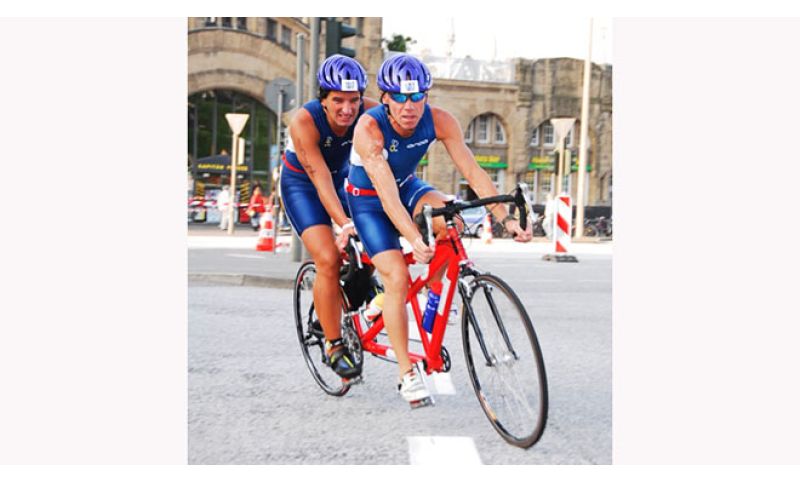
Because a blind athlete never trains alone. Every lap in the pool requires someone willing to train with me. Every bike ride means finding a guide willing to ride a tandem and share hours of effort. Every run requires a person who ties themselves to me with a rope and covers every kilometer at my side.
I am not the only one making sacrifices.
My guides also make them, who over these twenty-five years have devoted their time, their passion and often sacrificed their own training and competitions to allow me to pursue my dreams.
I owe them an enormous part of everything I have achieved. And it is also thinking of them that I feel a deep sadness today.
After three years away due to a knee injury, I had decided to return to competing; not to win, not to stand on a podium, not to seek a title.
Simply because triathlon has been my life for twenty-five years and I wanted to experience again the emotion of a starting line, but instead I found myself facing a regulation that has already excluded me from two races. Not because I was not capable of competing, not because I was not trained, but because the new rules prevent me from doing so.
And this is where my question arises.
How can a Federation that should represent and promote paralympic sport create rules that end up preventing athletes with disabilities from participating? Paralympic sport exists to break down barriers, not to create new ones.
Rules are essential when they guarantee safety, fairness and inclusion, but when their effect is to leave a disabled athlete out of the starting line, then something is wrong.
Today I feel excluded not from competition, but from the right to participate itself and this is profoundly unjust. A Federation should help athletes practice their sport, not build bureaucratic obstacles that keep them away.
I will continue to train, I will continue to swim, I will continue to cycle and I will continue to run because triathlon will always be part of my life. But I hope that those who today have the task of guiding this movement find the courage to reflect, because the problem does not concern only Alberto Ceriani; tomorrow it could concern any other athlete with a disability. Inclusive sport is not measured by slogans, but by the concrete possibility of allowing every athlete to be themselves.
Alberto Ceriani

 5
5


 5
5


 5
5
10
10
4
4
5
5
10
10
4
4

 Ritratti
 Oscar
Oscar Albi d'Oro

