

















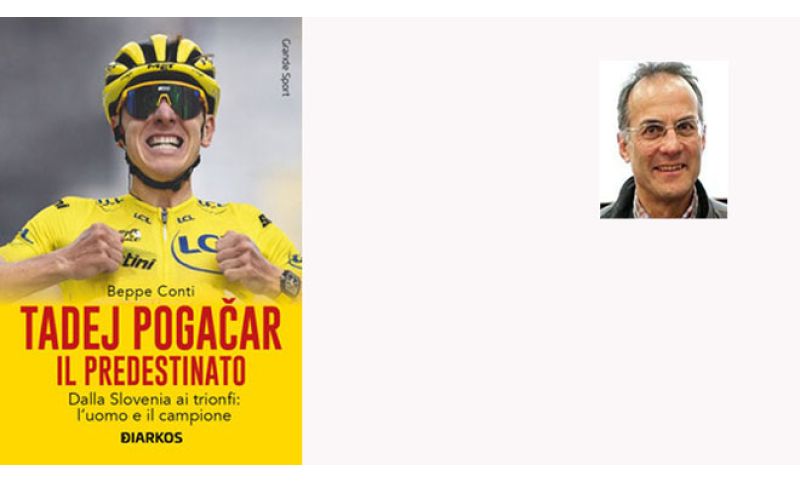
Pogacar, in Slovenian, means talkative. I don't know Tadej Pogacar, I don't know if he's talkative or reserved, verbose or silent, discreet like Coppi or volcanic like Bartali or polyglot like Merckx. What's certain is that he speaks a lot – and very clearly – through his deeds, which for him are pedal strokes like the fairy tales of Gianni Rodari, in heaven and on earth. And if Pogacar weren't talkative, there are others who write about him, for him, with him. This is the first of two installments about two books on Pogacar.
-
If Coppi was the greatest and Merckx the strongest (copyrights to Bruno Raschi and Gian Paolo Ormezzano), relative superlatives, for Pogacar one must resort to the dictionary of absolute superlatives, emphatic, redundant ones. "The champion" (subtitle), "extraordinary phenomenon" (page 8), "immense phenomenon" (page 11) and from here on it's a barrage of "fantastic", "incredible", "irresistible" and "immeasurable", underlining his "talent" and "spectacle", "legend" and "myth".
An established author, Beppe Conti; a title that already seems to provide an answer, "Tadej Pogacar the Predestined" (280 pages, 18 euros); a publisher, Minerva, rooted in sports; and a yellow cover that refers to the Tour de France, four victories and two second places in the last six editions. Conti begins by recounting his first Tour, that of 2020, conquered two days before turning 22, amid astonishment and disbelief. The testimony of Ernesto Colnago, who custom-built the bicycle for the Tour; the memories of Andrej Hauptman, who discovered the young rider and accompanied and launched him; the confidence of Beppe Saronni, who evaluated and signed him; the directives of Alex and Johnny Carera, his agents, to tie him to the team led by Mauro Gianetti; then the other chapters, in chronological order, between classics and World Championships, a couple of near triumphs (Milan-Sanremo 2025, third, the victory in 2026 came after the book was already in stores, and Paris-Roubaix 2025, second, and he would have been second in 2026 as well), European Championship and also a Tre Valli Varesine. Beppe concludes his Pogacariad by gifting another couple of chapters, the first to update his personal ranking of the best seven of all time (after Pogacar, of course: Coppi, Merckx, Hinault, Bartali, Binda, Anquetil and Gimondi) and to list the victories, circuits excluded, of the flying Slovenian.
To make sense of Pogacar's unique trajectory, Conti seeks comfort and comparisons in the past, for what can be done, well knowing that cycling has become two-legged science and two-wheeled technology, and that nothing, from the roads to the strategies, can be considered perhaps even a distant relative. Conti records race data, chronicle notes and statements from protagonists, precious for delivering geography to history and resurrecting visions and emotions.
Between one record and another, a glimpse of the more human Pogacar emerges, the one who gives his water bottle to a child, the one who participates in a charity race, and a hint of the more fairy-tale Pogacar is intuited, the one who caresses the pedals while others stomp on them. Pogacar will become much more human when he begins to lose. Unless he finds the strength to retire before sunset.
(end of first installment – to be continued)



 1
1
 1
1

 Ritratti
 Oscar
Oscar Albi d'Oro


Se sei giá nostro utente esegui il login altrimenti registrati.