
















The 2026 Tour de France will experience its 27th Grand Départ abroad on July 4th. Exactly one hundred years ago, it was 1926, when the race experienced a historic moment as the start was given from Evian, for the first time away from the Paris headquarters of the organizing newspaper L'Auto.
Among other anniversaries that stand out in Tour history, the editions marked by the number 6 offer pages worth revisiting: the atypical victory of Roger Walkowiak in 1956, the heroic finale of Raymond Poulidor's fourteenth and final participation at the age of 40 in 1976, and the changing of the guard in 1986 between five-time French winner Bernard Hinault and the first American winner, his La Vie Claire teammate Greg LeMond. Thanks to our friends at Aso, we will retrace these events in a sort of countdown to the great appointment in Barcelona.
THE LAST TOUR OF THE MOST BELOVED OF ALL
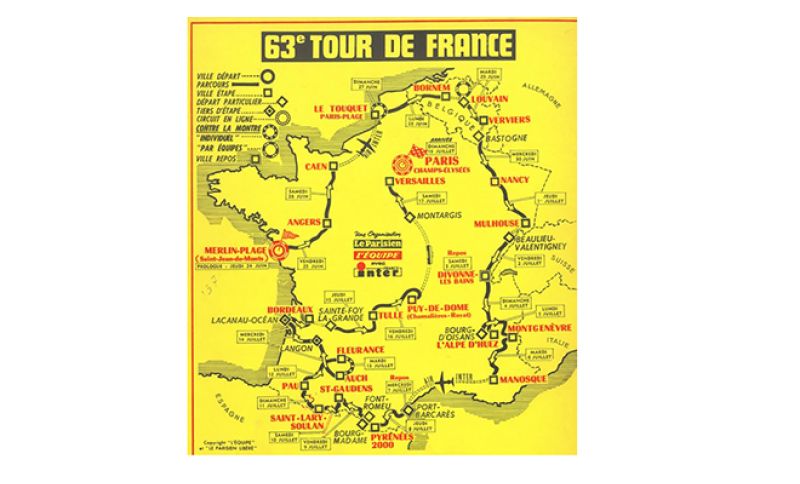
Edition: 63rd
Dates: June 24 - July 18, 1976
Stages: 22
Distance: 4,017 kilometers between Saint-Jean-de-Monts – Merlin-Plage and Paris
Countries crossed: France, Belgium, Switzerland, Spain
Starters/Finishers: 130 / 87
Average speed: 34.518 km/h
Podium:
1. Lucien Van Impe (BEL / Gitane-Campagnolo)
2. Joop Zoetemelk (NLD / Gan-Mercier-Hutchinson)
3. Raymond Poulidor (FRA / Gan-Mercier-Hutchinson)
Points Classification: Freddy Maertens (BEL / Flandria-Velda-West Vlaams Vleesbedrijf)
King of the Mountains: Giancarlo Bellini (Brooklyn)
Best Young Rider: Enrique Martinez Heredia (Kas-Campagnolo)
Super Combative Award: Raymond Delisle (FRA / Peugeot-Esso-Michelin)
Team Classification: Kas
Yellow Jerseys: Lucien Van Impe (15), Freddy Maertens (10), Raymond Delisle (2)
Stage Winners: Freddy Maertens (8), Joop Zoetemelk (3), Gerben Karstens (2), Hubert Mathis, Giovanni Battaglin, Hennie Kuiper, TI-Raleigh, Miguel Maria Lasa, Aldo Parecchini, Jacques Esclassan, José Luis Viejo, Raymond Delisle, Willy Teirlinck, Lucien Van Impe, Wladimiro Panizza, Michel Pollentier, Ferdinand Bracke (1)
A LEGEND EVEN AT 40 YEARS OLD
The 1976 Tour de France began without five-time winner Eddy Merckx (injured), and with the defending champion Bernard Thévenet, who was ill (he would eventually abandon the race), which translated into great uncertainty and high hopes for many in the peloton. Including the favorite, Raymond Poulidor, 40 years old, present for the 14th and final time.
Belgian Freddy Maertens dominated the early stages, wearing the Yellow Jersey from the start until the foothills of the Alps, thanks to his numerous victories. In this edition he won 8 stages: a record shared with Charles Pélissier (1930) and Eddy Merckx (1970, 1974).
The battle for the general classification between Joop Zoetemelk and Lucien Van Impe ignited on Alpe d'Huez (stage 9). The Dutchman won, but the Belgian took the Yellow Jersey. Encouraged by crowds gathered to celebrate his final Tour de France, "Poupou" was still in contention after that stage, 4th in the general classification, close to the favorites.
Two extraordinary feats followed: the first signed by Spaniard José Luis Viejo, winner of the eleventh stage (Montgenevre - Manosque), with 22 minutes and 50 seconds of advantage after a solo breakaway of 160 kilometers. This is the largest gap ever recorded in the post-war era.
The next day, Raymond Delisle won atop the Pyrenees 2000 and snatched the Yellow Jersey from Lucien Van Impe. But Van Impe had actually followed the advice of Cyrille Guimard, who had suggested he focus on a decisive attack in the following days, particularly on the climbs of the fourteenth stage.
Lucien Van Impe then delivered the decisive blow in the stage from Saint-Gaudens to Saint-Lary-Soulan: he attacked on the Portillon climb, arrived alone at Pla d'Adet and relegated Joop Zoetemelk to over 3 minutes back. This is how the Belgian laid the foundation for his first (and only) Tour de France victory.
The fight for the top positions remained wide open. Despite not winning any stage, Raymond Poulidor did not have a single day of decline, remaining attached to the best climbers and maintaining his position. His consistency allowed him to reach that point in the race among the top five in the general classification. The podium? Still possible!
Accumulating 30 seconds from Raymond Delisle (3rd), Raymond Poulidor caught him at Puy de Dôme (stage 20), two days before the Paris finish. He secured 3rd place outright in the final stage, crossing the finish line with a 9-second advantage over the Frenchman and 31 seconds over Walter Riccomi.
At 40 years old, "Poupou" competed in a final Tour worthy of his status as an icon. He reached his eighth podium (three second places, five third places), a record never surpassed. He retired with seven stage victories, but never wore the Yellow Jersey. Perpetually second in the general classification, but beloved by the public.
Raymond Poulidor finally wore the Yellow Jersey during the television broadcast "Les étapes de la gloire" (The Stages of Glory), symbolically presented to him by Jacques Anquetil. "Cycling has given me everything, beyond my wildest dreams. Now that I have it on: yes, if I had worn it, it would have given me immense pleasure. Winning the Tour de France is something I'm missing a bit, but I have no regrets."

 1
1


 1
1


 2
2
1
1
2
2
1
1

 Ritratti
 Oscar
Oscar Albi d'Oro

