

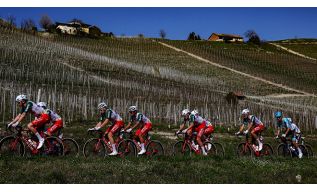
















The Giro d'Italia has once again proven to be capable, like no other event, of telling the story of Italy road by road, promoting the endless beauty of our cities, countryside and mountains and all that history that fills everything, for better or worse. No travel guide or tour company has the same power as the Giro d'Italia, if only for the enormous visibility that the pink race is able to bring to our territories. The great race knows how to tell Italy's story from unexpected, unique perspectives, and from this point of view it remains in great form.
The Giro is also a fundamental moment to talk about road safety and this year I had the opportunity to appreciate the RAI commentators who every day gave space with competence and depth to this fundamental theme. Francesco Pancani, Davide Cassani, Stefano Rizzato and Stefano Garzelli, one of the honorary participants of the Michele Scarponi Foundation, continuously raised the volume by remembering Sara Piffer, Matteo Lorenzi and Michele, discussing bike lanes, feet on the ground and many of the issues we care about. And they always did it at crucial moments of the race, when viewership was high.
In the safety spots that interspersed the commentary there was always talk of a road shared between people who move by car and by bike, where you must respect each other, an old hackneyed mantra that often avoids looking squarely at the wrong road safety culture of our country, one that puts everyone on the same level, motorized and not, and this means, without beating around the bush, aligning with the rules and non-rules of the strongest. In short, much more could have been done: clarifying once and for all what the motorist can do to protect those who travel unarmed on the road. We could have talked about speed, for example. Instead, once again we had to settle for a spot, like the one from the FCI, that places responsibility exclusively on the cyclist. Let's defend ourselves, otherwise we're asking for it.
The Giro can change our approach to the road, but cycling must pick up the pieces of a shattered story starting precisely from its own origins and from safety, the real kind, the kind people are afraid to talk about otherwise they lose members or some sponsors.
But we've already lost the young people. This year, with the various collaborators of the Foundation, I entered almost a hundred classrooms, from primary to middle and high school. To almost all the students involved I always asked two questions: how many road safety courses they had taken at school up to that point and whether they knew at least one cycling champion. Well, very few have seen for more than an hour over eight years of school a representative of the traffic police enter the classroom, few then in large cities get their cycling license, so you often reach 18 years old having done at most two hours of road safety in class with an educational approach aimed at preventing the use of alcohol and drugs, at discouraging the use of scooters and bikes and reminding us that you have an accident and not a horrible act of violence, if perhaps you hit someone while driving your car and looking at your phone. Then a meager 1.5 percent knows at most the name of an Italian cycling champion. Coppi, Bartali, Gimondi, Moser, Pantani, Nibali are perfect strangers to our young people. It's not essential for people's lives to know the history of cycling, but it is essential for the survival of cycling to make itself known to younger people because otherwise all those values, which we tell ourselves so much about, we end up packaging them in Granfondo experiences and the pink race becomes the leader of all cycling tourism guides.
So when will there be a real cultural project for young people in schools centered on cycling and road safety? The Michele Scarponi Foundation, in its small way, started doing this some time ago and we are amazed every time by the strength and enthusiasm that these three words together manage to create in the classroom: young people, cycling and safety, that's how you win the Giro d'Italia.

 3
3


 3
3


 3
3
3
3
1
1
1
1
3
3
3
3
1
1
1
1

 Ritratti
 Oscar
Oscar Albi d'Oro

