

















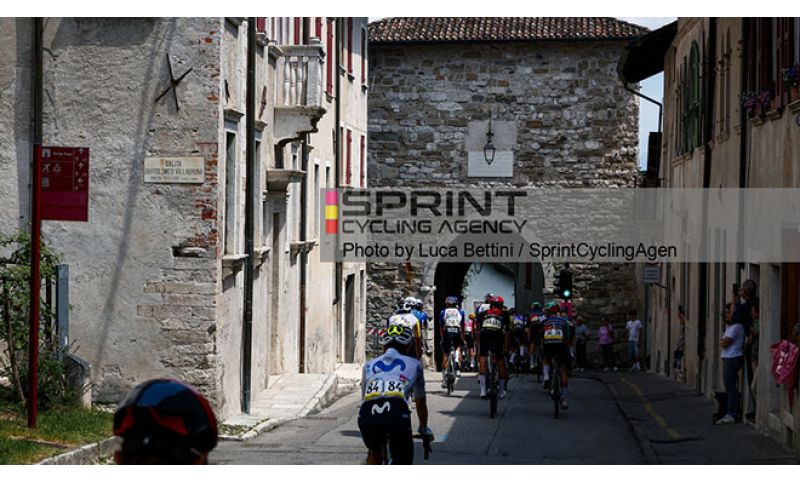
The 2026 Giro d'Italia is not merely a race: it is a human atlas measured in kilometers, meters of elevation, lost seconds, thresholds of pain. It started from Nessebar and will end in Rome, after 21 stages, 3,469 kilometers and 48,700 meters of elevation gain: a vertical geography of the soul, with an average of 165.1 kilometers per day and approximately 14 meters of climbing for every kilometer covered. The data, read coldly, is a formula; observed from the roadside, it becomes destiny.
Modern cycling loves watts, power curves, normalized speeds. But the Giro continues to demand something that no algorithm can fully return: the ability to remain human when the body becomes machine and the machine is no longer enough. Filippo Ganna, in the time trial Viareggio-Massa, wrote one of the clearest pages: 42 kilometers in 45'53", an average close to 55 kilometers per hour, not a race but a line drawn against the wind. Yet, within that geometry, there remained an ancient fragility: the man alone, helmet low, the road ahead like a courtroom.
Then came the mountains, which in the Giro are never simple altimetries. They are moral places. Blockhaus, Corno alle Scale, Pila, Carì, Alleghe: names that seem like locations and instead become chapters. Jonas Vingegaard transformed the general classification into an almost mathematical progression, taking the pink jersey on the climbs and defending it with the coldness of great dominators. After stage 19 he holds 4'03" over Felix Gall: a margin that, in cycling, is not merely time, but psychological space, mental distance, silent authority. The Feltre-Alleghe stage showed the harshest face of the race: 151 kilometers and approximately 5,000 meters of elevation gain, that is more than 33 meters of climbing per kilometer. This means that this section had a vertical density more than double compared to the overall Giro average. Here the number stops being statistics and becomes narrative: every kilometer weighed like two, every turn carried with it a fragment of possible surrender. Sepp Kuss won it as a pure climber, completing the trilogy of stage victories in the three Grand Tours: Tour, Vuelta and Giro. A historical fact, certainly; but also a small domestic epiphany, familiar, almost private, within the immense theater of the Dolomites.
This Giro lives on a double polarity. On one hand precision: Magnier who signs three sprint victories, Narváez who leaves the race with three wins, Ganna who reduces time to measurable matter, Vingegaard who builds advantage like an engineer of fatigue. On the other hand the unexpected: crashes, breakaways, late attacks, men who seem to step outside the script and for an afternoon become its authors. It is here that statistics find their poetry: not in replacing emotion, but in giving it depth, in demonstrating that even a tear can have an average pace, a gradient, a delay at the finish line.
The 2026 Giro, then, should be read as a great living table. Every row is a rider, every column a wound: time, gap, elevation, wind, hunger, fear. But the total never truly adds up, because cycling always contains an unobservable variable: courage. And perhaps this is why we continue to watch it. Not to know who arrives first, but to recognize, in those men bent over the handlebars, the most ancient form of our stubbornness. A race lasting three weeks, but also an exact metaphor: you start from the sea, you climb, you fall, you resist, you descend toward Rome. And in the end, more than the classification, what remains is the faint sound of the chain: the humble and immortal sound of those who continue to move forward.

 1
1


 1
1


 5
5
1
1
1
1
3
3
2
2
5
5
1
1
1
1
3
3
2
2

 Ritratti
 Oscar
Oscar Albi d'Oro

