























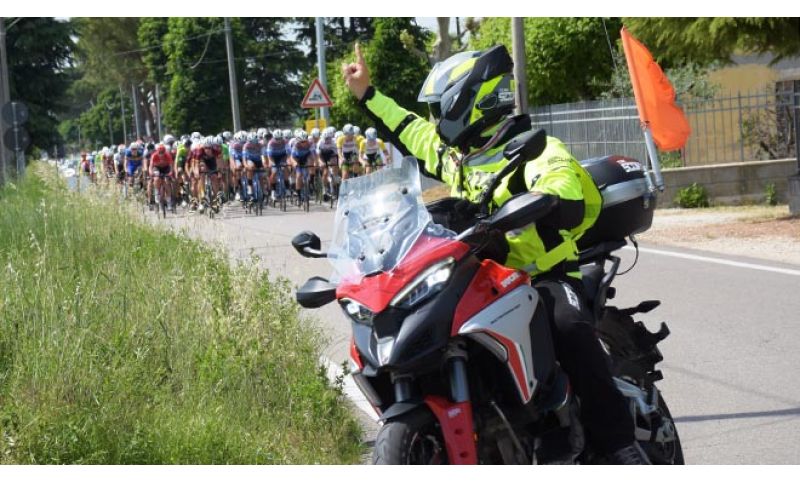
It is unclear why, in various professional races or stage races, technical support crews have developed the habit of neglecting to install the fluorescent orange flag on their motorcycles. An identification element of their specific function and the most visible in traffic impact, which the Regulations absolutely require to be mandatory. Within the safety sector, this question has been circulating for quite some time and there is growing exchange of photographs confirming what is happening. Moreover, it is said, precisely when the Highway Police are present, who as responsible for the escort service, should not be put in an awkward position with non-compliant behaviors that perhaps are overlooked only out of general appreciation that these motorcyclists deserve.
And where television broadcasts transmitted around the world, more than the inconsistencies, should be useful to highlight how Italy has valued and regulated these precious volunteer figures dedicated to the safety of cycling races, assisting or substituting for police forces. An operation that should be boasted about more often, given its uniqueness.
Why then don't they put the flag? Seeking a reason where reason cannot exist is certainly a complicated exercise. Some venture the hypothesis that they don't put the flag because in races where the Highway Police are present, traffic regulation is effectively left exclusively to them, while technical support crews are assigned the activity of preventive route safety with flagging of unguarded road accesses or signaling points of greater danger or obstacles on the roadway. A most important activity, absolutely essential, possible even for normal motorcycle escorts, but certainly more effective if entrusted to the greater competence and authority of technical support crews, which however, if employed in this manner, must either remove their technical support vest, or combined with this also install the orange flag on the motorcycle. One cannot exist without the other! The Regulations do not allow it.
Inventing exceptions that do not exist thus becomes a form of "vain distinction" that is not precisely what is taught in training courses.
DANGER SIGNALING FLAG – Some recent routing errors, where signaling could have offered riders and their entourage rather uncertain indications, bring back the reflection on why Italy, unique in the world, uses the rectangular orange flag, rather than the triangular yellow one universally requested by the UCI.
Flag signaling has a dual function: to indicate a dangerous curve to the right or left, a possible narrowing of the roadway, or the presence of an obstacle on the road and from which side to pass it.
It's not that Italian signaling lacks logic, but it has the limitation of escaping the necessity of giving riders, who sometimes race in one country and sometimes in another, the same type of warning, conventionally understood, especially in moments of absolute speed. Where making a mistake can be fatal, such as along a descent traveled at 100 kilometers per hour or in race finishes.
The triangular yellow flag originated in France in the post-war period by choice of the Tour organizers, and was introduced and adopted in Italy for the first time in 1995 by the then Team Publifest, a group of motorcycle escorts formed a few years earlier.
The usefulness of this mobile signaling, done with escort motorcyclists, is quickly recognized almost everywhere. Other groups adopt it and gradually its use spreads until it is found shortly thereafter also at the Giro d'Italia.
Between '97 and '98 this small flag enters the teaching of the first motorcycle escort courses introduced by the FCI, to then receive its consecration from the Ministry of the Interior when, in its circular of 9.11.1998, it states: "the assigned personnel must pre-signal the presence of the obstacle by means of a triangular flag of yellow color having a height of not less than 50 cm, adopting, as far as possible, unambiguous conventional signals known to the competitors".
But in 2015 the CNDCS begins to think differently until obtaining, in the same year, the federal resolution with which the triangular yellow flag is replaced by the one we still know today. A decision never shared by the UCI, which from the following year, and still now, in its annual report on the quality of Italian professional races, will begin to highlight as an organizational deficiency the inadequate danger signaling made with methods and use of a flag that has no precedent in any other race on the international calendar, different from those indicated by the UCI's safety commission.
The call is authoritative, but apparently not sufficient to induce the FCI to change its mind.
Meanwhile, increasingly often, technical support crews and motorcycle escorts are seen folding the extreme points of the flag to improvise a hypothetical triangle that might serve to indicate to riders also the direction to follow or along which to pay maximum attention.
What to do then in Italy? To those in charge, the difficult decision.

 5
5


 5
5


 1
1
2
2
1
1
1
1
2
2
1
1


 Ritratti
 Oscar
Oscar Albi d'Oro

