

















From Iasi, Romania, to Jurilovca, Romania, 575 km. Then from Jurilovca to Bulgaria to Serres, Greece, 1050 km. Finally from Serres to Igoumenitsa, Greece, 560 km. Total: 2185 km, 50 days and 50 nights. It's not mandatory to reach Cape North, tackle the Santiago Way, or cross some African desert. More valuable, because more creative and courageous, is to design and live a journey like this, from the Black Sea to the Adriatic, from the borders with Moldova to those with Italy. Especially since the journey was designed and experienced by bicycle.
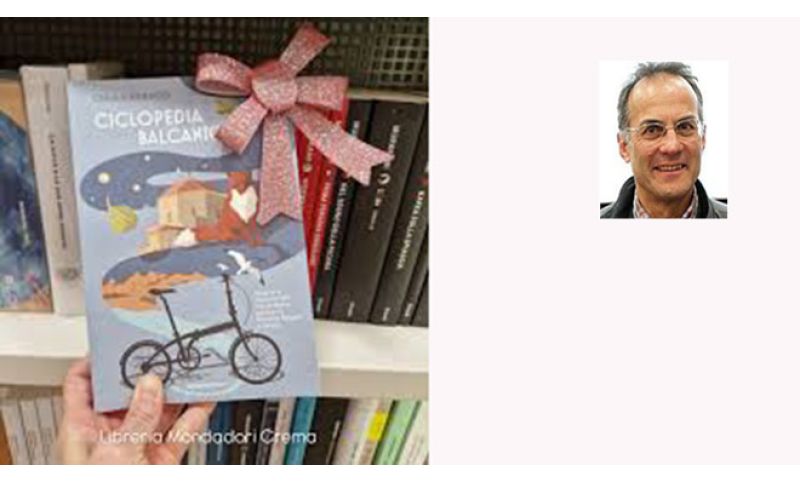
"Balkan Cyclopedia" (Ediciclo, 208 pages, 17 euros) is the story of this two-person bicycle trip, by Carla Alexia Dodi, a teacher by profession, also a journalist, here a writer, and Draga, a folding bicycle of Chinese origin, already tested in an adventure in Dobrogea, between Romania and Bulgaria, and then in an exploration of the Danube Delta, between Romania and Ukraine. A tandem, therefore, almost a mythological figure, half human, Dodi, and half mechanical, Draga, although the roles blur, there's a mechanical part in Dodi, who pedals, and a human part in Draga, which looks, accompanies, assists, shares, comforts, or asks for help. Dodi defines Draga as a "companion of adventures, critical conscience, and ironic interlocutor". And writes: "I tried to prepare her well for the great crossings we would make. But, ultimately, she remained the same, without too many sophistications. She has an aluminum frame, robust and a bit heavy, thirteen kilos. She folds in two, when necessary. Useful in the great fatigue of a long journey: she can enter any motorized transport, if needed. With me, she gained a rear rack and a basket to put in front, on the handlebars. Then the lights, front and back". Seven-speed gear. No panniers, but a backpack and tent tied with an elastic cable. Draga, in Romanian, means dear, that is joy, also treasure. The relationship established not only between Dodi and Draga, but between all cyclists and their bikes, is close to intimacy, affectionate to the point of dependence. There's one last detail Dodi is very attached to: she has space for only one book, as paper weighs and takes up space, so she chooses a double one, "If This Is a Man" and "The Truce" by Primo Levi. It will serve as her guide and compass.
The Great Balkan Journey has a destination: Sultana, a Greek friend. But the flying checkpoints are unexpected, sudden, infinite: monasteries and bell towers, workshops and cellars, cafes and wine, dreams and projects. "The man has a ruddy face and strong hands, he wants to talk. You must not be afraid! He staggers. He says he has a good heart, honest intentions, two daughters abroad who have forgotten him – I worked my whole life for them! – and now he cries, burying his hands in his eyes". "In the village of Aliman, they looked at us like Martians landed on earth on a day of fierce sun. In Negureni, with heavy legs, we stopped on a bench in front of a garden gate. In many Romanian villages, street benches replace the square: here you take the cool or the first spring sun, talk, exchange the day's news". "I was remembering the last days of my father, who had passed away just before the pandemic. He could no longer walk well when he sat behind the wheel of his car, one September morning".
Bicycle trips are lives centrifuged, radiographed, recovered. Bicycle encounters are peaceful, no one would take advantage of a cyclist. Encounters powered by legs are more direct, simpler than those with motor escape. Sensations on a bike are stronger, as if amplified by fatigue, authenticity, the lack of screens, glasses, windows. On the ferry to Italy, Dodi looks at Draga, "tiny among trucks of frightening dimensions", doesn't sleep and counts sheep, "but I can't count what satisfies me most, the best adrenaline: smiles, hugs, open doors. Hospitality and care". Perhaps we only pedal for this.



 5
5
 5
3
3
5
3
3

 Ritratti
 Oscar
Oscar Albi d'Oro


Se sei giá nostro utente esegui il login altrimenti registrati.