
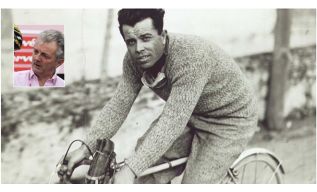






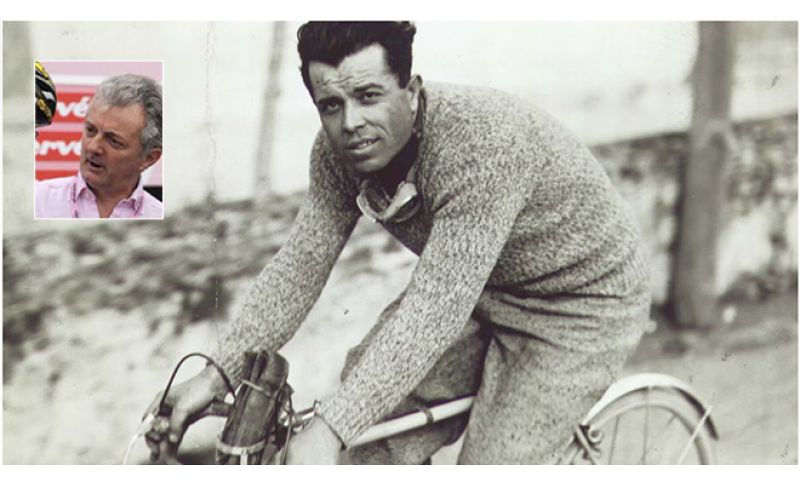
They were years of peace, in Italy and in the world, the 1930s. But they were intense and incandescent years for Guerra, in Naples and Campania. He had already announced himself in 1929, with his victory in the Benevento - Naples race, the fourth and final stage of that edition of the Campania already recounted, Learco Guerra. But in fact the epic of Guerra, Learco Antenore Giuseppe, a sequence of resounding proper names in the registry, born in San Nicolò Po, Mantua, in October 1902, lived out his magic and his total reason for being and persisting even today as the roads speak of him as a democratic sovereign of Parthenope, in the arc across the sky of the 1930s. He came late to cycling, as a boy he had worked as a mason, and soon became, under the guidance of Costante Girardengo, the technical and human antithesis of the invincible Alfredo Binda - the unsustainable number one of the era -, Learco Guerra, an unattainable quality of a stage racer, 'the human locomotive' of the still humble mythology of the time, smiling and generous, beyond every limit, and frank well beyond the cold and hieratic Binda, had already made a breakthrough in Naples, and in its public, on the side at the end of the Great City. His sentimental irruption into the hot soul of Campania, more than the partial finish line of Naples already mentioned if not the Diamond Cup in Sala Consilina of the same year, we identify it in the Coppa Caivano, an Italian Cup race of 1930, which was in fact the detonator - it must have been the oceanic crowd that animated the inside and outside with cycling passion, the Parthenopean hinterland - of the moving harmony Guerra/Naples vs Campania.
Guerra found in us the pueblo that invokes the cyclist to caress his effort, then more certain than now, superhuman. Guerra, well before, let's say Maradona, both dark-haired, look at them together, he will be in black and white and Diego in color, in a parallel more intrepid than bold, but in the same score of hearts in unison, of hearts from below, so that an applause would overflow upward. Guerra, not a chamber violin, but a hurrah under the open sky.
And Guerra, both his and ours, how much singular still comes to mind, will win the Campania for a historic hat-trick in 1932, in '34 and in '35. Three and not a series of four, only because - it comes to mind - in 1933 it was not raced...
In 1932, the date that marks the definitive return to road racing for the Campania, with the organization of Mezzogiorno Sportivo and the pawing passion of director Felice Scandone, Learco Guerra (Maino) beat Alfredo Binda (Legnano), precisely his designated rival, and Michele Mara (Bianchi) in a race valid as the first Italian Championship trial, with start and finish in Naples. And Guerra, by the way, was hailed that April day at the highest level, he who came from having conquered the previous year, in Copenhagen, the title of world champion, the only time the World Road Championship was won against the clock.
We thus tell of Campania truly at the center of national cycling attention, in that season, often a mandatory stage because our race was inserted in the Challenge points competition valid for the conquest of the Italian title. And this effectively meant the presence at the start of the dominant cycling industry teams, from Maino to Bianchi, from Legnano to Wolsit, from Olympia to Dei...
In 1934, Guerra (Maino) won ahead of Mario Cipriani and Joseph Soffietti (both of Frejus), with Giuseppe Olmo and Alfredo Binda fourth and fifth. "Guerra has kept his promise," headlined a newspaper of the time, telling of an edition battered by bad weather - "forced showers for the athletes" - and a route from Naples (Piazza Nazionale) to Naples (Arenaccia) that for the first time presented the Chiunzi Pass, after facing the usual climbs of Sannio and the hinterland, and found its final climax in the climb of Santa Maria del Pianto, a sort of Poggio from Sanremo, after Casoria and Arpino...
At the third and final success, Guerra beat, once again in a sprint, because Guerra was also a long-distance sprinter, in addition to being a stage racer and time trialist a thousand seasons before the present day, Giuseppe Olmo (Bianchi) and Giuseppe Martano (Frejus). To this day, no one has ever equaled and much less surpassed Guerra's record. Coppi, Moser, Bitossi, Saronni, will stop at two victories, in the honor roll.
And in the end, not so much in the end, that time confirms far beyond these pages the infinite Guerra in Campania. It was said of him that for the overflowing anticipation of his arrival at the Arenaccia, a funeral's time was even moved, in Naples. Who knows, or perhaps we do know, if we only glimpse the mass of enthusiasts who seem to still emerge from the detail of the photos of those days. Love is a perfect understanding, sometimes. In Guerra, for Naples, certainly, mutual, if only we remind you how his last victory in his career Learco Guerra from Mantua signed it in Naples for a shade of heart more at the 1937 Giro d'Italia. Although the Campania, the following year, would still have come close: second in the second stage, what does it matter being half a wheel from first, Leoni, Naples beautiful land of love, and third in the final points classification.
He would disappear, Guerra, my mother told us about it, and it's always the same book, at only 60 years old. From Parkinson's disease, what a cruel outcome, the disease of uncontrolled tremor, for him who had been forever - at a measured pace - the "human locomotive".
From "The History of the Giro di Campania" by Gian Paolo Porreca, LeVarie editions
from tuttoBICI of October






 |
 |
||
 |
 |
|
|
 |
|
||



 Ritratti
 Oscar
 Albi d'Oro


Se sei giá nostro utente esegui il login altrimenti registrati.