























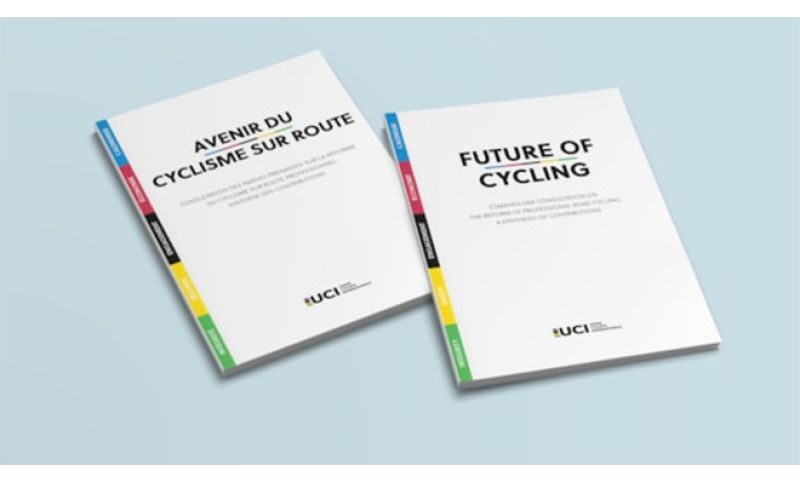
The Union Cycliste Internationale is ready to change the world of cycling and has decided to open its doors to the reform of a sport traditionally reluctant to change. Following the consultation launched last February, the UCI has presented a 40-page document that brings together proposals from the main components of professional cycling: riders, teams, organizers, trade associations, federations, media and sponsors.
A total of 55 contributions were received and they cover five areas: calendar and participation, economic model, fan engagement, safety and integrity of results. The most discussed topic was the calendar, followed by financial aspects. Sports integrity, on the other hand, proved to be the least addressed area.
«We are ready to evaluate significant developments in a sport known for its conservatism», declared UCI president David Lappartient.
Among the most concrete proposals is the reorganization of the international calendar. The goal is to reduce overlaps between races and limit riders' travel, who are often forced to move from one continent to another within a few days.
The idea is to divide the season into geographic blocks: the Spring Classics, an Iberian week, a summer session in Australia and an Asian block at the end of the season. Some WorldTour races could become optional, while week-long stage races could be reduced to five days.
The Grand Tours could also undergo modification, with the reduction of some stages and a duration shorter by a weekend. In exchange, however, the UCI is considering making the participation of the best riders in the main WorldTour events mandatory, especially in non-European markets. Examples cited include the Tour Down Under in Australia and the Tour of Guangxi in China.
On the economic front, the central proposal is the creation of a unified offer for television rights. Today each organizer negotiates independently with broadcasters. In the future, instead, an official world circuit could be sold collectively to television networks and sponsors, following the model already adopted by other sports.
The Union Cycliste Internationale also envisions new revenue streams through sponsorships, an international digital platform, tickets and hospitality services. The document also includes hypotheses such as a spending cap for teams and a transfer window, tools typical of professional football.
The federation also aims to transform cycling's audience, currently numerous but often passive, into a more active and loyal fan community.
Among the ideas are digital platforms with real-time data, exclusive content, behind-the-scenes material and content produced with artificial intelligence. Access could be paid, supported by sponsors or based on a mixed formula.
For safety, the UCI has emphasized the collaboration already underway with SafeR. Some proposals, however, call for more incisive measures: from independent homologation of routes to reducing speeds through new rules on materials.
On the sports integrity front, in addition to combating technological and pharmaceutical doping, greater support for race commissioners is suggested, with more adequate tools and a path toward progressive professionalization.
For now these are only hypotheses and in any case we are talking about modifications to be adopted - apart from those on safety which have immediate effect - starting from 2029. Some could be adopted, others modified or shelved. The document, however, signals a clear intention: to rethink professional cycling, making it more sustainable, safe, profitable and truly capable of engaging its audience.

 6
6


 6
6


 2
2
2
2

 Ritratti
 Oscar
Oscar Albi d'Oro

