


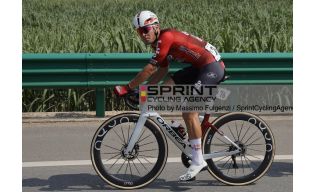

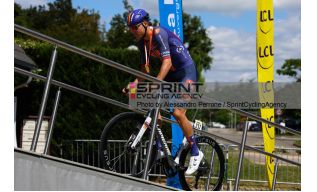

















One of the topics that always resurfaces, before and after the road cycling World Championships, is the use of race radios. While this means of communication between riders and team management is always in use during the season, when national teams compete, their use is blocked.
This also happened at the World Road Cycling Championships in Canada, and a discussion has reignited that in professional cycling regularly returns to the center of the debate: are communications between sports director and rider a necessary aid for safety and strategy, or do they stifle the creativity and decision-making ability of the protagonists on the road?
On this thorny issue, former champions and technical commentators have often weighed in, but even casual fans have expressed their views, and just these days, two authoritative voices with opposing opinions have clashed: Philippe Gilbert, former world champion and voice of rider tradition, and Maxime Monfort, now sports director of Lidl-Trek, who defends the use of race radios as an essential component of modern cycling.
For Philippe Gilbert, the question is quite straightforward: limit instructions and value instinct. This is a line also followed by a strong rider with major media impact like Mathieu van der Poel. The Dutchman, in fact, said he appreciated racing without a radio because races become less predictable and he also advances a practical compromise proposal. For Gilbert the argument is very simple and he suggests limiting the use of communications to at most one or two riders per team in the role of captains, reserving radios mainly for safety needs and a few essential tactical decisions. According to the Belgian former world champion, such a measure would reduce the constant instructions coming from team cars and restore more space for riders' personal initiative.
«My proposal is that there should be at most one or two riders per team in the role of captains», explains Gilbert.
Completely opposite in view is Maxime Monfort, for whom cycling would be too professional a sport to go backwards. Monfort reiterates the necessity of maintaining radio communication. For the Lidl-Trek sports director, eliminating race radios would mean ignoring the reality of a cycling that is now extremely professional and analyzed down to the smallest details. Monfort, who for many years wore the Lotto jersey as a rider, also points to the economic and managerial aspect: a race made completely unpredictable impacts the work of teams, sponsors, and investments that make high-level cycling possible.
«It's impossible in a sport that has become so modern, in which every little thing is analyzed – Monfort emphasized on Belgian radio -: the stakes for teams are so high, even financially, that you can't turn everything into a gamble just because radios are missing».
The dialogue between Gilbert and Monfort took place in the studio of the Peloton broadcast, highlighting a broader issue: to what extent should technology intervene and dictate the rules of strategy? Gilbert's proposal would be to have an experimental race with a maximum of one or two radios per team, which would serve to measure effects and impacts on the spectacle, safety, and competitive balance. On the other hand, Monfort, while remaining skeptical, represents the concerns of sports structures that organize, plan, and finance professional cycling.
Between greater freedom and tactical control, the group remains divided. The experiment hoped for by some – and feared by others – could, however, provide concrete data for a debate that has so far remained largely theoretical: the future of race radios, in short, could decide not only how a race is run, but also what kind of cycling we want to see.

 8


 8


 1
1
3
3

 Ritratti
 Oscar
 Albi d'Oro


