
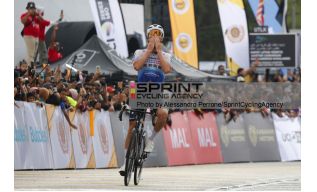














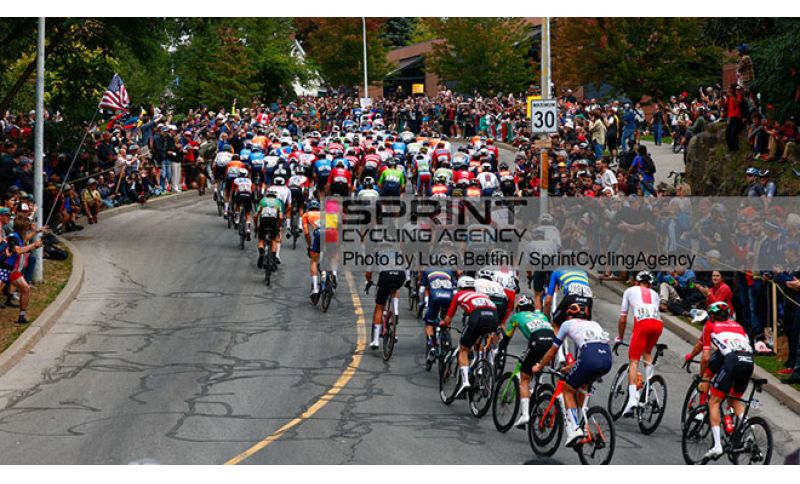
The rainbow jersey conquered by Brandon McNulty in Montreal has closed a surprising World Championship and has already opened the race towards the next editions. The American attacked 32 kilometers from the finish, resisting the return of his pursuers and giving the United States its first elite road world title since Armstrong in 1993. Behind him were Michael Matthews and Mathieu van der Poel.
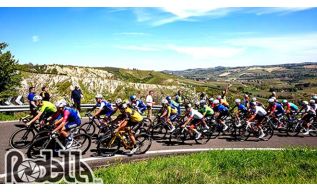
The Canadian circuit, with its short but closely-spaced climbs, seemed designed to favor classics specialists. Yet the final classification told a different story: four riders weighing more than seventy kilograms - Matthews, Quinn Simmons, Van der Poel and Mads Pedersen - finished in the top six.
Wout Van Aert was missing, who had launched an attack with Van der Poel 90 kilometers from the finish and then worked to help Evenepoel close the gap. With different form, however, Van Aert could have joined a group of protagonists in which all the qualities of a classics champion were represented: power, endurance, the ability to attack on climbs and speed in the final kilometers. Montreal, in short, was not necessarily closed off to great one-day race specialists. Simply, McNulty imposed a different interpretation of the race.
In 2027 the baton will pass to France, with the return to Sallanches: it will be the second edition of the SuperWorlds, with all cycling disciplines represented. It is a location of strong symbolic value: here Eddy Merckx conquered his first world title as an amateur in 1964, while Bernard Hinault dominated everyone at the 1980 World Championship. The alpine course in the Haute-Savoie should offer a total elevation gain of approximately 5,700 meters, enough to transform the race into a natural selection. It will be a World Championship much more severe than Montreal's, the hardest of the last 47 years, built for lightweight climbers and riders capable of enduring hours of suffering without losing their explosive power. The names come naturally and impose themselves: Tadej Pogačar, Remco Evenepoel, Paul Seixas and Isaac Del Toro. Pogačar will start as the absolute favorite, but the course could also suit Evenepoel, especially if the race transforms into a long team time trial. Seixas and Del Toro, meanwhile, represent the new generation already ready to measure themselves against the world's cycling elite.
After the mountains will come two editions that appear much more favorable to sprinters. In 2028, the year that will also see the Olympics in Los Angeles, the World Championship will be held in Abu Dhabi and the UCI has already clarified that the artificial climb built into the course to make it harder will not play a decisive role. Peter Van den Abeele, responsible for courses for the international federation, has spoken openly of a "World Championship for sprinters." It will be a rare opportunity for sprinters, often forced to face courses too selective to aim for the rainbow jersey. Jasper Philipsen and Tim Merlier will be the natural references, Italy can count on Jonathan Milan and among the young riders pay attention to Paul Magnier and Matthew Brennan, who in the meantime will have made their definitive leap in quality. Van Aert and Van der Poel are not pure sprinters, but in a group sprint they would not start as underdogs. The difference, however, would probably be on the side of Philipsen, Merlier, Milan and other specialists. The desert wind could also become a factor, as happened in Doha in 2016, when Peter Sagan won for the second time: the group could break apart, but the most powerful riders would have good chances of getting through the selection unscathed.
In 2029 the World Championship will return to Denmark, with Copenhagen indicated as the main venue. The course is not yet known, but the geography of the Danish capital suggests a fast race poorly suited to climbers. The last world championship held in Copenhagen, in 2011, ended with a group sprint on slightly uphill road: Mark Cavendish won his first and only world title, and in the women's race it was a second victory for Italian Giorgia Bronzini. Even if some undulating sections are included, it would be difficult to build a truly selective circuit in the surroundings of the capital. Logic therefore points towards another confrontation between sprinters, in which weight, positioning and team organization could count more than finisher qualities.
2030 will instead be the year of Belgium. Brussels will host the World Championships in the year of the country's bicentennial, an occasion destined to become a great national celebration. The organizers' project is to propose a selective course, with the stated objective of crowning an authentic Flandrien. The question concerns above all Wout Van Aert. In 2030 he will be 36 years old: an important age, but not incompatible with a world victory. Joop Zoetemelk won in 1985 at 38 years old, while Alejandro Valverde conquered the title in 2018, also at 38. Experience, tactical ability and knowledge of Belgian roads could still matter.
The competition, however, will be formidable. Pogačar would be 32 years old, exactly the age Van Aert is today; Evenepoel would be 30, in the prime of his competitive maturity. And behind them will grow Seixas, Del Toro, Matthew Brennan and Paul Magnier, young today but destined to become absolute protagonists.
Then in 2031 we will return to Italy in Trento with the third edition of the SuperWorlds. The course, partly urban, could follow that of the 2021 European Championship won by Colbrelli over Evenepoel. Therefore hard but not extreme.
Finally in 2032 there will be the historic first time for India and the city of Pune, with a course that will presumably develop on the hills surrounding the city and therefore will appeal to both attackers and climbers.
The calendars of the coming years offer an almost perfect succession: first the mountains of Sallanches, then the speed of Abu Dhabi and Copenhagen, finally the Flemish selection of Brussels and that of Trento. But cycling never fully respects predictions. Montreal just reminded us: McNulty was not the main favorite, yet he was the strongest on the decisive day. Because the World Championship may have a precise course, but the rainbow jersey always ends up on the shoulders of whoever knows how to interpret the race best and manages to seize the right moment.

 1
1


 1
1


 1
1
5
5
1
1
5
5

 Ritratti
 Oscar
Oscar Albi d'Oro

