
























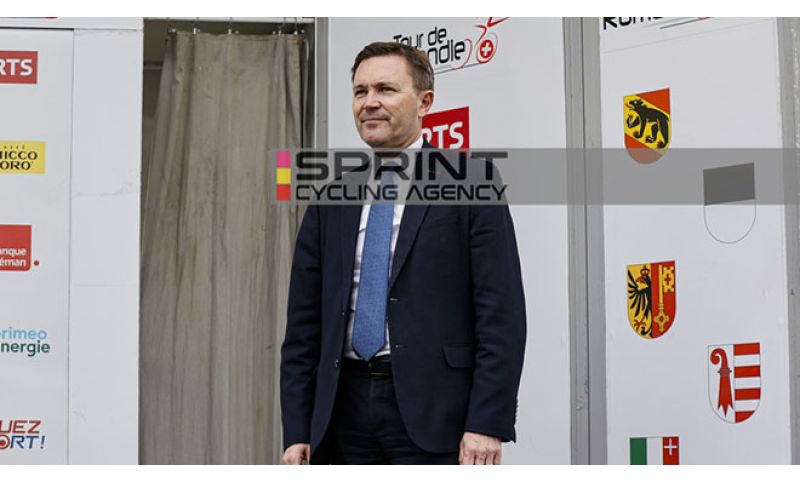
David Lappartient, UCI president, addressed several topics during the press conference in Montreal, where the road World Championships will conclude on Sunday.
THE COURSES - "We always try to propose different types of courses, so that all athletes have, sooner or later, the opportunity to become world champions. Zurich 2024 was challenging, and Kigali 2025 was even more so. This year's course is quite tough and the 2027 one (Haute-Savoie in France) will probably be the most difficult course in the last 47 years. However, the 2028 edition will be held in Abu Dhabi and will be completely flat; Copenhagen will be flat but potentially windy; Brussels will not be flat, but not as difficult as this year's. Two aspects will not change: the distance – which will remain long, as it is an important race like the world championship – and the circuit structure (although sometimes there could be 60 or 100 km of approach before the circuit)."
THE HEAT - "Climate change is a reality. We have seen, both at the Tour and even more at the Vuelta, extremely high temperatures not just for one day, but for consecutive days, which has been a real challenge for riders. The question is how to address climate change, and I was somewhat surprised that, among the contributions received on the reform of professional cycling, this topic was not really mentioned. Can we adapt the calendar, perhaps by slightly shifting the dates? Of course, the Tour will remain in July, but for other races this is an aspect that needs to be discussed as part of the professional cycling reform. Not in 2027 or 2028, but with a view to a three-year cycle, it is a topic to be addressed."
THE SCHEDULES - "What measures can we take regarding race times? For the heat, we cannot change the schedule from one day to the next by deciding to start three hours earlier. This is a decision that must be made in advance, considering public order and road closures. Every choice must take into account television audience, road management, revenue and organization."
THE WORLDS - They will generally remain scheduled for late September, although the UCI is evaluating the possibility of making them the last major event of the season. "It would be nice to conclude the year with the World Championship," Lappartient explained. In 2032 there will be the first World Championship in Pune, India. "The UCI's vision is to expand beyond the current leading countries, such as Italy, France, Belgium or Spain, where we are very strong. However, it must be recognized that the population of these countries represents perhaps only 3.5% of the world's population. If we want to be present where people are, we need to understand how to extend the reach of cycling; I believe that hosting the World Championships in India – a nation with 1.4 billion inhabitants – represents an enormous opportunity."
THE WORLD TOUR - "We also believe that, when we open the calendar for the period after 2029, we must include races in areas where we are not currently present. Today we are not in Africa, we are not in South America, where we know people's passion for cycling, we are not in the United States, a huge country and a market of great relevance; and we are not in India or other Asian countries. This is probably where we need to extend the World Tour. If we could attract sponsors from large countries with strong economies, it would create a win-win situation for everyone."
GPS TRACKING - Lappartient reiterated the desire to make the system mandatory: "We want to know where the riders are and be able to locate them in case of an accident, particularly in the mountains." The UCI is collaborating with Swiss Timing, but technical and economic issues remain. "We need a system that is always operational. If a crash occurs, we cannot afford for the system to fail precisely at the point of the accident." The president also clarified that the UCI does not intend to commercially manage the data: "We simply need access to the data, also for race commissioners, without commercial purposes." If teams and organizers cannot find a shared solution, the UCI could intervene directly, but would charge the costs to stakeholders.
SAFETY - "Zero risk is impossible to guarantee. We have worked to make races safer and launched numerous initiatives, which have been positively received by the group. I would also like to highlight the constantly increasing speed and the evolution of bicycles, which are becoming increasingly high-performing. Over the last five years, the average speed of the classics has increased by 2 km/h: it may seem small, but it has a huge impact. In the short term, we will see the introduction of airbags in cycling as well to protect riders."
THE BICYCLES - The UCI president announced greater collaboration with bicycle manufacturers. "We cannot proceed without involving the industry: they are the key players," he explained, announcing dedicated working groups on frames, wheels, tires and other components. The goal will be to evaluate the technical evolution of bicycles also from a safety perspective.
THE YOUTH - Another topic concerns the increasingly early entry of young riders into professionalism. "The professional peloton is not the ideal place to learn: riders must arrive already prepared," Lappartient observed. The UCI therefore intends to discuss the possibility of creating an intermediate phase between youth categories and professionalism, especially in women's cycling.





 Ritratti
 Oscar
Oscar Albi d'Oro


Se sei giá nostro utente esegui il login altrimenti registrati.