






















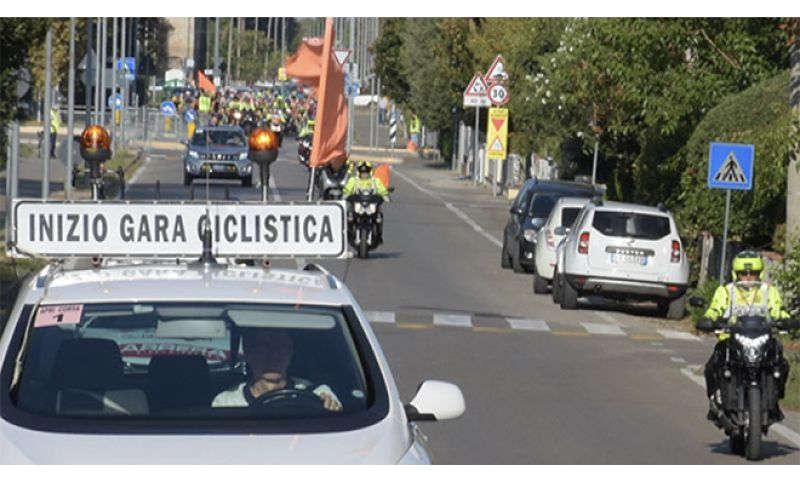
Finally good news for the safety of professional cyclists and cycling races. The newspapers and TV stations have barely mentioned it, but among the proposals for reforming the Road Code that Minister Salvini has submitted for consultation with operators and associations in the sector, there are several that concern cycling. A real quality leap after years and years of demands from the safety operators of our cycling world that were rarely taken into consideration. Modifications that have been refined in recent months by the working group tasked by the Government with preparing the final draft of the new Road Code according to the guidelines of reform law 177/2024. For cycling, it must be said, a much more cross-cutting effort than what was politically done for the reform law approved at the time with only the majority's votes. Let's look at the innovations together.
ABOLITION OF AUTHORIZATION – The regulation, of an administrative nature but with great impact for race organizers and directors, is the abolition of the authorization previously necessary to hold cycling races. It is replaced by a normal prior notification from organizers containing the race program, the methods of conduct, and the number of participants.
A true simplification measure and a blow to certain burdensome acts that organizers are forced to endure to obtain the right to hold events that in the vast majority are a precious asset for society and youth development. A cost reduction measure, given the insistence of some entities in requesting the submission of unjustified clearances, safety plans, or the increasingly common payment of processing fees, even as much as 300 euros as in the case of the Province of Oristano.
The abolition of authorization is consistent with the latest modification of article 9, which made competitions permitted rather than prohibited. Although the prescriptions that the road-owning entities may send to the organizer to signal any critical issues must be observed.
Along with this, the interesting innovation for anyone participating in the competition is the obligation to respect the prescriptions imposed by the competent authorities as well as those possibly imposed by the organizers. A specific violation against participants who, in the current text, instead respond jointly with the organizers.
Greater attention therefore to the communications (written and verbal) of the organizer, when these contain prescriptions having the value of responsibility for any non-compliant parties.
SIMPLIFIED ORDINANCES – With sensitivity to the simplification of what is bureaucratically required to hold a cycling race, almost surprisingly but very appropriately, the principle is introduced that the temporary suspension of traffic or road closure on the occasion of sporting competitions, in the case of multiple provinces involved, the measure is adopted by the prefect of the place where the competition begins, after consulting the other competent prefects. Fantastic. Just one ordinance per race!
EXTENSION OF TECHNICAL ESCORT POWERS - Of great effectiveness and practical realism is the modification of the powers of technical escorts. With the new Road Code, these figures become "police auxiliaries" and as such, limited to cycling races, will assume full authority for traffic signaling and regulation equal to that of normal police officers, with the obligation therefore for road users to comply with their instructions or stop requests. Authority extended also outside the "bubble" of race start and finish, in order to arrange the best transit of the competition or resume traffic immediately after its passage. Obligations that the new regulation supports, in another part of the Code, with the updating of cases in which traffic is prohibited, now also specifying the case of roads on which sporting competitions are held in the presence of road closure measures or temporary suspension of traffic.
Similarly, in yet another part, the obligation is introduced for road users to adapt their behavior to traffic regulation signals also from "Police Auxiliaries," that is, also from technical escorts.
New and important clarifications that will necessarily need to be transferred into the training activities of driving schools, with the inevitable obligation to teach aspiring drivers how cycling races are signaled, managed, and with what observances for normal road users.
ORDINANCES AND EXEMPTIONS – The specificity of cycling enters further into the new Road Code with a clarification that was previously only contained in the Regulations, namely that within the "bubble" of race start and finish, that is, within the temporal scope and within the perimeter of effectiveness of temporary traffic suspension measures, to competitors and support vehicles used for the conduct of the competition, exclusively the sports rules of the reference discipline apply.
This regulation, transferred from the Regulations to the Road Code and thus made into first-level law, will assume particular relevance in any judicial proceedings for the protection and liability of those, following the race, who suffer accidents with vehicles outside the race.
ESCORT IN TRAINING - Consequently to the modification of their powers, technical escorts may soon be used to protect athletes during training, those organized by societies recognized by CONI, according to methods that will be better specified in the relevant Regulations. At the moment, the hypothesis remains that these "escorted" training sessions must enjoy specific authorization, but it is not certain that this will remain in the final text. Removing authorization for races and introducing it for certain training sessions poses some contradiction. But reflection is necessary since the new Road Code, for these particular training sessions, provides that the technical escort can act not only as signaling but also as traffic regulation, that is, being able to stop it if necessary to allow athletes to pass without interfering with their intensity of action.
"Escorted" training sessions are introduced as an option for sports societies that wish to use them, leaving others free to act according to traditional practices or their possible resources.
DOUBLE-FILE RIDING – Training that in the new Road Code may benefit from another long-awaited innovation, which puts us on par with other European countries: that, for professional cyclists only, they may travel on extra-urban roads in double file, with groups of a maximum of eight bikes and spaced at least 50 meters apart to facilitate overtaking by motor vehicles. This method is not applicable in training protected by technical escort.
Riding side by side and in small groups addresses the idea of giving professional cyclists more safety due to their greater visibility, as well as facilitating younger cyclists in learning bike handling techniques when together with others.
HELMET – The obligation of a helmet is introduced for all riders (and passengers) of pedal-assisted cycles, the so-called e-bikes or pedal-assisted bikes. This obligation is extended to all riders of any type of bike if under fourteen years of age. This extension, rather limited compared to the requests of much of the sports world, is evidently affected by the pressure of those associations that never wanted to hear about an obligation. Having introduced it for pedal-assisted bikes is nonetheless significant given its growing use, just as the mandatory nature for those under 14 years of age is an important signal, an objective step forward that may leave a mark on road safety culture even after adolescence.
Overall, appropriate measures to increase safety and reduce the risk of injury in case of accident.
RED REAR LIGHT – With the intention of guaranteeing greater protection to cyclists, giving them greater visibility, including those with road bikes, the obligation of a red rear light is introduced, to be kept in operation even during daylight hours. Nothing more sensible given the constant number of accidents involving cyclists on extra-urban roads.
EXEMPTIONS FROM BIKE PATHS – To protect cyclists using road bikes, the exemption from the obligation to use bike paths where present is introduced. An essential regulation since professional cyclists on these paths, for reasons of space or promiscuity with others, do not have the effective ability to develop their sporting action at the necessary speed without excessive risk.
The possibility of exemption eliminates the risk of certain penalties and reduces liability for accidents that may occur outside the bike path.
HANDBIKES AND CHILDREN – For handbikes, signaling of the vehicle with an appropriate flag is introduced. A most appropriate regulation, in fact already practiced by those involved, which in this case is extended to bicycles ridden by children under twelve years of age.
CYCLISTS AND ROUNDABOUTS – To better protect cyclists within roundabouts, they may travel in the left lane, the one closest to the center, except for the necessary signals to exit the roundabout itself.
GOOD WORK - Of these regulations, certainly perfectible before the decree-law is brought to a vote in Parliament, it is necessary that the cycling world, given the consultation launched, knows how to fully appreciate them. They constitute an innovative and strategically important page for the protection of cycling, riders, and their competitions. They are the wise and professional contribution of technicians and officials that the MIT has rightly involved, some of whom very close to the cycling movement, often present as experts or speakers at conferences and seminars organized by societies, motorcycle escort groups, or federal structures. Where, moreover, constant has always been the attention, collaboration, and project support of the Road Police Service of the Ministry of the Interior.
Soon the results of the consultation launched will be known, and therefore also the important judgment that our FCI will want to give together with its organizers, societies, riders, technicians, race directors, and safety operators.
But in the meantime, for this important quality leap, thanks and much recognition to all its protagonists.

 9
9


 9
9


 4
4
1
1
4
4
1
1

 Ritratti
 Oscar
Oscar Albi d'Oro

