














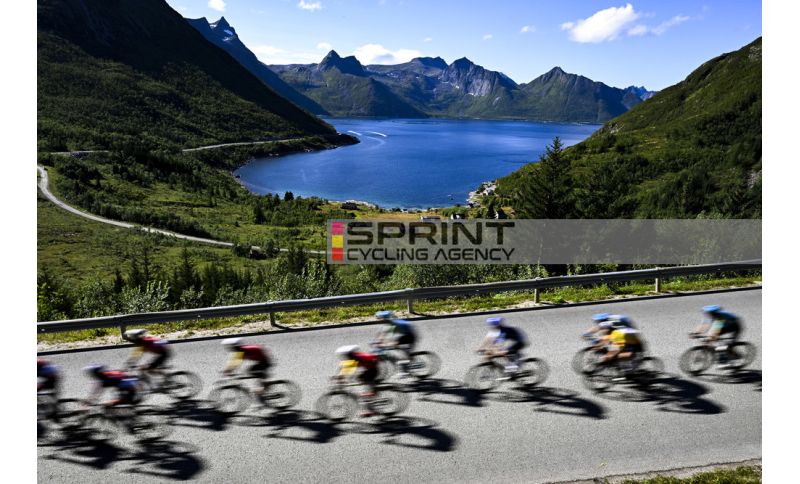
There is less and less time before the start of the Arctic Race of Norway 2026. The race, scheduled from Thursday, August 13 to Sunday, August 16, will unfold between Evenes and Narvik and, following the emotions delivered in the last edition won by Corbin Strong by just eleven seconds over Tom Pidcock, it is expected to give rise to new exciting confrontations.
While waiting to savor them live and admire the protagonists of a race that over the years has managed to create a very strong identity, becoming increasingly appreciated by riders and insiders, we propose five curiosities linked to the Norwegian race, the only one at the professional level that remains in the country, to better immerse ourselves in the atmosphere of the event.
There will be as many as five teams (never so many since 2018) making their debut this year beyond the Arctic Circle. We are talking about the newly founded Modern Adventure Pro Cycling of George Hincapie, the Spanish Caja Rural Seguros RGA, the Italian Polti VisitMalta (the fifth Italian-flagged team to participate in the ARN), the Norwegian Team Ringerike (which, for the first time since 2017, will bring to four the number of local teams in the race) and Lucky Sport Cycling Team, the second Swedish team ever to participate in the Arctic Race of Norway after Team People4you - Unaas Cycling which took part in the inaugural edition in 2013: thanks to the latter, there will be a total of five teams from the Scandinavian area that will animate the world's northernmost professional race, a figure that harks back to the very early years of the event when there were even seven squads from this part of Europe.
With the exception of the inaugural edition, at the start of all subsequent editions of the Arctic Race of Norway there has always been at least one Italian rider. Only one, however, and we are talking about Gianni Moscon in 2016, has been able to impose himself in the general classification of the event, while there are three who, in the history of the race, have managed to achieve a stage victory: Alberto Dainese and Michele Gazzoli in 2023 and Moscon himself in 2016. Italian riders have nonetheless often played a leading role in the Norwegian race since, together with American riders, they boast the highest number of third-place finishes in the final standings since the competition was born in 2013: we are talking about those achieved by Oscar Gatto in 2016, Nicola Conci in 2022, and Christian Scaroni last year.
Even before the "midnight sun" one, the jersey that in recent years has become more recognizable at the Arctic Race of Norway, allowing anyone to identify the race with certainty and immediacy, has been that of the climbers. After being a monochromatic orange until 2021, from 2022 to 2024 the sponsorship of the well-known hotel chain Thon led to the establishment of the "peacock jersey" characterized by a design that closely recalled that of the interiors of its facilities. Since 2025, the best climber of the race wears the "northern lights jersey" whose peculiar pattern was so successful and resonated with the public that last year the garment sold out just two hours after the opening of the official shop following the event, receiving a number of requests significantly higher than anticipated.
Since 2023, the fleet of vehicles that make up the Arctic Race of Norway convoy is entirely electric. From the teams (all equipped with two support cars, a nine-seater van, and a small truck) to the small advertising caravan to every component of the organization, everyone at the ARN drives electric vehicles that every day, thanks to crucial synergy with a dedicated partner, are recharged through mobile stations that travel alongside the race. This effort, which began in 2019 and continued in subsequent years, earned the ARN the Eco-Lighthouse certification, the Norwegian standard that certifies the event's eco-sustainability and its commitment to respecting the environment by meeting strict parameters.
The Arctic Race of Norway, although brief, is an event that manages to involve the social fabric and communities of the areas it passes through in the weeks preceding it. As evidence of this, for example, there are the four trophies that, one at the end of each stage, will be presented on the podium to the first in the young riders' classification: created using 3D printing technology, these are the result of the contest, developed by the ARN together with partners Equinor and Vitensenter Nordland, which saw secondary school students from the area compete in designing their appearance. The four best projects according to the jury composed for the occasion were chosen to become actual prizes, but what matters most in these cases, even before the final result itself, is the overall commitment and creative effort that the young people were able to bring out, stimulated by this initiative.

 1
1


 1
1


 1
1
12
12
1
1
12
12

 Ritratti
 Oscar
Oscar Albi d'Oro

