














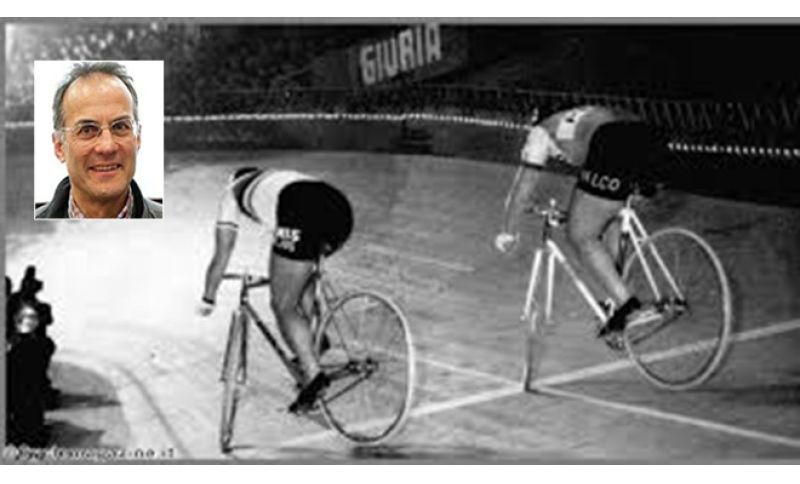
Time is a tyrant, but so is space. In fact, the two are accomplices: time saturates space. And with Covid or summer, comes the moment of clearing out. You start by aiming to free up the attic, you settle for liquidating a box. And among bags, folders and files, essential clippings emerge. Like these articles of mine on Antonio Maspes from the "Gazzetta dello Sport" (tomorrow the second installment...).
On the subject of track cycling on television: "A great spectacle and not just for an enthusiast like me. Every time I get emotional, even though today there's more power than tactics. In the sprint, once upon a time with 11 seconds in the last 200 meters you'd win a final, today you don't even make it into the top 24" (August 19, 1994).
On the subject of the kilometer time trial from a standing start that was raced two at a time: "It was and must remain an individual race" (August 19, 1994).
On the subject of the track: "The track is shiny and reflects the lights, instead it should be matte. Because in the sprint you also need to perceive the shadows" (August 19, 1994).
On the subject of the pursuit: "Once you could see the entire track with a red signal and a green one, so you immediately understood which rider was in the lead. Instead now they show the two halves, every so often they overlay the times and you can't understand anything" (August 19, 1994).
On the subject of commentators: "Competent yes, but you have to eat that bread and eat from that plate for many years before you understand certain subtleties: the little tap, the tightening and the widening, the counter-pedal. Someone like me or Gaiardoni, alongside them, would have been useful" (August 19, 1994).
On the subject of the surplace: "It had been years since you saw a surplace anymore. There's an explanation. When the track is short, 250 or 333 meters, it's better to start in front, because the curve is tight, the straightaway is short, the comeback almost impossible. Today the tracks of velodromes are almost all short. When instead they are long, 400 meters like the Palermo ring, then it's better to stay behind: you can surprise your opponent, you can exploit his slipstream, you can make a comeback" (August 20, 1994).
Again on the subject of the surplace: "Alone it's like tightrope walkers who walk on the wire, with small oscillations, a bit forward and a bit backward. On two, on the tandem, it's much more difficult: only the one steering does the surplace, the other is on the bike defenseless, like dead weight" (August 20, 1994).
On the subject of his surplace record: "Thirty-three minutes against the Dutchman Derksen. On that occasion I lost a kilo and 800 grams. I watched my opponent and meanwhile I sang Milanese songs. It helped me relax and also to count the time. 'Oh my beautiful Madunina' lasted three minutes, 'The thousand of Milan what beauty' another three. When I finished singing the first song, I pressed with my thumb on the handlebars: it meant three minutes. When I finished the second, I pressed my index finger: six. Then my middle finger: nine. Until I switched to the other hand" (August 20, 1994).
On the subject of the... mirror trick: "Grand Prix Tour de France in Paris, in 1962, against Plattner. Surplace. At one point the sun illuminates the little button attached to my glove and dazzles me. Idea. I go home and polish the button like a mirror: not to see figures, but shadows yes. A nice advantage for me, since I no longer had to turn around to look at my opponents. They never noticed" (August 20, 1994).
On the subject of the Olympics: "Not everyone remembers my bronze: Helsinki Olympics 1952, tandem, with Cesare Pinarello" (September 19, 2000).
On the subject of victories: "My most beautiful victories? The first and the last world title". And when Gaiardoni revealed that his most beautiful victory was when he beat Maspes himself at the 1963 world championship, Maspes clarified: "I was certainly not happy to lose to Gaiardoni, but at least the title stayed in Italy" (September 19, 2000).

 1
1


 1
1


 7
7
5
5
21
21
1
1
3
3
5
5
2
2
7
7
5
5
21
21
1
1
3
3
5
5
2
2

 Ritratti
 Oscar
Oscar Albi d'Oro

