

















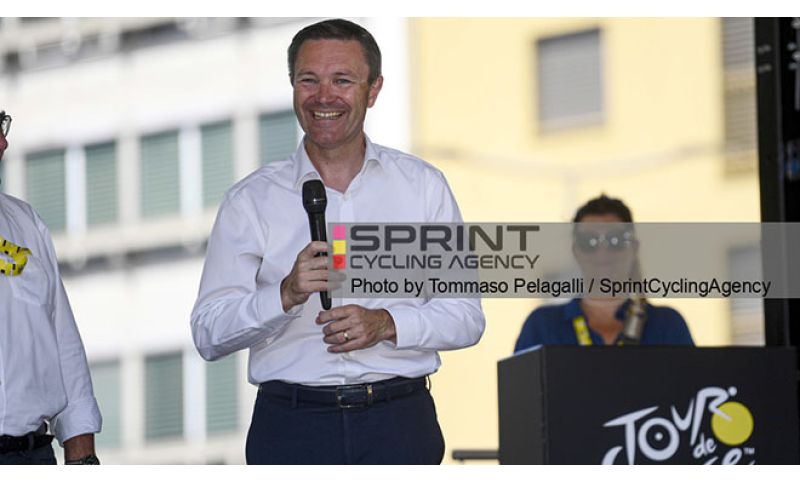
The controversy surrounding anti-doping tests carried out in the middle of the night during the 2026 Tour de France now appears to be behind us. The president of the UCI, David Lappartient, has firmly defended the work carried out by the International Testing Agency (ITA), emphasizing that no elements have emerged from the Grande Boucle that would suggest doping cases.
The statements from the head of the International Cycling Union came at the start of the second stage of the Tour de France Femmes, where he addressed one of the most discussed topics from the latest edition of the French race: night-time anti-doping tests targeting the main contenders in the general classification.
Among the riders subjected to these tests were also Tadej Pogacar, who went on to win his fifth Tour de France, and Jonas Vingegaard, tested respectively at five and two in the morning on the night of July 19.
The visits by ITA inspectors had sparked considerable discussion within the peloton, particularly due to concerns that they could compromise the athletes' rest at the most critical moment of the race. Lappartient, however, believes this was a fully justified measure.
«We will not support a practice that is repeated every night on riders. Normal testing hours are not nocturnal - the UCI president explained to The Guardian - However, we support the ITA when it needs to conduct specific tests, because we know that with EPO microdosing, this is a substance that after six or seven hours may no longer be detectable. This is why riders must know that the ITA could intervene even during the night».
Lappartient also recalled that at the end of the Tour de France, no positive cases were made public. «The ITA never publishes press releases on negative results, only on positive ones. We have not seen any press release regarding the Tour de France, and this suggests that nothing unusual occurred during the race».
An important clarification that confirms that the 2026 edition of the Grande Boucle has not recorded, at least so far, any positive results made public by the anti-doping agency.
The UCI president, however, reiterated that cycling will inevitably continue to live with suspicion, precisely because of its history. «In cycling there will always be suspicion, because of our past. I know how much has been done to fight doping. Night-time testing represents an important tool in this fight, but it must not be used every day. It must remain an exceptional measure».
According to Lappartient, these tests are not directed against a single athlete, but rather represent above all a strong deterrent for the entire peloton. «It is not about suspecting a particular rider. It is a general message directed at the entire group».
The UCI president finally reiterated that the fight against doping remains one of the absolute priorities of modern cycling, but must be accompanied by transparency and dialogue with all components of the sport. A line that, in his view, has allowed cycling to make enormous progress compared to the past, while continuing to invest in increasingly effective testing without compromising respect for athletes.

 35
35


 35
35


 7
7
4
4
2
2
2
2
2
2
42
42
3
3
7
7
4
4
2
2
2
2
2
2
42
42
3
3

 Ritratti
 Oscar
Oscar Albi d'Oro

