
























There's a moment every cyclist knows, but no one can really explain: when a bicycle stops being a simple means of transport and becomes a sensation. Much has been written about that sensation. People say that carbon transmits one feeling, titanium another. Fascinating descriptions, repeated endlessly, but never scientifically proven. This past summer, however, someone tried to measure them.
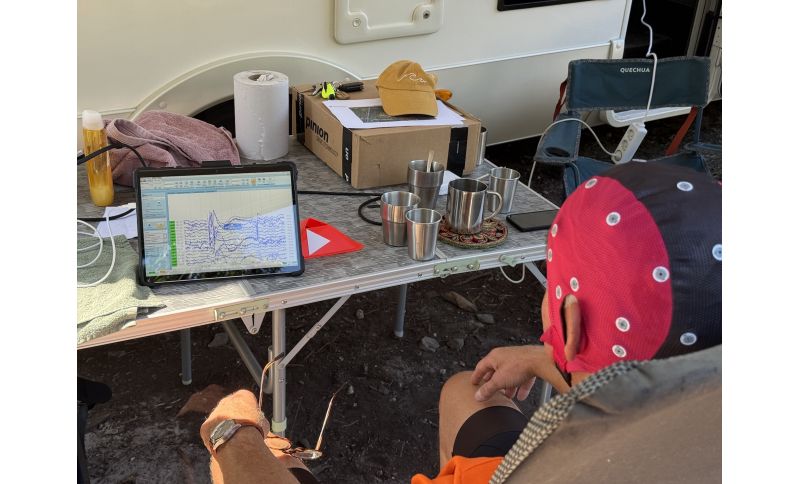
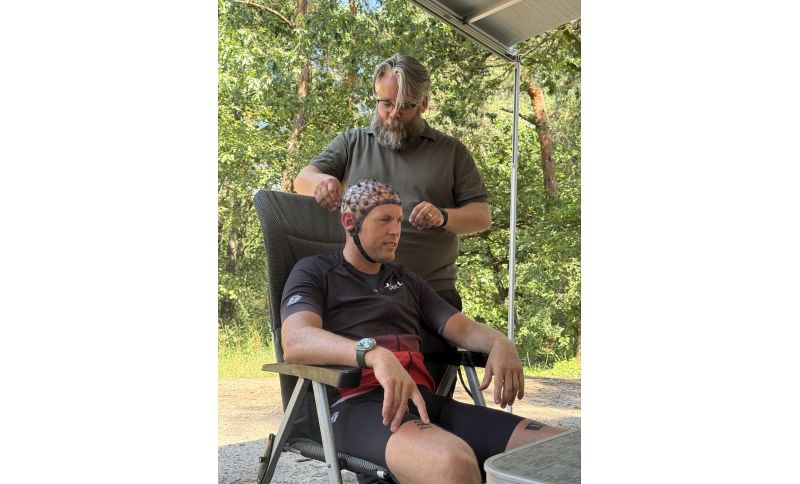
On a closed circuit nestled in Dutch forests, nineteen gravel cyclists rode the same loop twice: once on a carbon bike and once on a titanium one. They wore a special helmet covered with sensors, a 24-channel mobile electroencephalograph (EEG), capable of recording electrical brain activity during pedaling. A camera installed on the handlebars simultaneously recorded what the cyclist saw, synchronizing every root, curve, and descent with the corresponding brain response.
The study was designed by Neurofactor, a Dutch company specializing in neuroscience, already known for recording the brain activity of skydivers in free fall, Formula 1 drivers at the wheel of a McLaren, and even visitors to the Mauritshuis while observing Vermeer's masterpiece 'Girl with a Pearl Earring'. Measuring a cyclist's brain during pedaling, however, represented an even more complex challenge: the moving brain produces many "disturbances" in the signals, and the so-called ride feel is, by its nature, an experience difficult to put into words.
The idea came from Pilot – Titanium Bicycles, a small Dutch manufacturer that has been building custom titanium bicycles for over ten years. In Pilot's world, ride feel is a daily topic, but always approached in subjective terms. The company therefore decided to understand whether it was possible to measure it objectively, entrusting the experimental protocol, data analysis, and interpretation entirely to Neurofactor researchers, without any influence on the results.
Previous research had already sparked curiosity. Through a study on unconscious associations, Neurofactor had discovered that many gravel enthusiasts unconsciously linked carbon to concepts like fragility and risk of breakage, while the brain perceived titanium as a practically indestructible material. The question was therefore inevitable: would these unconscious expectations also be reflected during riding? The answer was surprising.
According to the main parameter analyzed, the brain behaved exactly the same way on both the carbon bike and the titanium one. Researchers verified and recalculated the data in various ways, but the result remained unchanged. Even the famous "magic carpet" effect often attributed to titanium didn't emerge in the brain recordings.
«We set out looking for a difference between titanium and carbon and didn't find one», explains the research lead Martijn den Otter. «It's not a failure, but an honest answer. The differences between individual cyclists were far greater than those between the bikes. Ride feel belongs mostly to the cyclist.»
And perhaps that's precisely the most interesting conclusion of the study. It doesn't mean the frame doesn't matter, but that the riding experience depends mainly on the person: their physical condition, the sensations of the moment, their expectations, and how they interpret what they're experiencing. The data suggest that every cyclist perceives a bike in a deeply personal way.
For Pilot, the result represents almost an unexpected gift. «We asked this question because we wanted to know the answer, not because we were seeking confirmation of our beliefs», says founder Pieter van der Marel. «A result that shows no differences has the same value for us as one that demonstrates them. And, ultimately, we like this conclusion: if feel comes mostly from the cyclist, then building every bike custom-made for a specific person makes even more sense.»
The study does, however, leave an interesting avenue open. On the most technical section of the course, cyclists on the titanium bike showed brain activity compatible with less muscle tension and more relaxed riding, also recording slightly better times. It's still a weak signal, limited to that single section of the circuit and insufficient to draw definitive conclusions, but promising enough to merit further investigation. The question, therefore, changes perspective. Not: is titanium more comfortable? But rather: does the brain have to work less to control it?
To answer this, Neurofactor has already announced a new, larger and more rigorous study, with motion sensors, muscle activity measurements, blind analysis, a greater number of participants, and a balanced sample of men and women. The protocol will be published before testing even begins.
«The new study could completely disprove this hypothesis of ours or confirm it», concludes den Otter. «That's how research should work: the result belongs to the data, not to those who collect it.»
The debate about frame materials will probably never stop. But from today it can count on one more piece of data: the bike matters, but the cyclist matters even more. And, depending on how you interpret cycling, it could be one of the most reassuring conclusions possible.

 1
1


 1
1


 7
7
1
1
1
1
4
4
2
2
7
7
1
1
1
1
4
4
2
2


 Ritratti
 Oscar
Oscar Albi d'Oro

